Symbols and Sacred Texts
Visual Teaching Tools
Symbols in Buddhism
Elephant
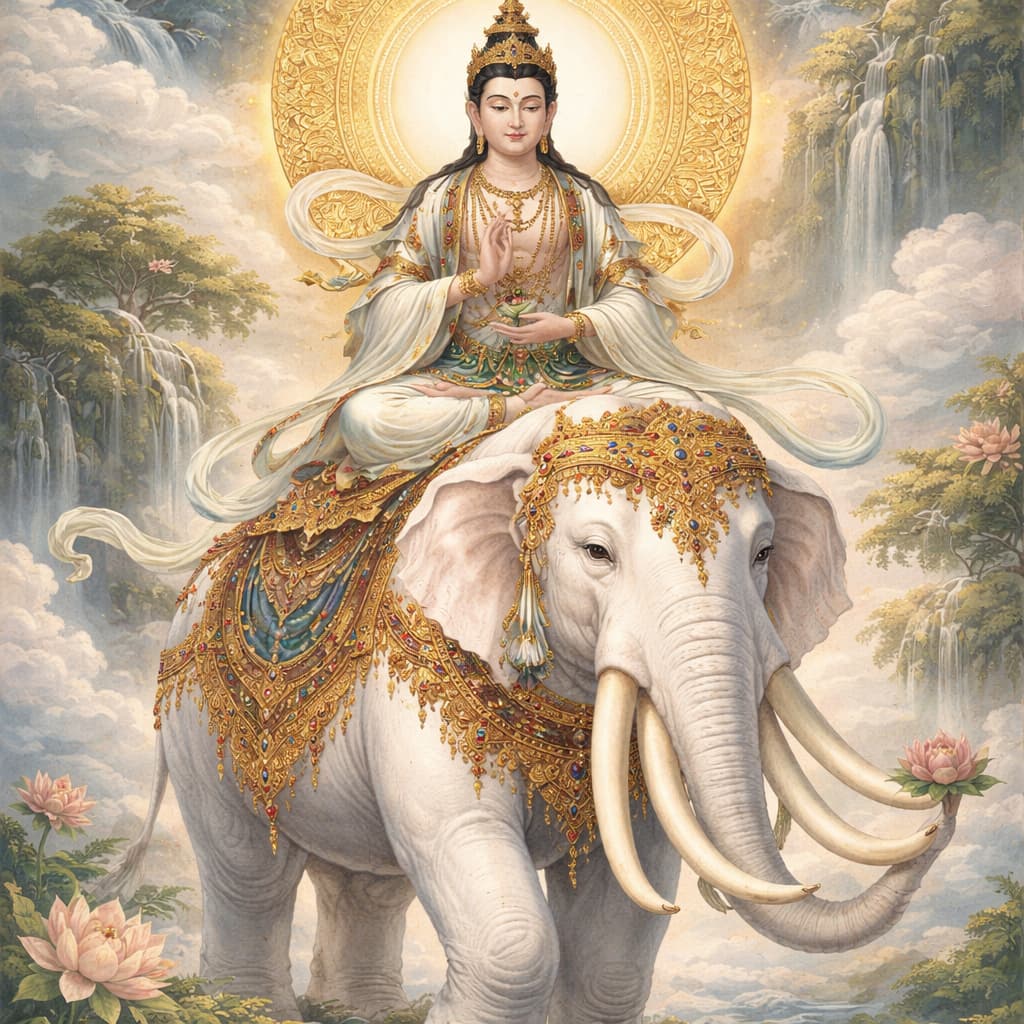
- Buddha's conception dream
- Mental strength when trained
- White = rare and precious
Lotus

- Purity from muddy water
- Stages of development
- Beauty from difficulty
Dharmachakra
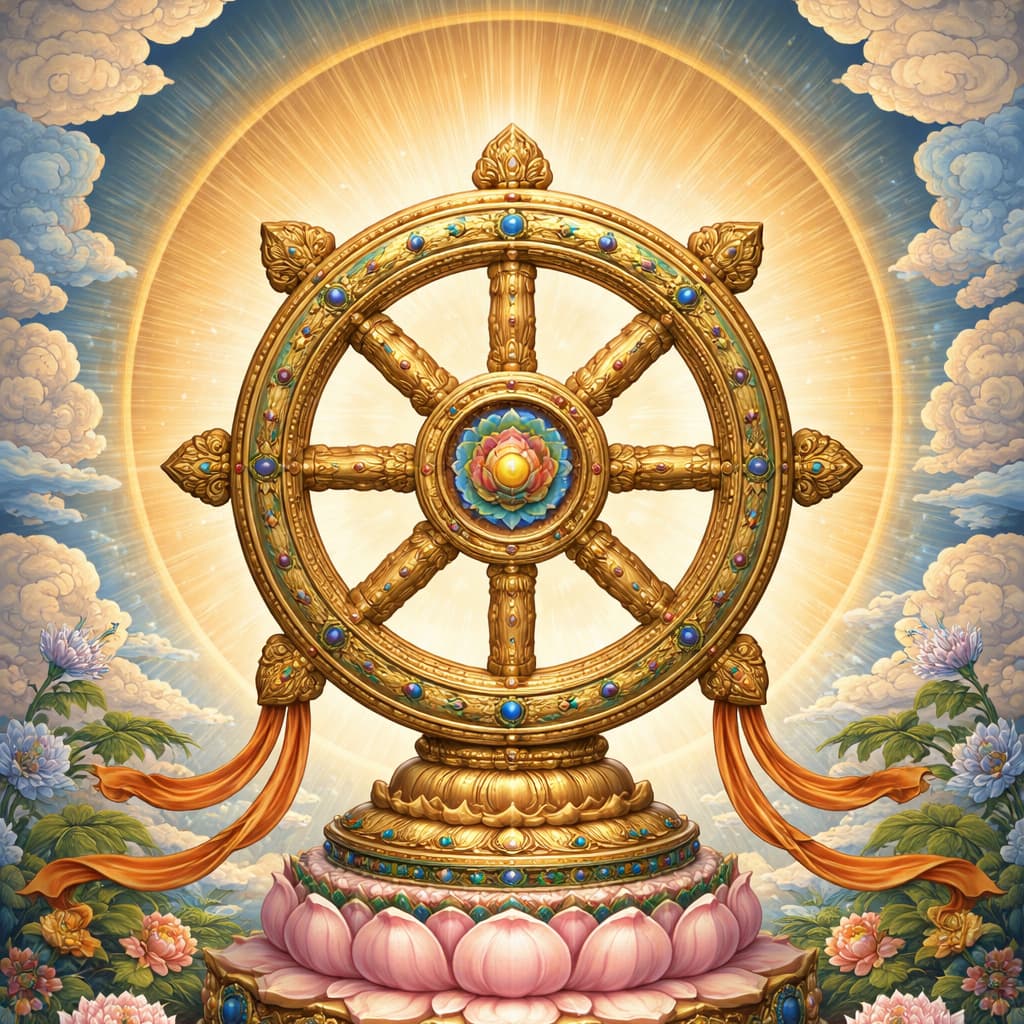
- "Turning the wheel"
- Eight spokes = Eightfold Path
- Represents the dharma
Don't confuse the Dharmachakra (Wheel of Dharma, representing the Buddha's teaching) with the Bhavachakra (Wheel of Life/Becoming), which depicts the realms of samsara and the cycle of rebirth. Different wheels, different meanings.
Additional Buddhist Symbols
Bodhi Tree

- Site of awakening
- Wisdom and insight
- Living connection to Buddha
Empty Throne

- Presence through absence
- Focus on teaching
- Journey metaphor
Stupa
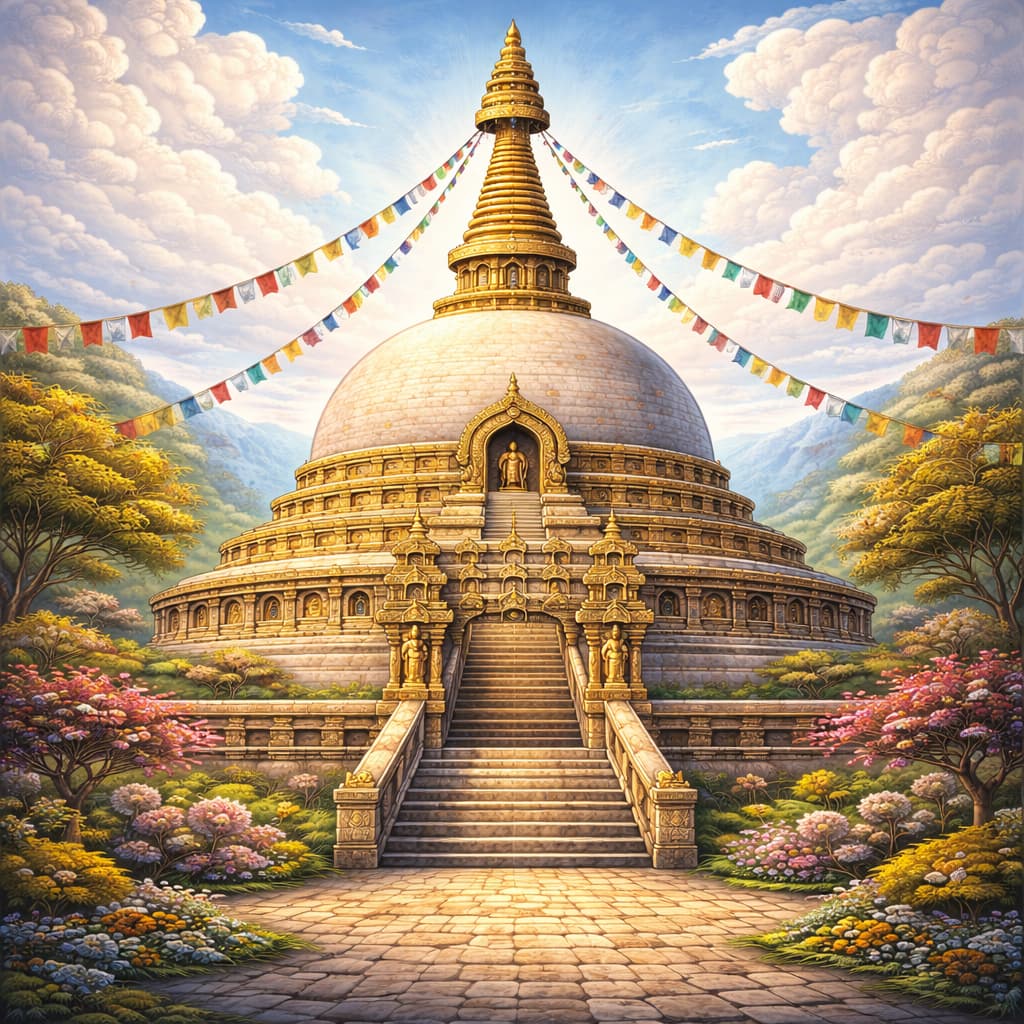
- Reliquary monument
- Cosmic diagram
- Pilgrimage destination
Early Buddhist art often represented the Buddha through symbols (footprints, empty throne, bodhi tree) rather than human images. Scholars debate whether this was a deliberate doctrinal choice or simply artistic convention of the period. Human Buddha images became common from around the 1st-2nd centuries CE.
Reading the Buddha: Symbolism in Statuary
Watch how Buddhist art communicates teachings through form, gesture, and symbol
As you watch, notice: posture (mudra), facial expression, and symbolic features.
Mindfulness (Sati) in Buddhism
Sati = “remembering to be aware” (waking up from autopilot)
Eightfold Path (Meditation Cluster)
- Right Effort: redirect attention skillfully
- Right Mindfulness: sustained awareness of experience
- Right Concentration: steadiness and stability of mind
Why Ethics Matters
- Mindfulness isn’t just “attention”
- It’s attention guided by Right View and Right Intention
- Without ethics, mindfulness can become a “productivity hack”
Four Foundations of Mindfulness (Preview)
- Body: breath, posture, sensations
- Feelings: pleasant / unpleasant / neutral tone
- Mind: distracted, calm, irritated, focused
- Dhammas: patterns like craving, impermanence in real time
Today’s practice will use: breath → body sensations → thoughts as events
Secular Mindfulness: Benefits and Concerns
Benefits
- Accessible mental health tools
- Scientifically validated effects
- Reaches people beyond temples
Concerns
- "McMindfulness"
- Stripped of ethical context
- Cultural appropriation questions
Term coined by critic Ron Purser describing commodified mindfulness stripped of Buddhist ethical framework. Critics argue corporate mindfulness helps workers cope with exploitative conditions rather than questioning them—turning a liberative practice into a productivity tool.
Introducing the Dhammapada
The Buddha's Path of Wisdom
Sacred Text Workshop: Day 1
By non-hatred alone is hatred appeased.
This is a law eternal."
— Dhammapada 1.5 (Twin Verses)
Why We're Reading the Dhammapada
- Most widely read Buddhist text across cultures and traditions
- Short, memorizable verses designed for daily practice
- Offers practical ethical teaching, not myth or theology
- Think "training manual for the mind," not "creation story" or "rulebook from a god"
is one useful word,
hearing which one attains peace."
— Dhammapada 8.100 (Thousands)
Buddhism emphasizes orthopraxy (correct practice) over orthodoxy (correct belief). The Dhammapada reflects this: it focuses on training the mind through action and reflection, not on professing doctrines or receiving divine revelation. This makes Buddhism a "practice-centered" tradition.
What Is the Dhammapada?
Etymology
- Dhamma: teaching, truth, phenomena
- Pada: path, verse, footprint
- Concept: Verses as "footprints" on the path—compact guidance
Origins
- Attributed to Gautama Buddha
- Part of the Pali Canon (Khuddaka Nikaya)
- Oral origins: designed for chanting and memorization
Genre: Ethical aphorisms, not systematic philosophy
"Portable" wisdom: An anthology of sayings, not a continuous sermon
Siddhartha Gautama (c. 5th-4th century BCE), the historical founder of Buddhism, is traditionally credited with teaching the verses collected in the Dhammapada. However, like many ancient texts, the Dhammapada was transmitted orally for centuries before being written down, so scholars debate which verses go back to the historical Buddha and which were added by later Buddhist communities.
How the Text Is Organized
Structure: 26 Thematic Chapters (vagga)
- Vagga = "group" or "collection"
- Chapters are loose thematic groupings, not plot segments
- Examples: "The Mind," "Flowers," "The Fool," "The Wise"
Modularity
Verses are self-contained. You can read non-linearly—order matters less than the idea.
Pedagogy
Repetition and variation serve as drills to train ethical reflexes.
Reading tip: Read it like philosophical poetry—cluster ideas, compare images, track recurring claims.
even so, fruitless are the fair words
of one who does not practice them."
— Dhammapada 4.51 (Flowers)
Core Ideas You'll Encounter
- Mind Precedes Action (Citta primacy): Mental habits shape ethical outcomes—Buddhism starts upstream
- Suffering (Dukkha): A condition to be understood, not punishment—more "friction" than "damnation"
- Causality: Desire and attachment drive suffering—clinging turns preferences into compulsions
- Self-Cultivation: No divine command; actions shape the agent
- The Ideal: The awakened person is a model of discipline, not a savior—the Buddha points the way; you must walk it
Mind is their chief; they are all mind-made."
— Dhammapada 1.1 (Twin Verses)
Citta is often translated as "mind" or "heart-mind." In Buddhist psychology, citta refers to the mental/emotional complex that generates intentions, perceptions, and reactions. The claim that "mind precedes action" means that before you act, there's a mental state (desire, anger, compassion, wisdom) that shapes what you do and how you experience it.
How to Read the Dhammapada Well
Pacing and Attention
Read slowly—treat verses like "dense files" that must be unzipped by thinking. Each verse rewards careful contemplation.
Literary Devices
- Expect metaphor (lotus, river, elephant)
- Expect sharp contrasts (The Wise vs. The Fool)
- Expect exaggeration for rhetorical effect
Context Matters
- Avoid "self-help" reductionism
- Goal: liberation (nibbana) through insight
- Not just stress reduction or productivity hacks
even so the wise are not moved
by praise or blame."
— Dhammapada 6.81 (The Wise)
Different translators render key Buddhist terms quite differently. For example, "dukkha" can be translated as "suffering," "stress," "unsatisfactoriness," or "anguish." Similarly, "dhamma" appears as "teaching," "truth," "law," or "righteousness" depending on the translator. These choices shape interpretation. Acharya Buddharakkhita uses traditional Pali terms with careful English equivalents. Other popular translations include Thanissaro Bhikkhu (more literal) and Gil Fronsdal (more accessible). Stay with our assigned translation for consistency.
Why This Text Matters in World Religions
- Orthopraxy: Demonstrates a practice-centered tradition (training vs. believing)
- Non-Theistic Ethics: Moral authority derives from causal insight, not a creator
- Comparative Religion: Counters belief-centered definitions of religion common in the West
- Foundation: Provides the moral/psychological backbone for later discussions on meditation and enlightenment
By oneself is evil left undone; by oneself one is purified.
Purity and impurity depend on oneself;
no one can purify another."
— Dhammapada 12.165 (Self)
Practice-centered traditions (orthopraxy) emphasize what you do—rituals, meditation, ethical conduct—as the core of religion. Belief-centered traditions (orthodoxy) emphasize what you profess—creeds, doctrines, theological statements—as primary. Christianity historically emphasizes orthodoxy (Nicene Creed, "Jesus is Lord"). Buddhism emphasizes orthopraxy (Eightfold Path, meditation practice). This doesn't mean Buddhism has no beliefs or Christianity has no practices, but it indicates where each tradition locates religious authenticity.