Encountering Hinduism
Chapter Three
Day 1: Historical Foundations and Development
REL 210: World Religions
⌨️ Keyboard Shortcuts
→ / Space: Next slide
← : Previous slide
S: Speaker notes
F: Fullscreen
O: Overview
ESC: Exit/Close
Hinduism – Basic Orientation
- The foundational elements of Vedic religion arrived with Indo-Aryan migrations (c. 1500–1200 BCE) into the Indus River Valley
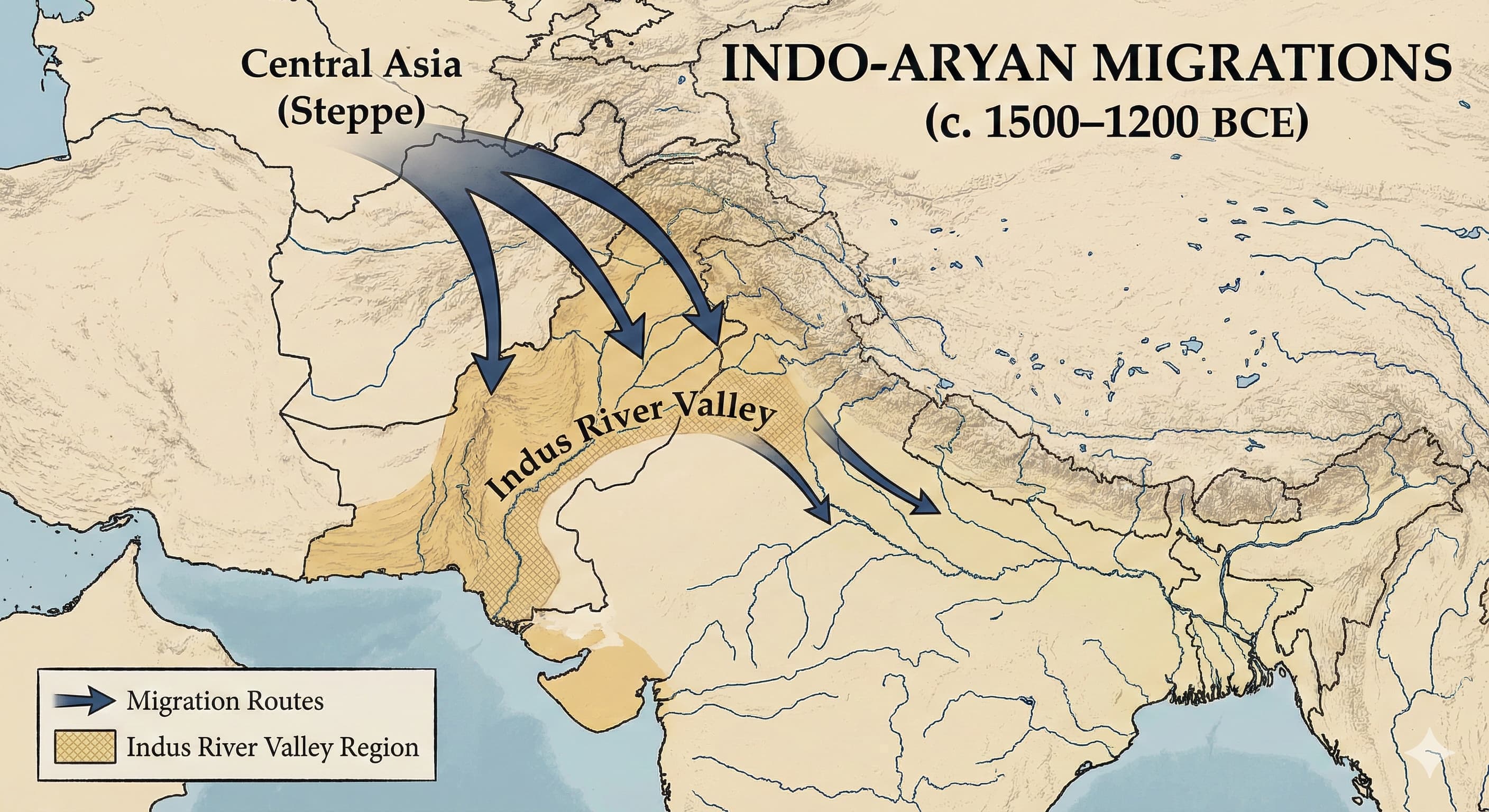
Map showing migration patterns of Indo-Aryan peoples into the Indus Valley region circa 1500-1200 BCE, illustrating routes from Central Asia into northwest South Asia
Hinduism: A Functional Definition
- The "Umbrella" of Indian Traditions: A "family of traditions" sharing common history rather than a single creed
- Demographics: Practiced by over one billion people; world's third-largest religion
- Internal Diversity: Encompasses monotheism, polytheism, and even atheism
- No Single Founder: Unlike Buddhism or Christianity, no historical founder or specific "start date"
Common Threads and Social Structure
- The Vedas: Ancient Sanskrit scriptures (c. 1500–1200 BCE) as foundational authority
- Dharma: Central focus on orthopraxy (right action) over orthodoxy (right belief)
- Social Nature: Historically non-missionary; identity tied to family, social class, and the subcontinent
- Key Concepts: Unified by shared vocabulary of Karma and Samsara
Right action, duty, cosmic law, and social obligation. In Hinduism, dharma refers to the proper conduct appropriate to one's role in society, stage of life, and cosmic order. Emphasizes orthopraxy (correct practice) over orthodoxy (correct belief).
Action and consequence. The law of cause and effect where every action has consequences affecting present and future existence. Karma shapes one's circumstances in this life and future rebirths.
The cycle of death and rebirth. The continuous flow of existence through multiple lifetimes driven by karma. Liberation (moksha) means escaping this cycle.
Geography and the Name "Hindu"
- Geographical Origin: The term Hindu was originally an exonym (a name given by outsiders)
Linguistic Evolution:
- Sindhu: The Sanskrit name for the Indus River
- Hindu: The Persian pronunciation (c. 500 BCE) for those living across the river
- Indos/India: The Greek/Latin variations of the same root
The "Ism": "Hinduism" codified as discrete category by 18th-century colonial administrators and 19th-century reformers
A name given to a people, place, or language by outsiders rather than by the people themselves. Examples: "Germany" (exonym) vs. "Deutschland" (endonym); "Hindu" (exonym) vs. "Sanatana Dharma" (endonym meaning "eternal law").
The Hindu Present as Shaped by Its Past
Key Historical Periods:
- Indus Valley/Dravidian (3000-1500 BCE)
- Vedic Period (1500-600 BCE)
- Upanishadic Period (600-400 BCE)
- Classical Period (400 BCE-600 CE)
- Devotional Period (600 CE-Present)
Indus Valley Civilization
The First Root of Hinduism (ca. 3000–1500 BCE)
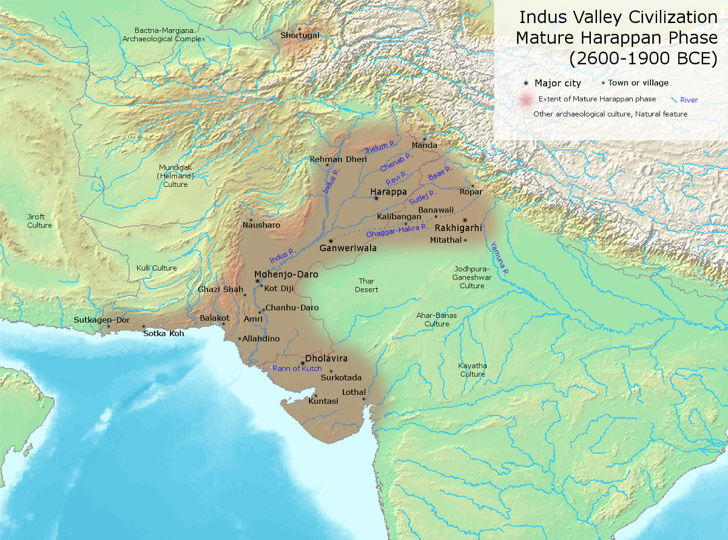
Indus Valley Civilization
ca. 3000–1500 BCE
- Urban Sophistication: Planned cities like Harappa and Mohenjo-Daro with indoor plumbing
- Identity & Language: Likely spoke Dravidian languages; genomically distinct from Indo-Aryans
- Chronology: Reached urban peak c. 2600 BCE
- Collapse: Driven by environmental shifts, not military conquest
A language family of approximately 80 languages spoken primarily in South India, including Tamil, Telugu, Kannada, and Malayalam. Linguistic and genetic evidence suggests the Indus Valley civilization spoke a Proto-Dravidian language, making modern South Indian culture a linguistic and cultural continuation of the IVC.
Inhabitants and Legacies
Harappans vs. Dravidians
- The Harappans: Archaeological name for IVC inhabitants; urban traders, not nomadic warriors
- The Dravidian Connection: "Dravidian" refers to a family of 80 living languages (Tamil, Telugu, etc.)
- Scholarly Consensus: Harappans likely spoke a Proto-Dravidian tongue
- The Great Migration: When cities collapsed (c. 1900 BCE), population shifted south
- The Result: Modern South Indian culture preserves many IVC elements
Harappan Religion: Material Inferences
Scholars rely on material culture to reconstruct belief systems
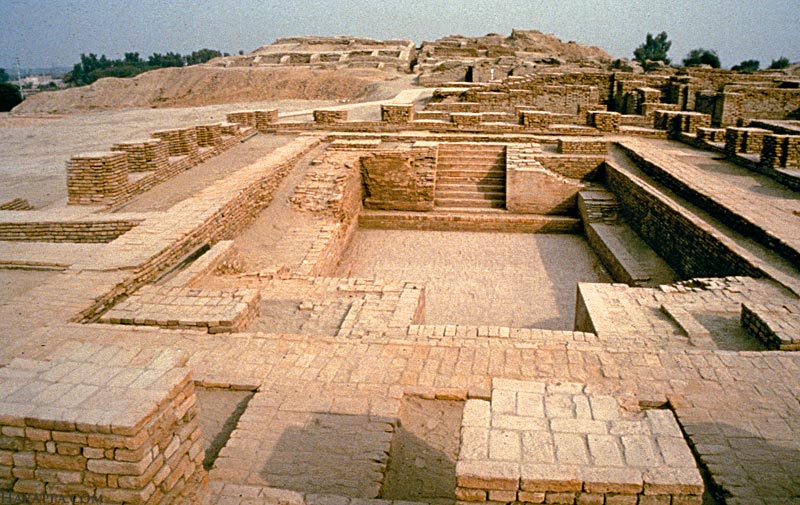
- Ritual Spaces: The Great Bath at Mohenjo-Daro suggests ritual purification
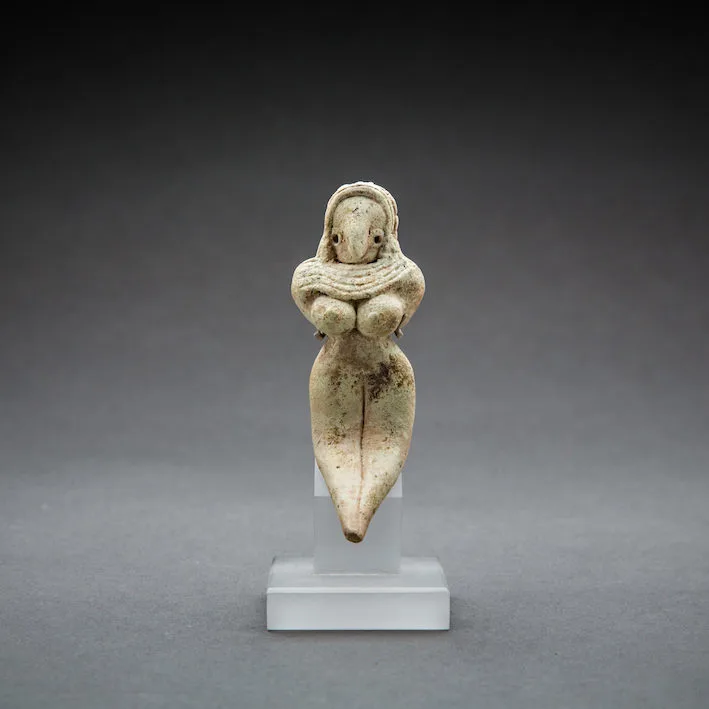
- Iconography: Terracotta figurines suggest Mother Goddess veneration
- Nature/Fertility: Tree worship (pipal) and animal veneration (bulls/unicorns)
- The Shakti Antecedent: Early roots of Shakti and Prakriti
Divine feminine power or energy. In Hindu theology, Shakti is the dynamic, creative force of the universe, often personified as goddesses. Shaktism is the Hindu tradition that worships the Goddess as supreme.
Nature, materiality, the physical world. In Hindu philosophy (especially Samkhya), Prakriti is the primordial matter/energy that constitutes the physical universe, often contrasted with Purusha (consciousness/spirit).
The Pashupati Seal: A "Proto-Shiva"?
Archaeological Observation
- Posture: Seated figure with heels pressed together
- Headdress: Large, prominent buffalo horns
- Surroundings: Elephant, tiger, rhino, buffalo
- Anatomy: Often described as ithyphallic
Historiographical Interpretation
- Early form of Yoga (Mulabandhasana)
- Power over nature / "horned deity"
- Pashupati (Lord of Animals) = Shiva epithet
- Symbol of fertility and Lingam
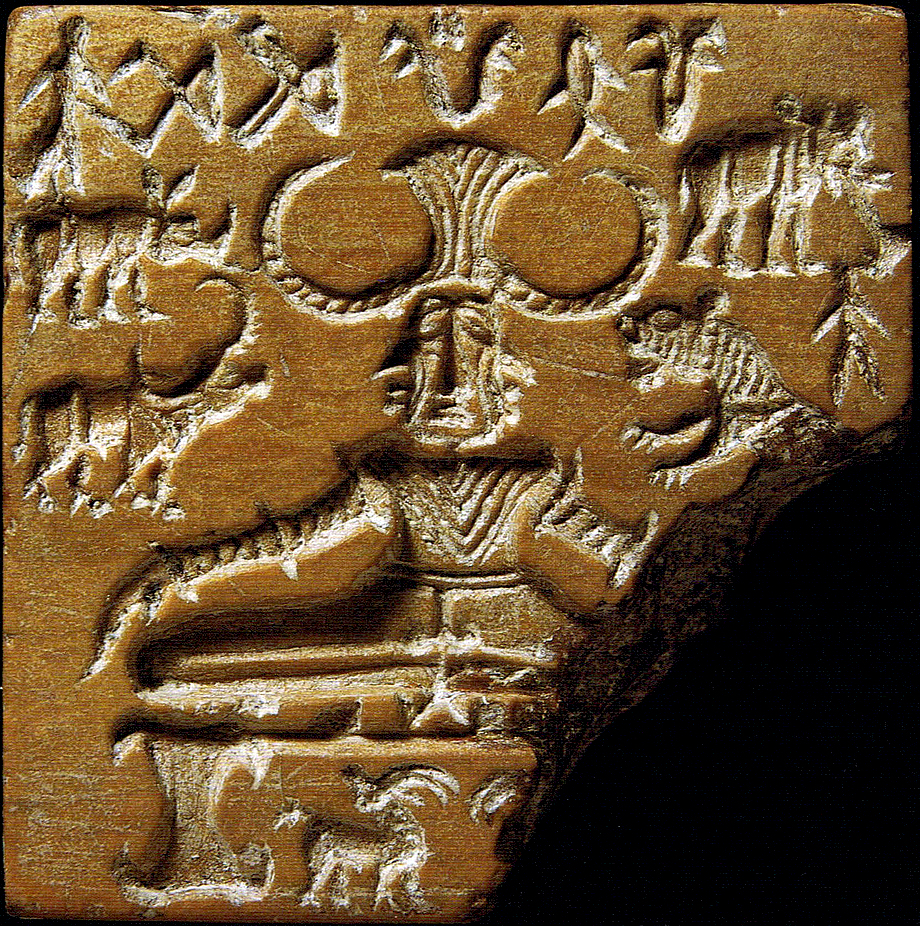
Pashupati seal (Mohenjo-Daro)
Click to enlarge
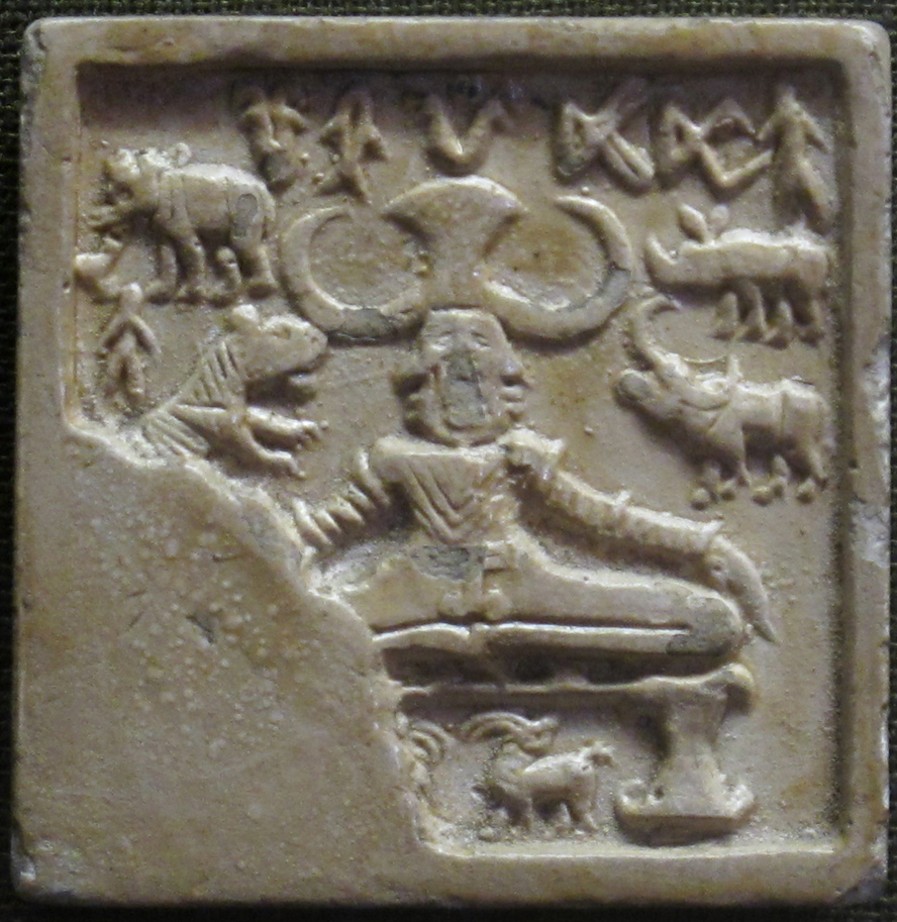
Pashupati seal detail
Click to enlarge
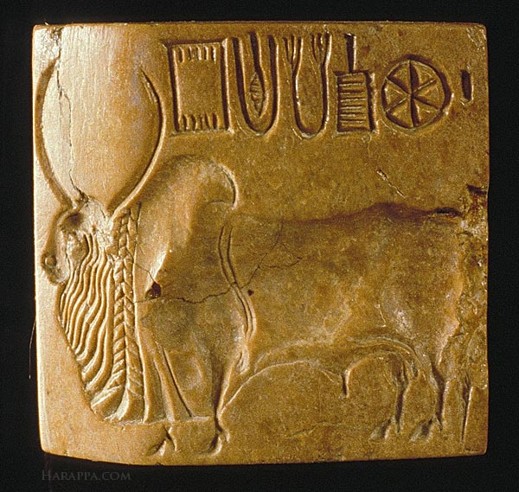
Indus Valley bull seal
Click to enlarge
Artifacts: Leadership and Aesthetics
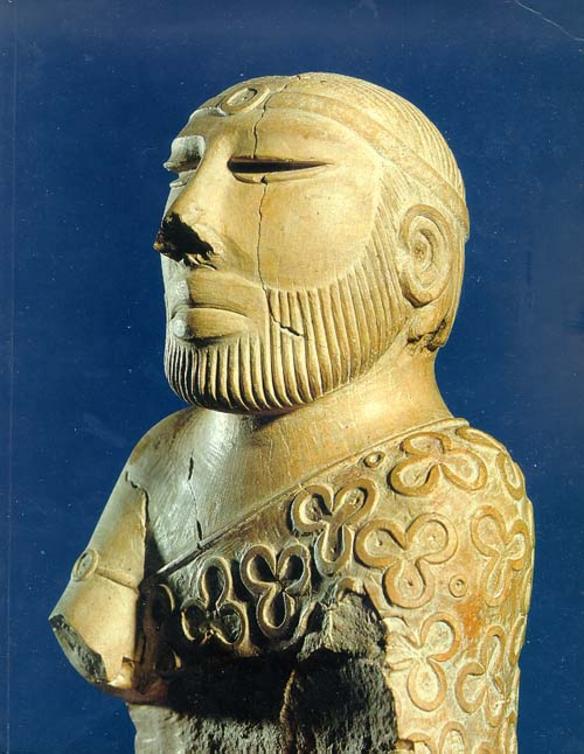
"Priest-King" Figure
- Debated status
- Suggests elite/religious leadership
- Despite lack of palaces
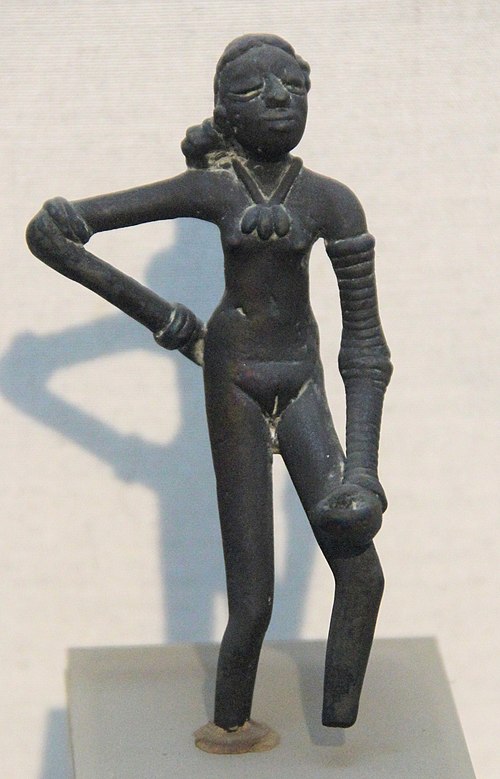
"Dancing Girl" Bronze
- Suggests ritual dance
- Specialized craftsmanship
- Indigenous aesthetics
Artifacts: Feminine and Fertility
Mother Goddesses
- Clay figurines found in homes
- Suggest domestic worship
- Divine feminine power
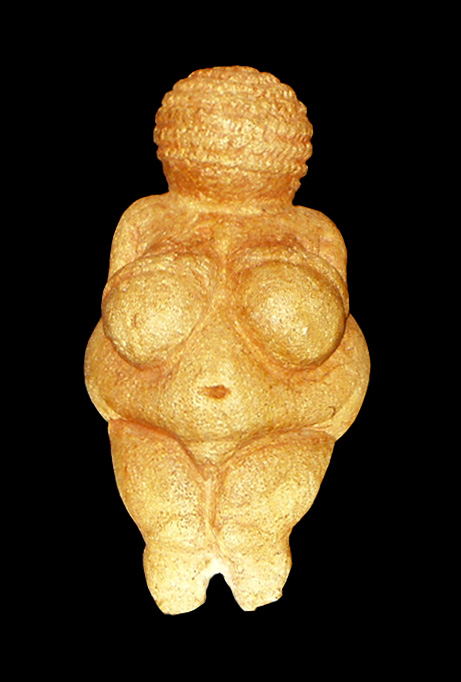
"Venus" Figurines
- Shared motifs with other cultures
- Focus on agricultural fertility
- Focus on human fertility
Indo-Aryan Migration
The Second Root of Hinduism
📺 Topic Spotlight
Indo-European Migrations
📝 Follow along with your worksheet! | 📋 Quiz to follow
Origins, Significance & the Aryan Migration into the Indus Valley
Indo-European Languages and Indo-Aryan Migration
- Indo-European: A language family that spread across Eurasia
- Indo-Aryan Branch: Connected to northwest South Asia (c. 2000–1000 BCE)
- Interaction: Groups interacted with existing communities; languages and cultures mixed and changed
- Linguistic Evidence: Earliest Vedic texts are Indo-Aryan; southern languages (Dravidian) remain prominent
⚠️ Critical Terminology Warning
"Aryan" here is a linguistic/cultural term referring to Indo-European language speakers. It is NOT the racist Nazi misuse of the word. The Nazi "Aryan race" ideology has no basis in scholarship.
The Vedic Period (ca. 1500–600 BCE)
- The Vedas: From Sanskrit vid ("to know"); earliest sacred "wisdom" texts
- Oral Tradition: Transmitted orally with mathematical precision
- The Rig Veda: Oldest of the four (c. 1400–900 BCE); 1,028 hymns to nature deities
Core Components:
- Hymns (Samhitas): Praises to Indra and Agni
- Sacrificial Focus: Centered on Yajna (fire sacrifice) to maintain Rta (cosmic order)
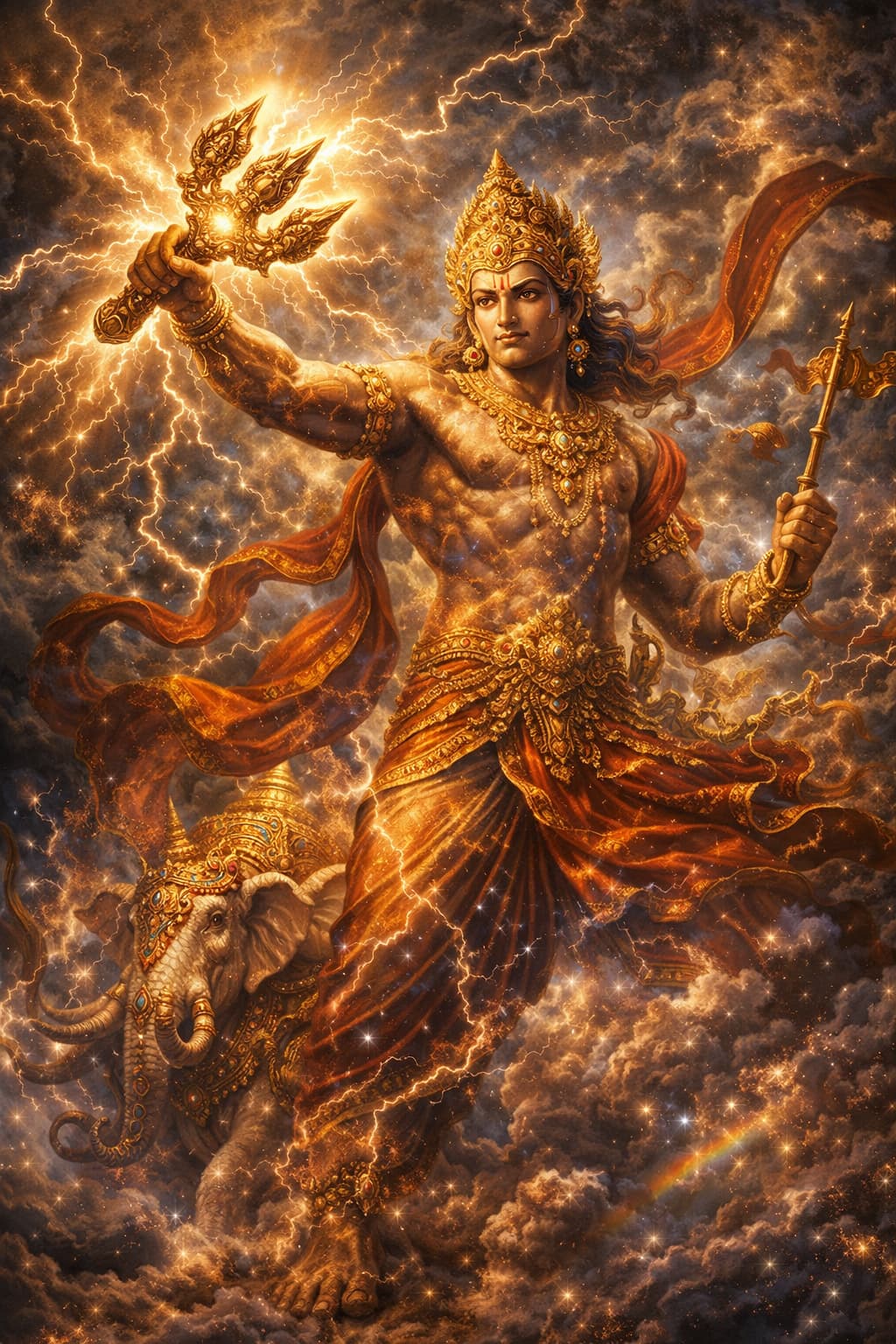
King of the Vedic gods, wielder of the thunderbolt (vajra), warrior deity who brings rain and victory in battle. Most frequently invoked deity in the Rig Veda, strengthened by offerings of soma (sacred drink).
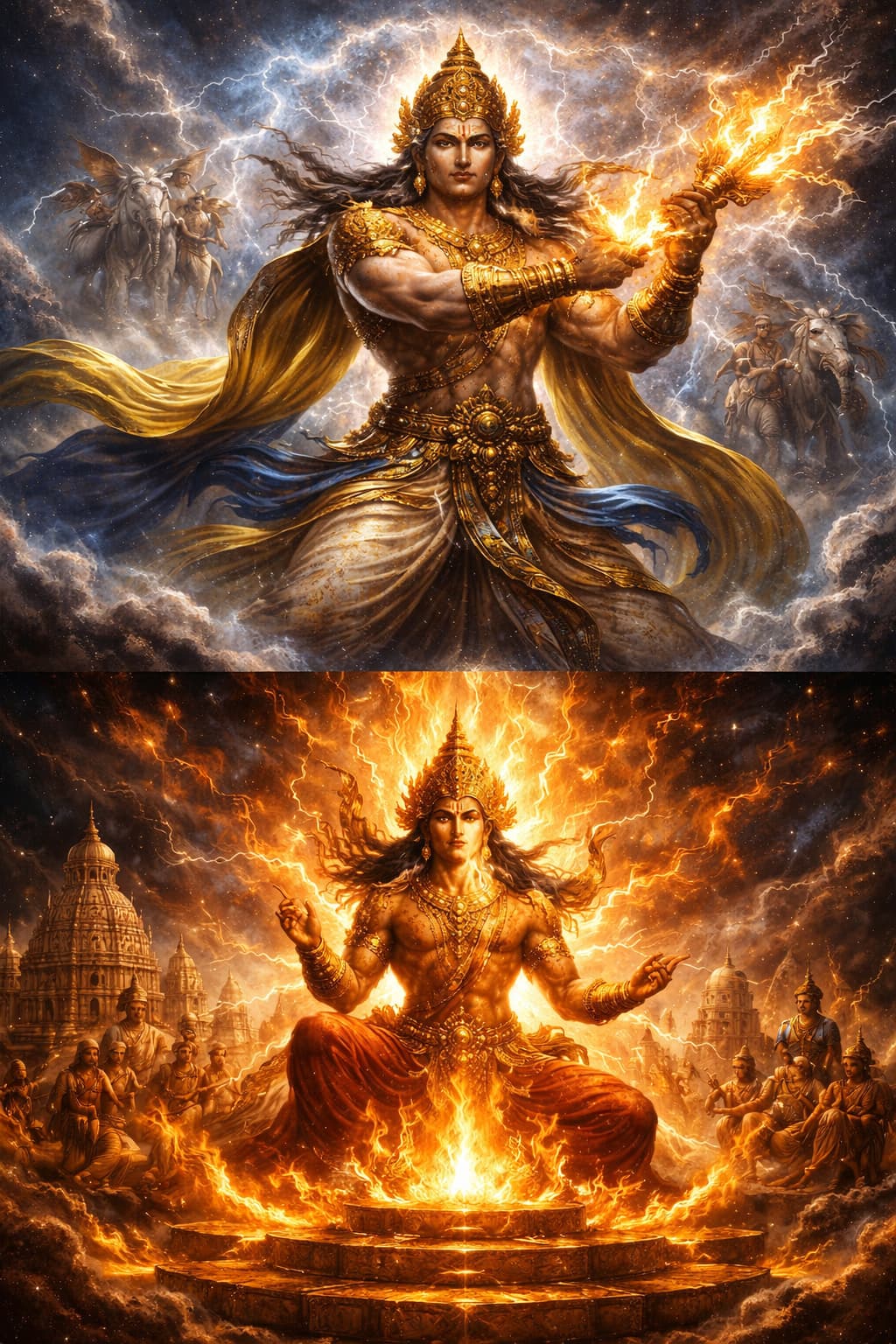
Vedic god of fire—fire of the sun, lightning, and hearth. Serves as divine messenger who carries sacrificial offerings from humans to the gods. Central to Vedic ritual as the interface between human and divine realms.
The Indo-Aryan and Harappan Synthesis
- Chronology Check: Cities abandoned c. 1900 BCE; Indo-Aryans arrived c. 1500 BCE
- The Reality: Migrants settled alongside remnants of de-urbanized populations
- The Dāsa: Vedas refer to outsiders as Dāsa—likely local groups with different rites
- Fusion: Synthesis of Vedic ritual and Harappan yoga/fertility motifs formed the bedrock of Hinduism
Term used in the Rig Veda to describe outsiders or enemies, later evolving to mean "servant" or "slave." Likely referred to non-Vedic indigenous populations. The term's evolution from "enemy" to "servant" may reflect social hierarchies that developed during Indo-Aryan settlement.
The Caste System
Varna, Jati, and Social Hierarchy
The Vedic Caste System (Varna)
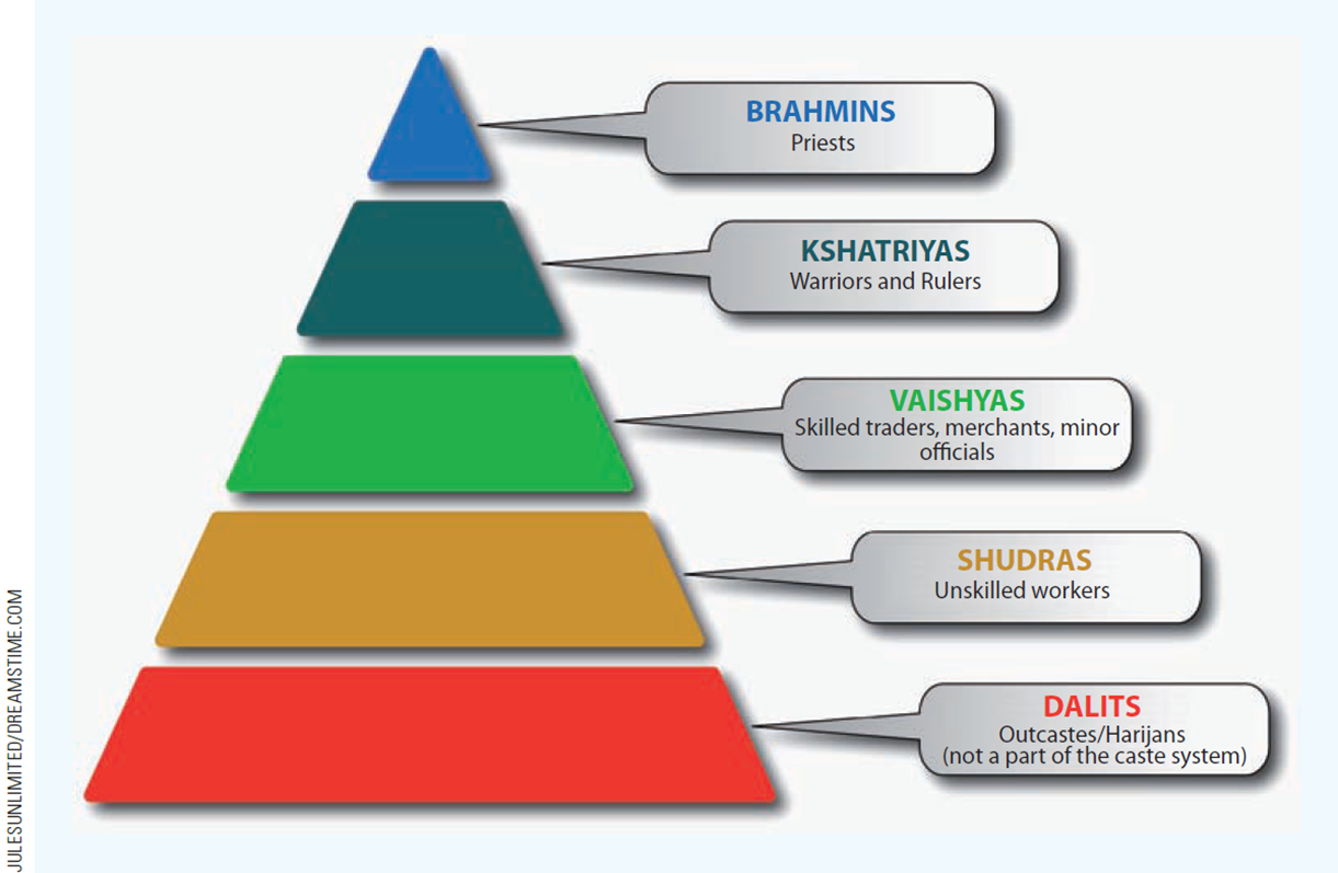
- Social Ideal: Fourfold system called varna ("class/order") in late Vedic texts
- Varna ("Color"): Best treated as symbolic/classificatory term; skin-color theory is discredited
Traditional Structure (Rig Veda 10.90):
- Brahmin: Priests (mouth)
- Kshatriya: Rulers/Warriors (arms)
- Vaishya: Merchants/Commoners (thighs)
- Shudra: Servants/Laborers (feet)
Literally "color" or "class." The fourfold classification system of Vedic society into Brahmins (priests), Kshatriyas (warriors/rulers), Vaishyas (merchants/farmers), and Shudras (laborers/servants). This is an idealized textual model that interacted with thousands of local birth-groups (jatis) to create the complex caste system.
The Hymn of the Cosmic Man
Purusha Sukta (Rig Veda 10.90)
- The Primal Sacrifice: Universe created through sacrifice of Purusha, a primeval giant
- Social Blueprint: Varnas portrayed as organic, divinely ordained parts of a cosmic body
- Divine Hierarchy: Priests speak (mouth), warriors protect (arms), producers support (thighs), servants provide foundation (feet)
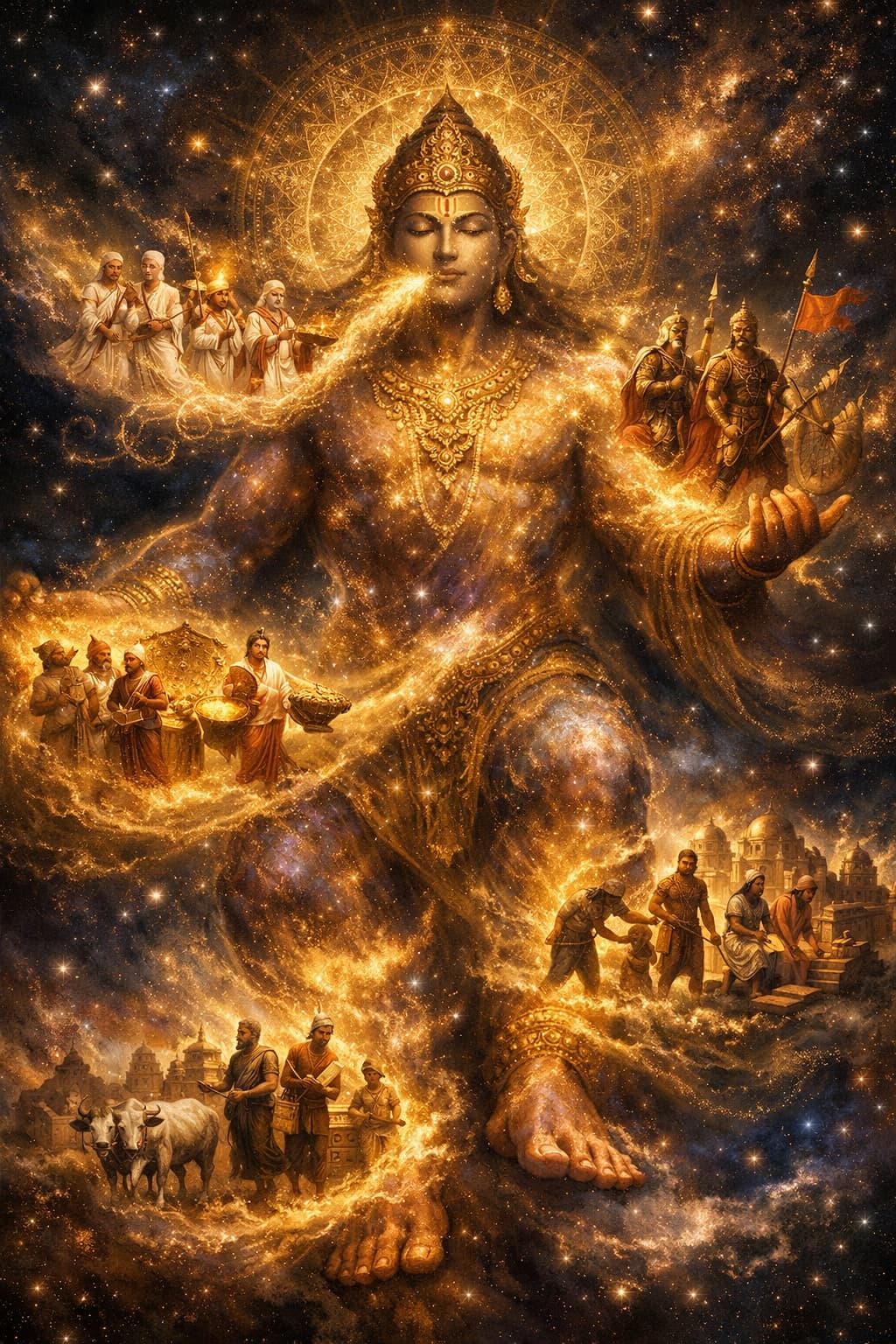
The primeval cosmic man whose sacrifice created the universe and social order. In Rig Veda 10.90 (Purusha Sukta), the gods sacrifice Purusha to create the world—and from his body parts come the four varnas. Later Hindu philosophy uses Purusha to mean consciousness/spirit.
Varna and Dalits
- Dalits ("Oppressed Ones"): Historically outside the fourfold varna system
- Ritual Pollution: Performed tasks considered polluting (butchery, tanning, cleaning latrines)
- Hereditary Status: Led to deep social discrimination and untouchability
- Terminology: Gandhi called them Harijan ("children of God"), but many find the term patronizing
Communities historically excluded from the four-varna system, formerly called "untouchables." Dalits faced severe discrimination including prohibition from temple entry, shared water sources, and physical proximity to upper castes. The term "Dalit" (chosen by Dr. B.R. Ambedkar) emphasizes oppression and resistance rather than Gandhi's paternalistic "Harijan" (children of God).
Jati – Birth Group
- Definition: Jati means "birth"—thousands of local birth-based groups
- Function: Often tied to clan, tribe, or occupation
- Expectations: Marry within the jati and follow occupational/social patterns
- Lived Reality: In practice, one's jati is more important than abstract varna
Local endogamous birth-groups, often tied to occupation. There are thousands of jatis across India. Unlike the four-varna textual ideal, jatis are the actual communities people identify with and marry within. The complex "caste system" is really the intersection of varna ideology with jati practice.
Vedic Religion
Sacrifice, Gods, and Cosmic Order
Vedic Religion: Sacrifice and the Gods
- Influencing Divine Forces: Gods play crucial role; sacrifice strengthens deities who sustain the cosmos
- Sacred Time: Sacrifice re-creates sacred time and maintains cosmic order
- Rituals: Included chanted hymns, drinking of soma (sacred drink), and animal sacrifice
Major Vedic Deities: Indra and Agni
Indra
- King of the gods
- Wielding the thunderbolt (vajra)
- Brings rain
- Warrior god strengthened by soma
Agni
- God of fire
- Fire of sun, lightning, and hearth
- Carries sacrifices to gods
- Central to Agnihotra
Agnihotra Ritual and the Rishi
- Agnihotra: Daily fire ritual by head of household to carry offerings to deities
- Rishi ("Seer"): Person who directly experiences divine reality, often through altered states
- Social Shift: Over time, power concentrated in Brahmin priests, creating sacrificial cult dominated by elites
A Vedic sage or seer who directly perceives divine truth, often through meditation or altered consciousness. Rishis are credited with "hearing" or "seeing" the Vedic hymns rather than composing them—the Vedas are considered shruti ("that which is heard"), eternal truths revealed to rishis.
Historical Transitions: Setting the Stage
- Growing Dissatisfaction: Developing critique of external ritual and questions about ultimate reality
- Philosophical Revolution: Contact with concepts of rebirth set the stage for the Upanishads
Preview: Next Class
- The Upanishadic revolution
- Core concepts: Brahman, Atman, Karma, Samsara
- From sacrifice to meditation