Tang at Its Height
and the An Lushan Rebellion
When Success Contains the Seeds of Crisis · 684–907 CE
Section I
How did one woman become emperor in a Confucian world that assumed only men could rule?
The Big Question
Only one woman in Chinese history declared herself emperor of her own dynasty.
How did Empress Wu rise from concubine to sovereign ruler?
And why did Tang cultural achievements peak precisely when centralized political control was fragmenting?
Empress Wu's Rise to Power
- Entered court as a concubine to Emperor Taizong; survived by attaching herself to his heir, Gaozong
- Convinced Gaozong to demote the empress and elevate her to that position
- Dark legend: smothered her own infant daughter to frame the empress — may be later propaganda
- 665: When Gaozong suffered a stroke, Wu made state decisions "from behind the screen"
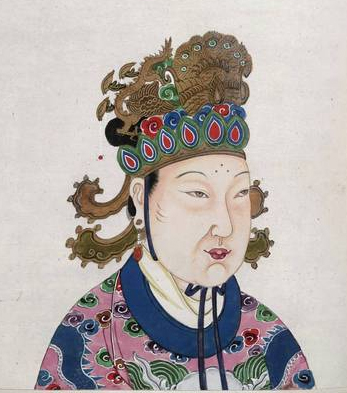
Empress Wu Zetian · Traditional Portrait · Public Domain · Wikimedia Commons
Emperor Wu of Zhou: 690–705
- 683: Gaozong dies; Wu controls court through her sons
- 684–690: Deposes two sons in succession for defying her authority
- 690: Declares herself emperor of the new Zhou dynasty — at age 65
- 705: Forced to abdicate at age 80 by court officials; dies the same year
Buddhism and Female Power
- Confucianism assumed cosmic order required male rulers — Buddhism offered alternatives
- The Great Cloud Sutra prophesied a female universal monarch; Wu promoted it empire-wide
- Buddhist monks became loyal allies; patronage created institutional support
- Expanded the examination system, recruiting new men outside the old aristocracy

Longmen Grottoes, Luoyang · Tang Dynasty · Public Domain · Wikimedia Commons
⏸ Pause & Reflect
Empress Wu used Buddhism to justify female rule in a Confucian world. What does her reign reveal about the flexibility — or the limits — of Chinese political culture?
Section II
How did Tang reach its cultural peak — and plant the seeds of its own crisis?
Xuanzong and the High Tang
- Curbed monastery power and excess Buddhist wealth
- New census to shore up the failing equal-field system
- Established frontier military provinces with professional armies
- Poetry, painting, and music flourished
- Li Bai served at court; horse painter Han Gan created masterworks

Han Gan, Night-Shining White · c. 750 CE · Public Domain · Metropolitan Museum of Art
Tang Poetry: The Golden Age
- Light-hearted celebration of wine, friendship, and nature
- Daoist imagery and spontaneous inspiration
- Known as the "Poetry Immortal"
- Served briefly at Xuanzong's court
- Moral voice protesting injustice and suffering
- Confucian conscience of the dynasty
- Witnessed and documented the An Lushan Rebellion
- Considered the greatest Chinese poet by later tradition
Du Fu: Witness to Catastrophe
Mansions of counts and princes all have new masters.
The civil and army uniforms differ from olden times.
Straight north past the fortified mountains kettledrums are thundering..."
⏸ Pause & Reflect
Li Bai and Du Fu represent two poles of Tang poetry. Which of the following best explains why Du Fu is often called the "Confucian poet"?
- He passed the jinshi examination on his first attempt
- His poetry was commissioned by the emperor for ritual purposes
- He used poetry to bear moral witness to political suffering and injustice
- He criticized Buddhism and advocated a return to ancient rites
Section III
How did Tang's greatest strength — its cosmopolitan, multi-ethnic military — become its greatest danger?
The Road to Rebellion
- Xuanzong's later reign dominated by favorite concubine Yang Guifei — her relatives seized enormous court power
- Frontier provinces commanded by professional, non-Chinese armies loyal to their generals, not the court
- General An Lushan commanded over 160,000 troops across three northeastern commands
- Bitter rivalry between An Lushan and Yang Guifei's cousin sparked open conflict

Tang Empire c. 700 CE — Frontier commands held by An Lushan highlighted northeast · CC BY-SA · Wikimedia Commons
The An Lushan Rebellion: 755–763
- 755: An Lushan rebels with his frontier army; marches south
- 756: Luoyang falls; veterans advance on Chang'an; Xuanzong flees west
- 756: Troops mutiny at Mawei Postal Station — demand execution of Yang Guifei; heir apparent declares himself emperor
- 757: An Lushan murdered by his own son; Tang calls on Uighurs to retake Chang'an — Uighurs loot the city
- 763: Rebellion finally suppressed after eight years
Yang Guifei and the Politics of Blame
- As Xuanzong fled west, his guards mutinied and demanded the execution of Yang Guifei and her relatives
- The emperor had no choice — Yang Guifei was strangled at a postal station; he watched
- Bai Juyi's "Song of Everlasting Sorrow" immortalized their tragic love as literary legend
- Yet the poem also blamed the woman for the emperor's failures — a persistent Confucian pattern
⏸ Pause & Reflect
The An Lushan Rebellion killed millions and shattered Tang centralized power. Yet historians argue we should not view "late Tang" simply as decline. What continued — or even flourished — after the rebellion?
Section IV
What does it mean for an empire to "decline" — and what counts as evidence?
After the Rebellion: A Different Tang
- Equal-field system and fubing militia
- Centralized court control over provinces
- Tang's ability to project military power
- Emperor's authority over frontier generals
- Poetry — Du Fu's greatest work, Bai Juyi's entire career
- Trade and commercial networks; salt monopoly revenue
- Regional diversity and local cultural expression
- Buddhist culture and Confucian intellectual revival
Late Tang Culture
- Bai Juyi (772–846) — accessible poetry with massive popular output; his Song of Everlasting Sorrow became a literary touchstone
- Tang tales — a new genre of classical fiction featuring love stories and supernatural themes
- 845: Emperor Wuzong's Buddhist persecution — monasteries destroyed, monks secularized — but Buddhism survived and recovered
- Han Yu (768–824) launched a Confucian revival, challenging Buddhist dominance and laying the groundwork for Song Neo-Confucianism
Tang's End: 907
- Regional military governors effectively independent — the court was a formality
- Eunuchs controlled the inner court, killing and enthroning emperors at will
- 875–884: Huang Chao Rebellion devastated the south and what remained of central authority
- Last Tang emperor forced to abdicate to a warlord — dynasty formally ended
- Followed by the Five Dynasties and Ten Kingdoms period (907–960)
⏸ Pause & Reflect
Which of these best explains why late Tang saw a cultural flourishing even as political power fragmented?
- The emperor deliberately funded the arts to distract from military failures
- Regional diversity, commercial growth, and religious competition all fostered creativity
- Buddhism's decline freed resources for secular cultural production
- The jiedushi banned political commentary, forcing writers to focus on aesthetics
The Tang Legacy
The Tang created institutional frameworks and cultural achievements that defined Chinese civilization for centuries — even as political unity fragmented.
poetry · legal codes · examination system · cosmopolitan ideal · Buddhist art · Confucian revival