HIST 270: History of China
Sui Reunification &
Early Tang Foundations
581–618 CE
The Big Question
After nearly 400 years of division, China reunited under a dynasty that lasted only 37 years.
How did such a short-lived dynasty lay foundations for one of China's greatest eras?
The Sui–Tang Series
Three lectures covering China's cosmopolitan "Golden Age":
- Lecture 1 (Today): Sui reunification and why it failed
- Lecture 2: Early Tang foundations of power
- Lecture 3: Tang at its height and the An Lushan Rebellion
Textbook = dynastic sequence · Lectures = why the patterns repeat
The 37-Year Dynasty
- Reunified China after 400 years of division
- Built the Grand Canal
- Created an early exam-based recruitment pipeline
- Established a legal code used for centuries
- Millions of conscripted laborers
- Four failed Korean campaigns
- Drought, floods, epidemic disease
- Emperor assassinated by his own guards
How can a dynasty be both transformative AND self-destructive?
Section I
Hybrid identity as the engine of reunification
Yang Jian and the Northwest Aristocracy
Reunification came from the north — from a hybrid military elite:
- Yang Jian rises from mixed Chinese-Xianbei heritage
- Intermarried with Northern Zhou royal family
- Combined Chinese bureaucratic skills with steppe military traditions
- Usurped Northern Zhou throne in 581; founded Sui

Emperor Wen of Sui (Yang Jian), r. 581–604
Founder of the Sui Dynasty. Claimed Han Chinese descent, but his family bore an assimilated northern identity typical of the northwest military aristocracy. Rose by serving Northern Zhou, married into the ruling house, then seized the throne in 581. Presented himself as a Buddhist Cakravartin king to legitimate rule across ethnic lines. Reunified China in 589 after ~400 years of division.
A steppe people central to northern China’s “Period of Division.” Over generations, Xianbei rulers adopted Chinese administration, while Chinese elites adopted steppe cavalry traditions. By the 6th century, elite identity in the northwest was deeply hybrid — a key reason Sui (and later Tang) could unify and rule a diverse empire.
Mixed Heritage as Advantage
- Military credibility: Steppe traditions = cavalry effectiveness + martial culture
- Administrative skill: Chinese traditions = bureaucracy, taxation, law
- Buddhist legitimacy: A universal idiom that cut across ethnic boundaries
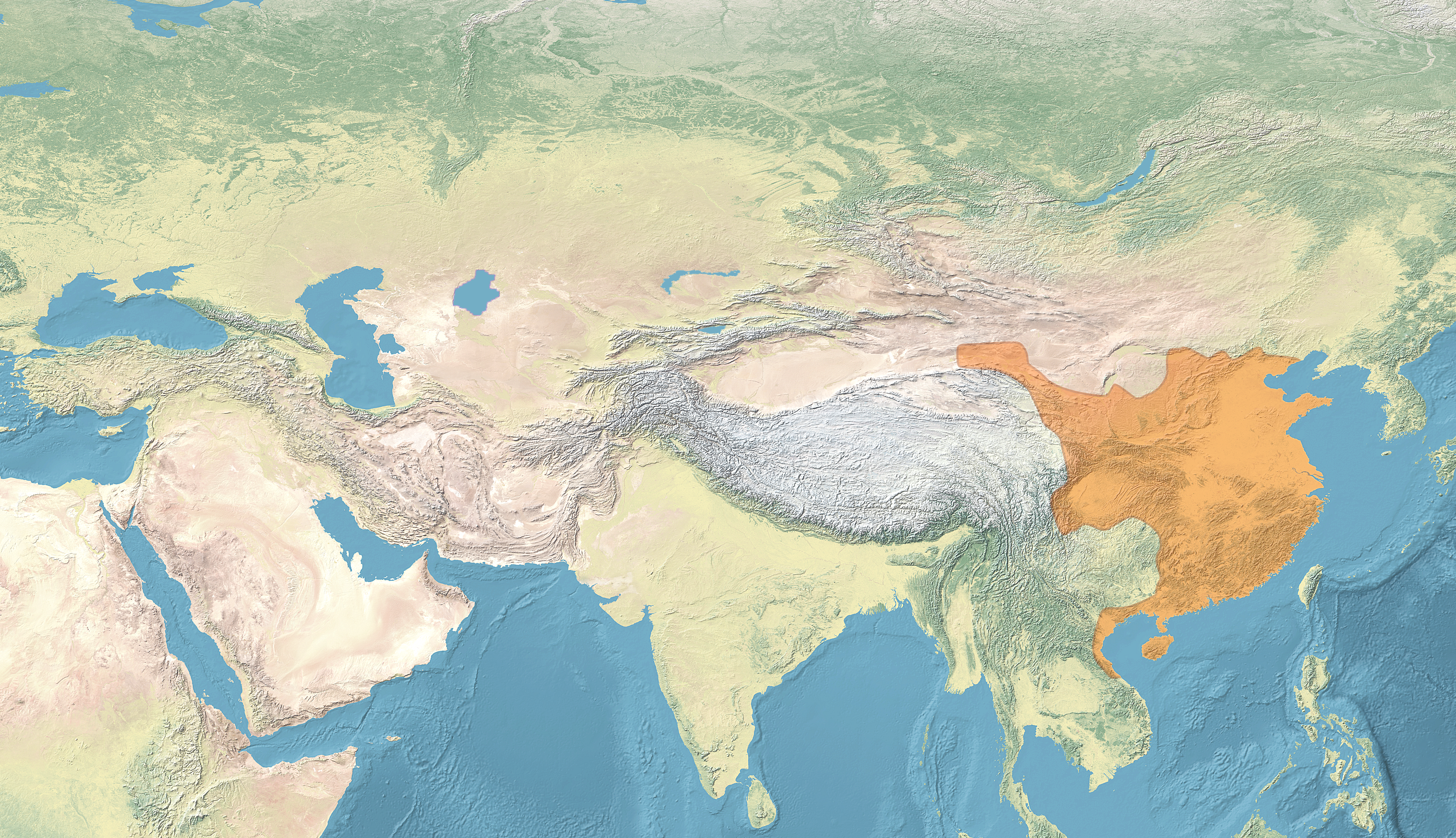
Sui Dynasty territory (unified empire)
Reunification: 589 CE
- 577: Northern Zhou conquers Northern Qi
- 581: Yang Jian usurps throne, founds Sui
- 588–589: Massive naval campaign against Southern Chen
- 589: Chen falls — first unified China in ~400 years
Naval power was decisive: huge deployments along the Yangzi + logistical coordination at scale
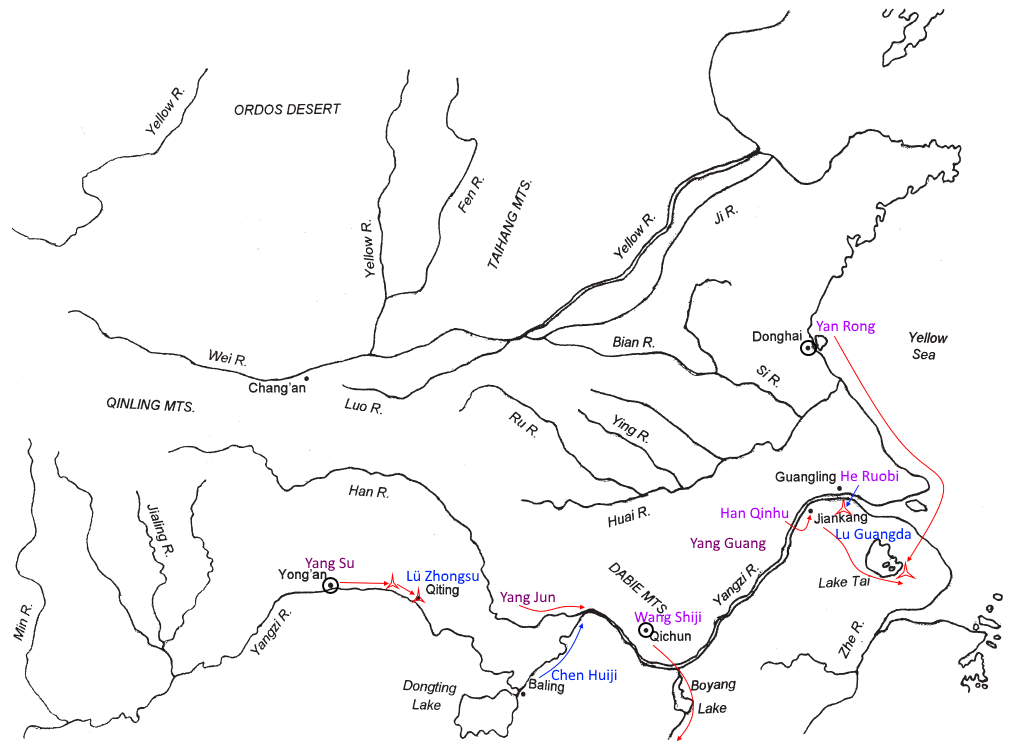
Sui conquest of Chen, 588–589
Buddhism as Imperial Ideology
Wendi presented himself as a Cakravartin — a Buddhist "wheel-turning king":
- Distributed Buddha relics across the empire (601 CE)
- Issued edicts framing rule as moral and universal
- Buddhism helped bridge regional and ethnic divides
- Confucian administration + Buddhist ideology = dual legitimacy
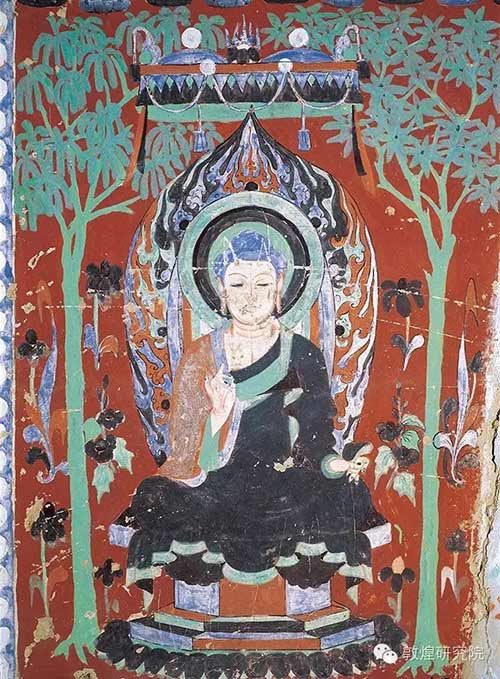
Dunhuang Mogao Caves — Sui-period Buddhist art
Buddhist ideal of a universal monarch who rules righteously and protects the dharma. For Sui rulers, it was politically useful because legitimacy did not depend on being “purely Han” or tied to a single regional lineage — it traveled across boundaries.
Wendi's Buddhist Vision
- Framed rule as protecting Buddhism for all people
- Borrowed the prestige of “dharma-protecting” universal kings
- Legitimacy here is universal — it crosses ethnic, regional, and class lines
⏸ Pause & Reflect
Why might a mixed ethnic background be an advantage for reunifying China after centuries of division? What does this tell us about identity in this period?
2 min partner talk → 2 min share → 1 min synthesis
Section II
The infrastructure of empire — administrative and physical
Rebuilding the Administrative State
- Limited local appointment power
- Returned to an exam-linked recruitment pipeline
- Undermined aristocratic gatekeeping
- Sui code becomes Tang foundation
- Tang revises, refines, standardizes
- Influence spreads across East Asia
Sui institutions outlasted the Sui — the Tang inherited and refined them.
The Grand Canal
A massive feat connecting north and south:
- Linked Yellow River and Yangzi systems
- Enabled grain transport to northern capitals
- Built with relay posts, granaries, and roads
- Solves the logistics problem of a north-led empire with a south-heavy economy
Political centers in the north; agricultural surplus in the south — the Canal solved the logistics of empire
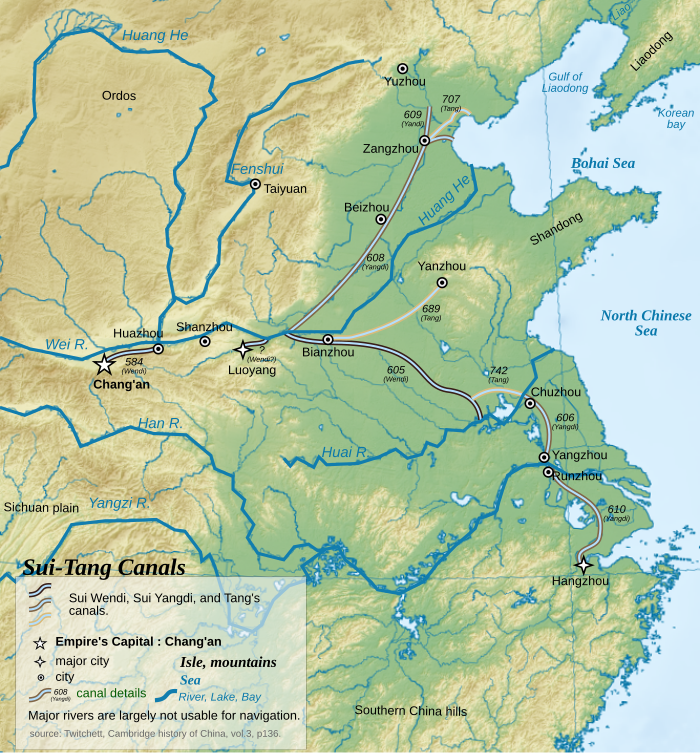
Grand Canal of China — Sui–Tang route
The Grand Canal: Human Cost
- Communities disrupted and displaced
- Deaths from exhaustion, accidents, disease
- Families separated; farming interrupted
- Rebellions flare along pressure points
⏸ Pause & Reflect
The Grand Canal required massive conscripted labor but benefited China for centuries. Who decides whether such trade-offs are worth it?
- Only rulers who bear political responsibility for outcomes
- Future generations who receive the benefit
- The people who bear the immediate costs and suffering
- Historians with the benefit of hindsight
Section III
When ambition becomes catastrophe — 604 to 618 CE
Emperor Yangdi: Overreach
Yangdi (r. 604–618) inherited Sui success and squandered it:
- Accelerated Grand Canal construction
- Rebuilt Great Wall sections
- Expanded palace complexes
- Launched repeated Korean campaigns
Each project demanded more conscripts, more taxes, more suffering.
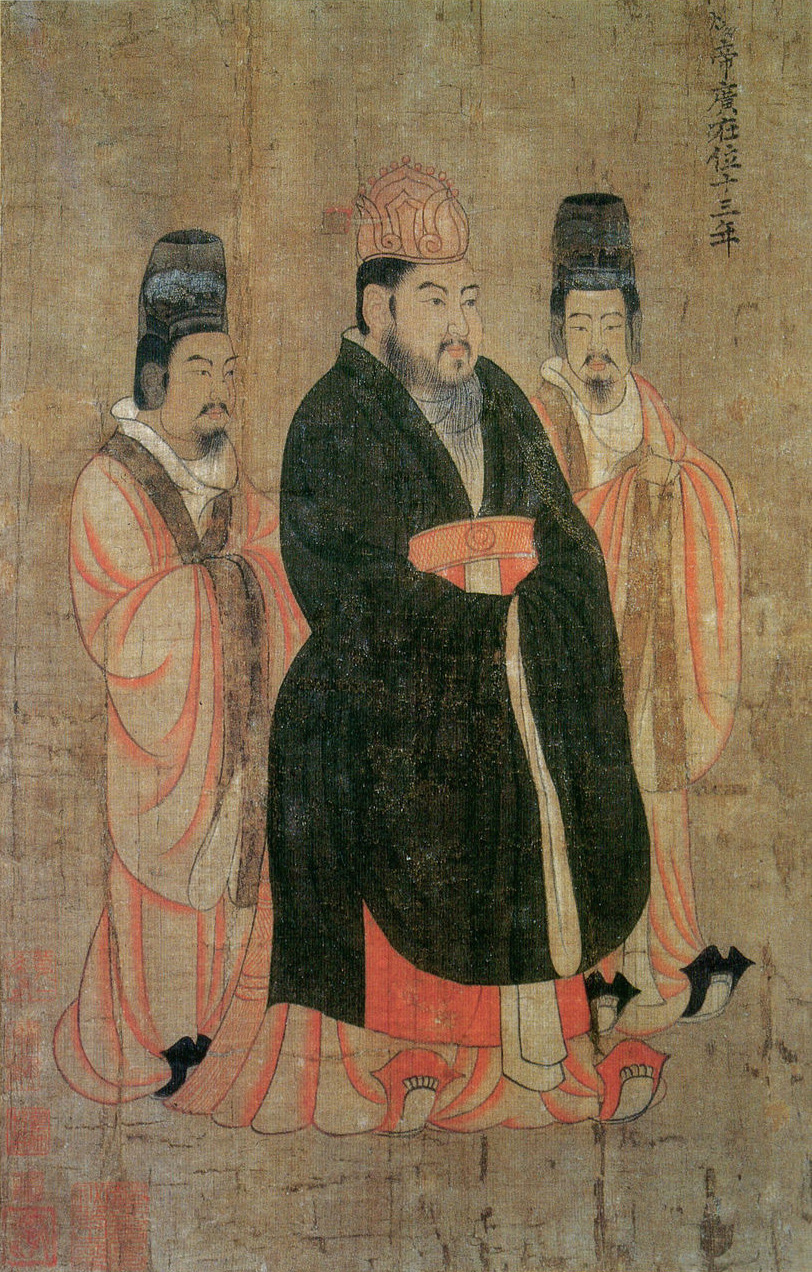
Emperor Yangdi of Sui (r. 604–618)
Second Sui emperor, remembered as a symbol of imperial excess. He expanded infrastructure and state reach, but repeatedly pushed mobilization beyond what the economy and population could sustain. His military fixation on Korea and relentless labor demands helped trigger empire-wide rebellion and his assassination in 618.
The Korean Disaster
- 598: Early campaign fails — weather + supply collapse
- 611–612: Massive mobilization; catastrophic attrition
- 613: Campaign cut short by rebellion at home
- 614: Another expedition gains little
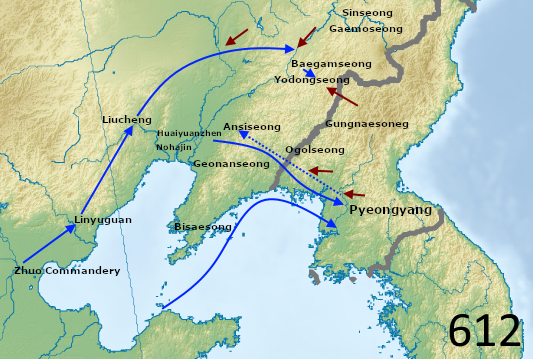
Sui–Goguryeo war (612) — logistics meets reality
A powerful Korean kingdom controlling northern Korea and parts of Manchuria. Sui rulers framed conquest as restoring “proper” imperial territory. Militarily, fortifications, terrain, and supply constraints made sustained invasion brutally costly.
Sui Collapse: 615–618
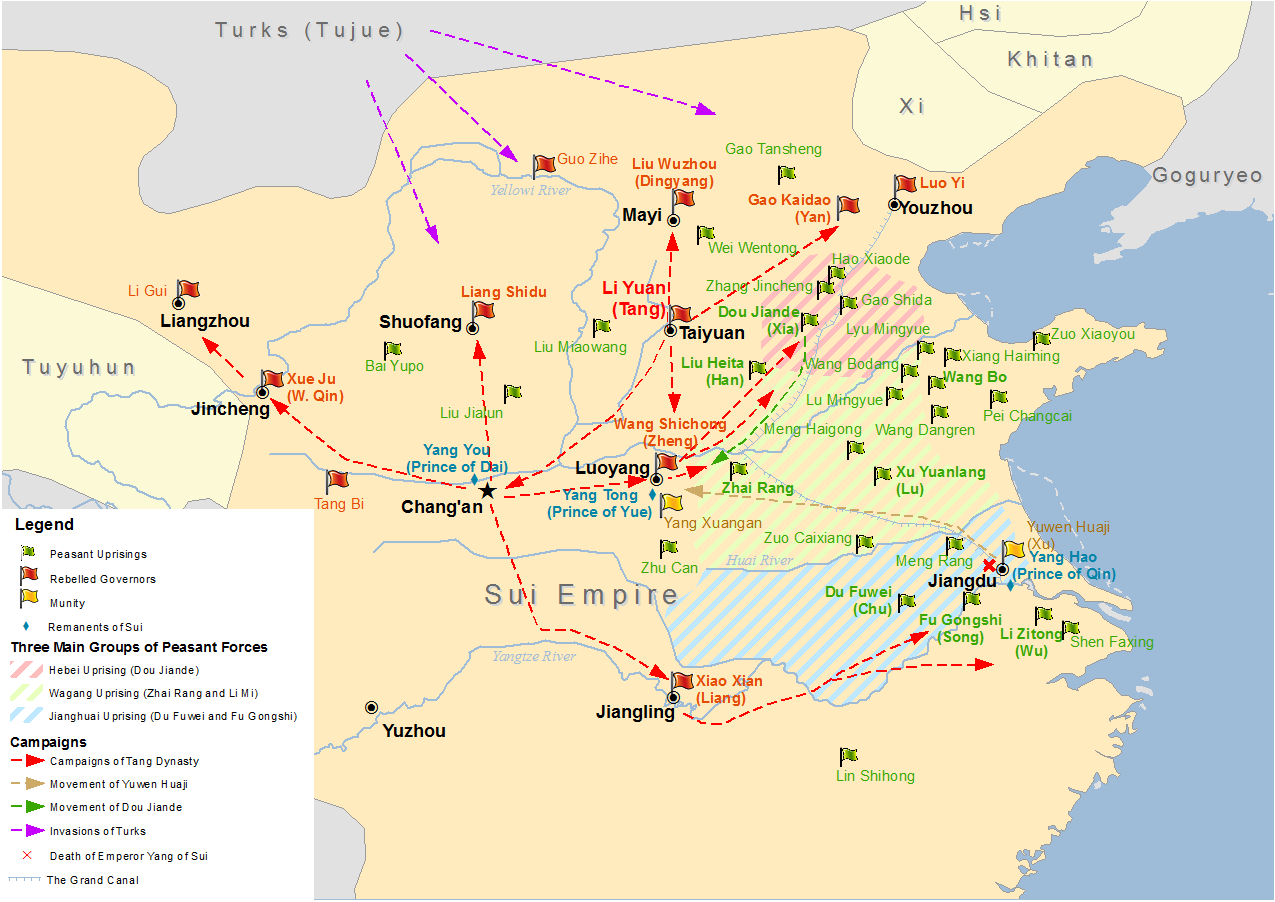
Uprisings across the empire
- Drought and floods in central China
- Epidemics amplified by mobilization
- Banditry + deserters + local revolts
- Regional officials stop obeying the court
- 615: Yangdi nearly captured by Turks
- 617: Li Yuan rebels (future Tang founder)
- 618: Yangdi assassinated by his own guards
- 624: Tang consolidates victory
The dynasty that reunified China after centuries lasted only 37 years.
Why the Tang Succeeded
The Tang founders came from the same northwest military aristocracy as the Sui:
- Li Yuan and Li Shimin were connected to Sui elite networks
- Same hybrid frontier culture + military competence
- Same ability to govern a diverse empire
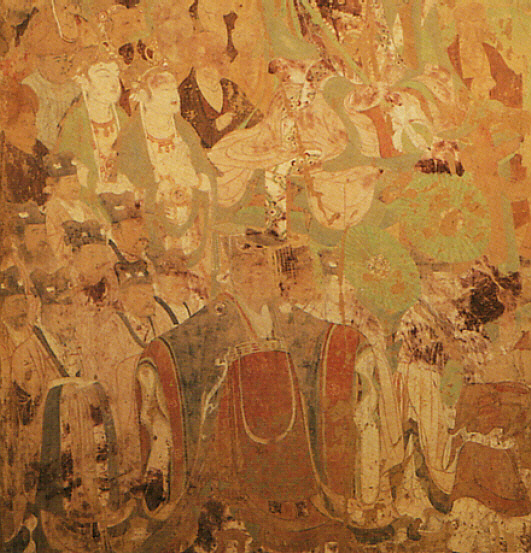
Tang Taizong (r. 626–649) — inheritor of Sui foundations
⏸ Pause & Reflect
The same ambition that reunified China destroyed the Sui. What distinguishes visionary leadership from imperial overreach — and who gets to decide?
Think 1 min → write 1 min → share → synthesis
Key Terms — Lecture 1
- Northwest military aristocracy — hybrid frontier ruling elite
- Yang Jian / Wendi — Sui founder, r. 581–604
- Xianbei — steppe roots of northern dynastic politics
- Cakravartin — Buddhist “wheel-turning king” legitimacy
- Grand Canal — north-south artery linking Yellow & Yangzi systems
- Conscripted labor — forced mobilization powering Sui projects
- Yangdi — second Sui emperor; emblem of overreach
- Goguryeo — Korean kingdom; target of failed campaigns
- Exam state — recruitment linked to central evaluation
- Imperial overreach — ambition exceeds state capacity
Closing: The Sui Legacy
The Sui accomplished what no one had done in centuries: reunifying China. They created institutional foundations — legal codes, administrative structures, a stronger recruitment pipeline, the Grand Canal — that would shape the Tang and beyond.
But they destroyed themselves through the same ambition that enabled their success. The Tang who replaced them weren’t rejecting the Sui — they were continuing it more sustainably.