HIST 270: History of China
Chapter 3, Lecture 2
The Han Dynasty: Founding, Governance, and the Confucian Turn
206 B.C.E.–9 C.E.
⌨️ Keyboard Shortcuts
Reveal.js Keyboard Shortcuts
Learning from Qin's Mistakes
Opening question: The Qin created China's first unified empire but collapsed in just 15 years.
What lessons did its successors learn?
The Han Achievement
- Created a dynasty lasting over 400 years (with a brief interruption)
- One of China's five major dynasties
- So influential that ethnic Chinese still call themselves "Han people" (漢人 Hànrén)
The Five Major Dynasties
Chinese history is often organized around five "great" unified dynasties that each lasted more than two centuries:
- Han (206 BCE–220 CE) — ~400 years
- Tang (618–907 CE) — ~300 years
- Song (960–1279 CE) — ~300 years
- Ming (1368–1644 CE) — ~275 years
- Qing (1644–1912 CE) — ~270 years
Each set lasting patterns for Chinese civilization that influenced all successors.
The Contest for Empire
Xiang Yu vs. Liu Bang
| Xiang Yu (項羽) | Liu Bang (劉邦) |
|---|---|
| Aristocratic background (Chu nobility) | Commoner (village headman) |
| Brilliant military commander | Mediocre general |
| Proud, suspicious of advisors | Humble, listened to advisors |
| Ruled through terror and violence | Built coalitions through rewards |
| Most powerful army | Skilled at recognizing talent |
項羽 Xiàng Yǔ (232–202 BCE)
The aristocratic warrior who dominated the post-Qin chaos:
- Grandson of a famous Chu general
- Legendary strength—said to lift bronze cauldrons
- Won dramatic victories against Qin armies
- Divided the empire among 18 kings after Qin's fall
- But his cruelty and arrogance made many enemies
- Committed suicide after final defeat at Gaixia (202 BCE)
His story became a cautionary tale about military prowess without political wisdom.
劉邦 Liú Bāng (256–195 BCE)
The commoner who became Emperor Gaozu:
- Started as a minor local official (village headman/constable)
- No military training or aristocratic background
- Fled into the hills to avoid Qin law—became an outlaw leader
- Key skill: recognizing and using talent
- Surrounded himself with capable advisors and generals
- Famous question: "Why did I win?" Answer: "Because you shared rewards and listened."
His rise from commoner to emperor became proof that the Mandate of Heaven could pass to anyone worthy.
The Civil War (206–202 BCE)
After Qin Fell
- Xiang Yu dominated militarily
- Divided empire among 18 kings
- Liu Bang received remote western territory (King of Han)
- This recreated the old fragmentation
Liu Bang's Advantages
- Attracted talented advisors and generals
- Built coalitions through rewards and promises
- Xiang Yu made enemies through cruelty
- Gradually consolidated power
202 BCE: Liu Bang defeated Xiang Yu at the Battle of Gaixia
Xiang Yu committed suicide rather than surrender
Liu Bang declared the Han Dynasty
Emperor Gaozu (r. 202–195 BCE)
Founding the Dynasty
- Title: Emperor Gaozu ("High Ancestor")
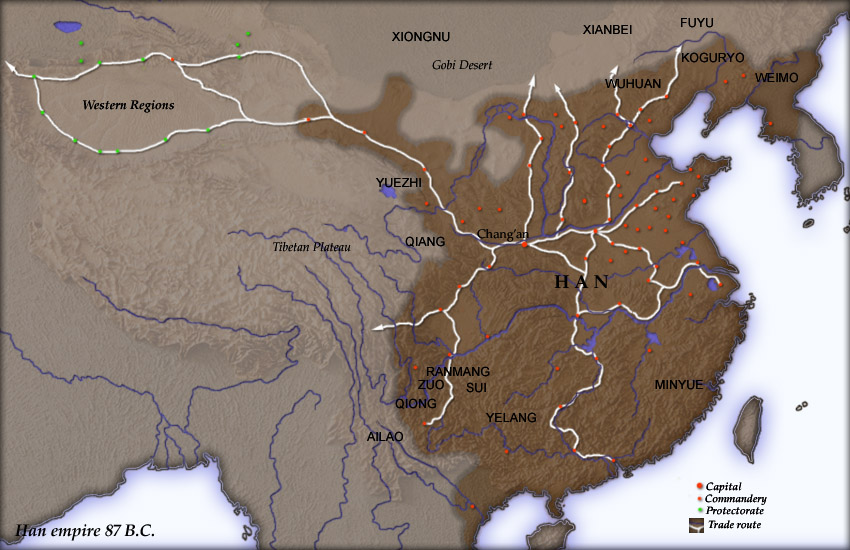
- Capital: Chang'an (near modern Xi'an)
- Not far from old Qin capital
- Kept Qin's administrative structure
- But removed its most hated features
Emperor Gaozu (高祖)
Understanding Chinese imperial names:
- Personal name: Liu Bang (劉邦)
- Temple name: Gaozu (高祖) — "High Ancestor"
- Temple names were given posthumously for use in ancestral rites
- "Gaozu" indicates he was the dynasty's founder
Chinese emperors are typically referred to by their temple names or reign era names, not their personal names (which were taboo to use).
Early Han Reforms
Lightening the Burden
- Eliminated some laws—removed Qin's most hated provisions
- Cut taxes—reduced to one-fifteenth of harvest (later one-thirtieth!)
- Lessened labor demands—fewer massive construction projects
- Abolished mutilation punishments—stopped branding, cutting off noses, etc.
Philosophy: "Resting with the people" (與民休息)—let society recover from war
Threats to Dynastic Longevity
Internal Weaknesses
- Feudalism / Decentralization
Regional rulers build independent power bases - Empress Clans
Consort families dominate the court through child emperors - Eunuchs
Palace insiders gain influence through direct access to the throne
External Pressure
- Northern “Barbarians”
Steppe confederations exploit moments of internal weakness
Dynasties rarely fall from one cause.
Collapse comes when court factionalism and
frontier pressure reinforce each other.
A Mixed System: Kingdoms and Commanderies
Western Half
- Commanderies and counties
- Directly administered by central government
- Like the Qin system
- Officials appointed by emperor
Eastern Half
- Kingdoms (王國)
- Given to relatives and allies
- Nearly autonomous governance
- Reward for helping win the war
The Problem: "Very soon he [Gaozu] recognized that giving followers independent resources was a mistake, and he spent much of his reign eliminating the fief holders who were not relatives."
The Rebellion of the Seven Kings
- Kings controlled territories and could become threats
- Central government tried to reduce kingdom powers
- 154 BCE: Seven kings rebelled against Emperor Jing
- Rebellion crushed within three months
- Demonstrated the danger of divided authority
Aftermath
- Subsequent emperors gradually reduced kingdom sizes
- Kings lost right to appoint their own officials
- Kingdoms became largely ceremonial by Emperor Wu's reign
The Rebellion of the Seven Kings (154 BCE)
The most serious internal threat to the early Han:
- Seven kingdoms (Wu, Chu, Zhao, Jiaoxi, Jiaodong, Zichuan, Jinan) rose in revolt
- Led by the King of Wu, who had enormous wealth from salt and copper
- Claimed to be removing "evil ministers" from the emperor's court
- Imperial armies defeated them decisively within three months
- All seven kings were killed or forced to commit suicide
The rebellion proved that the kingdom system was too dangerous to maintain. Centralization accelerated afterward.
⏸ Pause & Process
Think-Pair-Share
Compare Qin and early Han governance:
What did the Han keep from Qin?
What did they change?
Why do you think the Han approach was more sustainable?
Take 2 minutes to think, then discuss with a neighbor.
Emperor Wu (r. 141–87 BCE)
Han Wudi — "The Martial Emperor"
- One of the most important emperors in Chinese history
- Reign of 54 years—longest of the Han
- Transformed the Han from recovery to expansion
- Made Confucianism the official state ideology
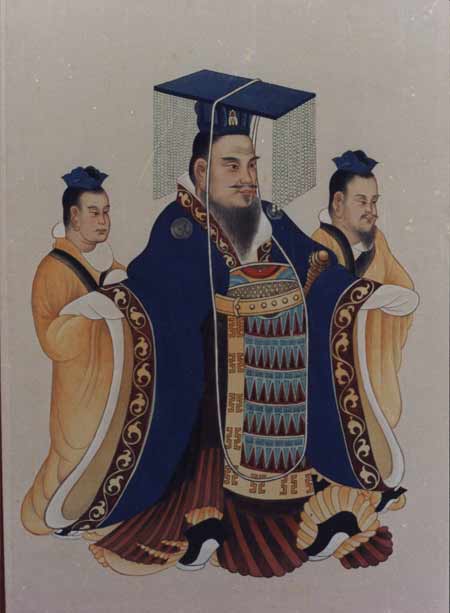
漢武帝 Hàn Wǔdì (156–87 BCE)
Breaking down the title:
- 漢 Hàn — The dynasty name
- 武 Wǔ — "Martial" or "Military"
- 帝 Dì — "Emperor"
His posthumous title reflects his military expansion—campaigns against the Xiongnu, into Korea, and Central Asia. But he also made lasting cultural and administrative changes.
Personal name: Liu Che (劉徹). Came to throne at age 15, ruled for 54 years.
Official Support for Confucianism
- Emperor Wu privileged Confucian scholars within the government
- Listened to scholar Dong Zhongshu
- Decreed officials should be selected based on knowledge of the Confucian classics
- 124 BCE: Established an Imperial University (太學) to train officials
董仲舒 Dǒng Zhòngshū (179–104 BCE)
The scholar who convinced Emperor Wu to adopt Confucianism:
- Synthesized Confucianism with yin-yang cosmology and the five phases
- Developed the idea of cosmic resonance—natural disasters as Heaven's warnings to rulers
- Argued all schools except Confucianism should be "suppressed"
- His version of Confucianism became Han orthodoxy
Note the irony: Dong Zhongshu's proposal sounds almost Legalist—using state power to enforce intellectual conformity!
The Five Classics
Officials were selected based on knowledge of these texts:
- Book of Changes (易經 Yìjīng) — divination and philosophy
- Book of Documents (書經 Shūjīng) — historical records
- Book of Poetry (詩經 Shījīng) — ancient songs and poems
- Spring and Autumn Annals (春秋 Chūnqiū) — history of Confucius's home state
- Book of Rites (禮記 Lǐjì) — rituals and ceremonies
Although Qin had burned books, some scholars had hidden copies, and others could recite entire texts from memory.
The Scholar-Official System
A distinctive feature of Chinese government for 2,000 years:
- Officials trained in Confucian values and classics
- Expected to admonish the ruler against misguided policies
- Moral education emphasized over harsh punishments
- Officials with Confucian values didn't need to be supervised as closely
The Confucian-Legalist Synthesis
Han government drew from both traditions:
From Confucianism
- Moral education and cultivation
- Scholar-official class
- Rituals and ceremonies
- Hierarchy based on virtue
- Officials who could criticize
From Legalism
- Clear laws and procedures
- Bureaucratic organization
- Rewards and punishments
- Centralized control
- Performance evaluation
This synthesis became the foundation of Chinese imperial governance.
The Vulnerability of the Imperial Institution
A Structural Problem
- Hereditary succession meant young children could become emperor
- First century BCE: several boys succeeded to the throne
- Adult men of the imperial lineage kept out of the capital (seen as threats)
- This left power vacuums filled by others
Who filled the vacuum?
- Empress Dowagers — mothers/grandmothers of young emperors
- Consort families — relatives of empresses
- Eunuchs — palace servants with constant access to the emperor
Women at Court: Empress Lü
Empress Lü (呂后)
- Widow of Emperor Gaozu (Liu Bang)
- Dominated court politics after his death
- Promoted her own Lü family relatives
- Ruthless in eliminating rivals
- Effective ruler—but not legitimate
Dimensions: 700x350px
Search terms: "Empress Lu Han Dynasty"
"吕后 portrait painting"
Suggested sources: Historical drama stills, museum collections
呂后 Lǚhòu — Empress Lü (241–180 BCE)
The first woman to dominate Chinese imperial politics:
- Wife of Liu Bang from before he became emperor
- Mother of Emperor Hui (r. 195–188 BCE)
- Ruled as regent after Hui's death through puppet child emperors
- Installed her Lü family members in key positions
- Famous for her cruelty—mutilated and murdered Liu Bang's favorite concubine
- After her death in 180 BCE, the Lü clan was massacred by Liu family loyalists
Her example showed both the potential and the limits of female power at court.
Palace Eunuchs
Who Were Eunuchs?
- Castrated men who served in the palace
- Originally managed the emperor's private quarters (especially women's quarters)
- Had constant access to the emperor
- Could be trusted not to start rival dynasties (no heirs)
Growing Power
- Emperors often trusted eunuchs more than officials
- By late Han: eunuchs became a powerful political faction
- Competed with scholar-officials for influence
- Court officials looked down on them as "southern barbarians"
Palace Eunuchs (宦官 huànguān)
A distinctive feature of Chinese (and other East Asian) court politics:
- Castration could be voluntary (for career advancement) or punishment
- Some came from families in the castration profession; others were captured "southern barbarians"
- Could rise to great wealth and power through palace service
- Scholar-officials despised them but couldn't match their access to the emperor
- By the Eastern Han, eunuchs formed a faction that could make or break emperors
From the textbook: "Court officials looked on palace eunuchs with contempt. Emperors who had grown up with them, however, often saw them as more reliable than officials because they had no outside base of power."
Wang Mang's Rise to Power
Wang Mang (王莽)
- Relative of Empress Wang
- Rose through the consort family system
- Became regent for child emperors
- Known as a learned Confucian scholar
- Cultivated reputation for virtue
The Xin Dynasty
- 9 CE: Deposed child emperor
- Declared new dynasty: Xin ("New")
- First non-Liu family ruler since Han founding
- Attempted radical Confucian-inspired reforms
王莽 Wáng Mǎng (45 BCE–23 CE)
A complex figure—usurper, idealist, or both?
- From the Wang consort family (influential for decades)
- Genuinely devoted Confucian scholar
- Served as regent for two infant emperors
- Accumulated titles and power gradually
- In 9 CE, declared himself emperor of the "Xin" (New) Dynasty
- Tried to implement policies from the Confucian classics literally
- Reforms failed disastrously; killed during rebellion in 23 CE
Traditional historians condemned him as a usurper. Modern scholars note he was trying to realize Confucian ideals—and failed spectacularly.
Wang Mang's Reforms
Trying to Implement Confucian Ideals
- Nationalized land — redistribute to peasants
- Revived public granaries for famine relief
- Limited private landholding
- Outlawed slavery
- Issued new coinage
- Cut court expenses
The Problem: These reforms looked good on paper but disrupted the existing system without helping ordinary people.
⏸ Pause & Process
Quick Write
Consider Wang Mang's story:
He was a learned Confucian who tried to implement policies from the classics.
His reforms failed disastrously.
Question: What does this suggest about the relationship between ideals and practical governance?
Take 3 minutes to write your thoughts.
Why Wang Mang's Reforms Failed
- Alienated powerful families without helping common people
- Economic disruption from currency changes
- Couldn't actually redistribute land—powerful families resisted
- 11 CE: Yellow River floods displaced millions
- Widespread famines and rebellions
The End of Wang Mang
- Red Eyebrow Rebellion and other uprisings
- 23 CE: Rebels captured the capital
- Wang Mang killed in the chaos
- A member of the Liu family restored the Han Dynasty
- 25 CE: Eastern Han (Later Han) established
- New capital at Luoyang (east of Chang'an)
The Xin Dynasty: Lasted only 14 years (9–23 CE)—shorter even than Qin!
The Red Eyebrow Rebellion (赤眉起義)
A peasant uprising that helped destroy Wang Mang:
- Rebels painted their eyebrows red to identify each other
- Rose in Shandong, spread rapidly
- Drew on religious beliefs—followers of a mother goddess cult
- At peak, numbered hundreds of thousands
- Helped destroy Wang Mang but couldn't establish stable government
- Eventually suppressed by the restored Han
Like Chen Sheng's revolt against Qin, the Red Eyebrows showed that peasant desperation could bring down emperors.
Conclusion: What Made Han Governance Work?
Success Factors
- Balance: Qin efficiency + Confucian morality
- Flexibility: Adjusted taxes and policies as needed
- Legitimacy: Scholar-officials with shared values
- Adaptation: Learned from mistakes
Persistent Problems
- Child emperors
- Consort family power
- Eunuch influence
- Weak succession mechanisms
The Han model worked—but it had vulnerabilities that would resurface again and again.
Key Terms Review
- Liu Bang / Emperor Gaozu
- Xiang Yu
- Chang'an
- Emperor Wu (Wudi)
- Dong Zhongshu
- Confucian classics / Five Classics
- Imperial University
- Empress Lü
- Consort families
- Eunuchs
- Wang Mang
- Xin Dynasty
- Eastern Han / Later Han
- Luoyang
Coming Up: Lecture 3
Han Society, the Xiongnu Wars, and the Silk Road
- What was life like for ordinary people in Han China?
- How did the Han deal with the powerful Xiongnu confederation?
- Zhang Qian's mission and the opening of the Silk Road
- Han expansion into Central Asia, Korea, and Vietnam
- The decline and fall of the Han Dynasty
Reading: Chapter 3, "Chinese Society in Han Times," "Central Asia and the Silk Road," through the end