HIST 270: History of China
Chapter 2, Lecture 1
Political Fragmentation & the Warring States System
770–256 BCE
⌨️ Keyboard Shortcuts
Reveal.js Keyboard Shortcuts
Tip: Press S to open speaker notes with detailed teaching guidance!
771 BCE
The Zhou king is dead.
What happens when the referee dies?
How do you create order when everything is falling apart?
The Multistate System Emerges
Spring and Autumn Period
770–479 BCE
- ~170 independent states
- Hegemon system maintains some order
- Powerful states "protect" Zhou ritual authority
Warring States Period
479–256 BCE
- Only 7 major states remain
- Hegemon system collapses
- Free-for-all warfare
Spring and Autumn Period (770–479 BCE)
Named after the chronicle Spring and Autumn Annals covering Lu state (722–479 BCE), traditionally attributed to Confucius.
During this era, Zhou kings retained symbolic authority while powerful states took turns acting as "hegemons" (ba) who called meetings, enforced agreements, and maintained interstate order.
Key source: The Zuo zhuan (Zuo Commentary) provides detailed narrative of this period.
Warring States Period (479–256 BCE)
Begins conventionally with the partition of Jin state (453 BCE) or death of Confucius (479 BCE).
The Seven Major States:
- Qin 秦 (chin) - west, eventually conquers all
- Chu 楚 (choo) - south, largest territory
- Zhao 趙 (jow) - north
- Wei 魏 (way) - central
- Han 韓 (hahn) - central
- Yan 燕 (yen) - northeast
- Qi 齊 (chee) - east coast
The Seven Major States
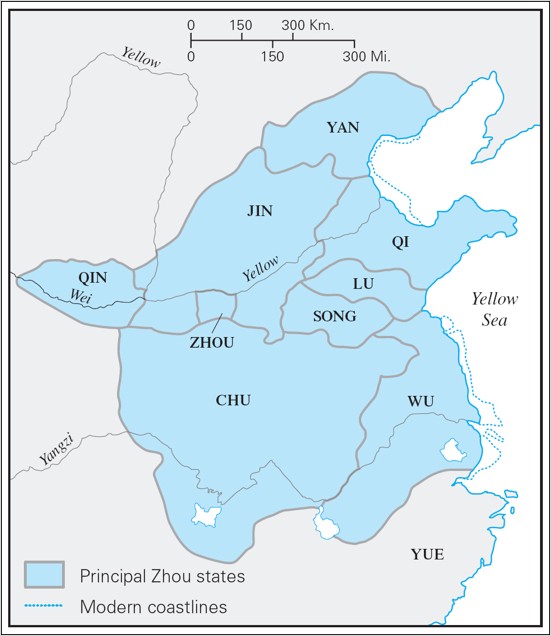
Qin (west) • Chu (south) • Zhao (north) • Wei (central) • Han (central) • Yan (northeast) • Qi (east)
The Warfare Revolution
From Aristocratic Chariots to Mass Infantry
Spring and Autumn
- Chariot warfare
- Elite aristocratic warriors
- Battles brief, ceremonial elements
- Casualties relatively low
Warring States
- Mass infantry armies
- Peasant conscripts
- Prolonged campaigns (months, years)
- Hundreds of thousands engaged
Chariot Warfare
During the Spring and Autumn period, states were ranked by how many hundreds of chariots they could deploy. A chariot typically carried three warriors: driver, archer, and halberdier.
Chariots were expensive - requiring horses, bronze fittings, and trained crews. This kept warfare an elite affair. Battles often began with champions challenging each other, and ceremonial rules governed conduct.
The Zuo zhuan records instances where commanders refused to attack an enemy crossing a river or forming ranks - such "honorable" conduct disappeared in the Warring States.
Conscription
Universal male military obligation - all adult male peasants required to serve in the army.
This was revolutionary: previously warfare was elite privilege. Now rulers needed to mobilize entire societies. This required:
- Population registers to track men
- Supply systems to feed armies
- Training programs for peasant soldiers
- Administrative systems to coordinate
The result: bureaucratic states that could project massive military force.
New Military Technology
The Crossbow
Crossbow technology spreads and rapidly improves during the Warring States
- Foot soldiers could kill aristocrats
- Minimal training required
- Penetrated armor at distance
- "Democratized" warfare
Iron Weapons & Armor
Widespread by 5th century BCE
- Cheaper than bronze
- Mass production possible
- Elite troops got iron armor, helmets
- Every soldier could be armed
The Crossbow Revolution
The crossbow's bronze trigger mechanism was a sophisticated engineering achievement. Unlike composite bows requiring years of training, crossbows could be taught in days.
One period text claimed: "A skilled soldier with a powerful crossbow and a sharp sword was the match for a hundred ordinary men."
States like Wei equipped elite troops with crossbows that could fire multiple bolts, shoulder armor, helmets, and three days' provisions - they could march 50 kilometers in a day.
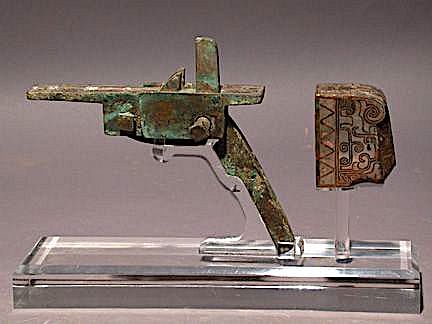
The Scale of Total War
Battle of Changping (260 BCE)
Qin vs. Zhao: Hundreds of thousands engaged over three years
Result: Zhao army surrendered; Qin allegedly executed 400,000 prisoners
Warfare Becomes Total
- Siege warfare develops: walled cities become targets
- Campaigns on multiple fronts simultaneously
- Entire societies mobilized for war
- Winner-take-all mentality: destroy rivals or be destroyed
Life in an Age of Fear
- States could disappear within a generation
- Families uprooted — refugees and displacement common
- Peasants conscripted for years at a time
- Old Zhou ritual norms collapsing
- Trust between states gone → diplomacy = manipulation
Why this matters: Philosophers aren’t debating in comfort — they are trying to solve how to survive social collapse.
The Birth of the Bureaucratic State
- Household registration to track population and labor
- Tax records to fund armies and state projects
- Land surveys to measure, allocate, and control territory
- Legal codes written and publicly enforced
- Standardized punishments applied across regions
Key idea: States stop being family networks and start becoming administrative machines.
Economic & Social Transformation
Economic Growth
- Iron agriculture increases production
- Larger populations supported
- Cities growing as power centers
- Money (bronze coins) circulating
Social Mobility
- Old certainties collapsing
- Merchants can become wealthy
- Talented individuals rise through service
- Family background matters less
Iron Agricultural Tools
Iron plows and tools spread during the Warring States period, dramatically increasing agricultural productivity.
Consequences:
- More land could be cultivated
- Food surplus supported larger populations
- Peasants could be taxed more heavily
- States had resources for larger armies
The same iron technology that made weapons also made tools - agricultural and military revolutions were connected.
Result: A dynamic, chaotic, opportunistic society where everything is up for grabs.
The Rise of the Shi Class
Old Aristocracy Declining
- Hereditary ranks mean less
- Military defeats destroy noble families
- Rulers need talent, not pedigree
The Shi Emerge
- Originally: lower-ranking aristocrats
- Now: educated men as advisors
- Could come from modest backgrounds
- Hired for expertise
士 Shi (shir) - The Scholar-Official Class
Originally 士 meant "knight" or "warrior" - the lowest rank of the hereditary aristocracy. During the Warring States, the term shifted to mean educated men who served as advisors, ministers, and officials.
Their expertise included:
- Military strategy
- Administration and taxation
- Diplomacy and rhetoric
- Philosophy and persuasion
Famous shi could move between states, seeking rulers who would adopt their ideas. The philosophers we study (Confucius, Mozi, Mencius, etc.) were all shi seeking patronage.
Itinerant Philosophers
- Shi travel between states selling their ideas
- Competition for good advisors drives "market" for solutions
- Rulers sponsor debates between rival thinkers
- Different philosophies = different strategies for surviving chaos
Next lecture: we'll meet these philosophers and their competing solutions.
The Hundred Schools of Thought
- Intellectual ferment: 6th–3rd centuries BCE (especially the 5th–3rd)
- "Schools" weren’t universities—more like networks of teachers, students, and texts
- Thinkers competed for patronage: ideas as statecraft
- Later historians organized this messy debate into named “schools” (useful labels, but imperfect)
- Shared problem: how to create order after Zhou authority fractures
Key insight: Political crisis produces intellectual creativity.
“Hundred” is a classical Chinese way of saying “many” or “a whole lot.”
The “schools” are partly later cataloging by historians — think intellectual genres more than locked-in political parties.
Many classic texts contain layers from different generations of thinkers, edited and expanded over time.
The Hundred Schools: What Are They Fighting Over?
- Human nature (xing 性): are people basically good, bad, or moldable?
- Good government: rule by virtue/ritual (li 禮) vs. law/punishment (fa 法)
- War & diplomacy: moral restraint vs. “win first, justify later”
- Social hierarchy: natural/necessary vs. harmful/constructed
- Language & reality: names/rectification — can bad words + bad categories wreck society?
Key takeaway: Same chaos, different diagnoses → different prescriptions.
Major Schools (and their “one weird trick”)
- Confucians (Ru): order through ritual + moral cultivation (better people → better politics)
- Mohists (Mo): order through impartial care, anti-war stances, and merit-based advancement — plus very practical tech and organization
- Daoists (Dao): order by not forcing things — skeptical of rigid social engineering
- Legalists (Fa): order through clear laws, incentives, and punishments (treat humans as predictable)
- Military strategists: war as a system — deception, logistics, terrain, morale
- “School of Names” (Mingjia): language and logic puzzles with political stakes (if names don’t fit realities, governance collapses)
- Yin–Yang / Five Phases thinkers: link politics to cosmic patterns — ideas that later feed into state ideology
Confucius 孔子
551–479 BCE
Life
- Born in Lu state
- Minor aristocratic background
- Served briefly in government
- Traveled teaching disciples
- Died believing he had failed
Legacy
- Disciples compiled Analects
- Most influential Chinese thinker
- Shaped East Asian civilization
The Analects 論語
"Selected Sayings" - conversations between Confucius and disciples, compiled after his death. Short, often cryptic passages. Not systematic philosophy but practical wisdom.
The Five Constant Virtues (Wu Chang 五常)
Confucian ethics is built on five enduring moral qualities that shape character and society.
Ren 仁 • Yi 義 • Li 禮 • Zhi 智 • Xin 信
These are not rules to memorize, but virtues to cultivate through everyday relationships.