⌨️ Keyboard Shortcuts
📚 Welcome to HIST 270!
Today we're starting at the beginning—China's first historically verified dynasty, the Shang. This lecture answers a fundamental question: How do we KNOW about ancient China? The answer involves a dramatic discovery story and two types of evidence working together.
🎯 Learning Goals for Today
Understand how archaeology + inscriptions = verified history (not myth)
See how Shang kings used ritual and divination to maintain power
Connect ritual objects (oracle bones, bronze vessels) to political authority
💡 Big Picture
The Shang weren't just making cool bronze art—they were creating a religious-political system where the king controlled access to the spirit world. This pattern (ruler as intermediary between humans and gods) will keep appearing in Chinese history.
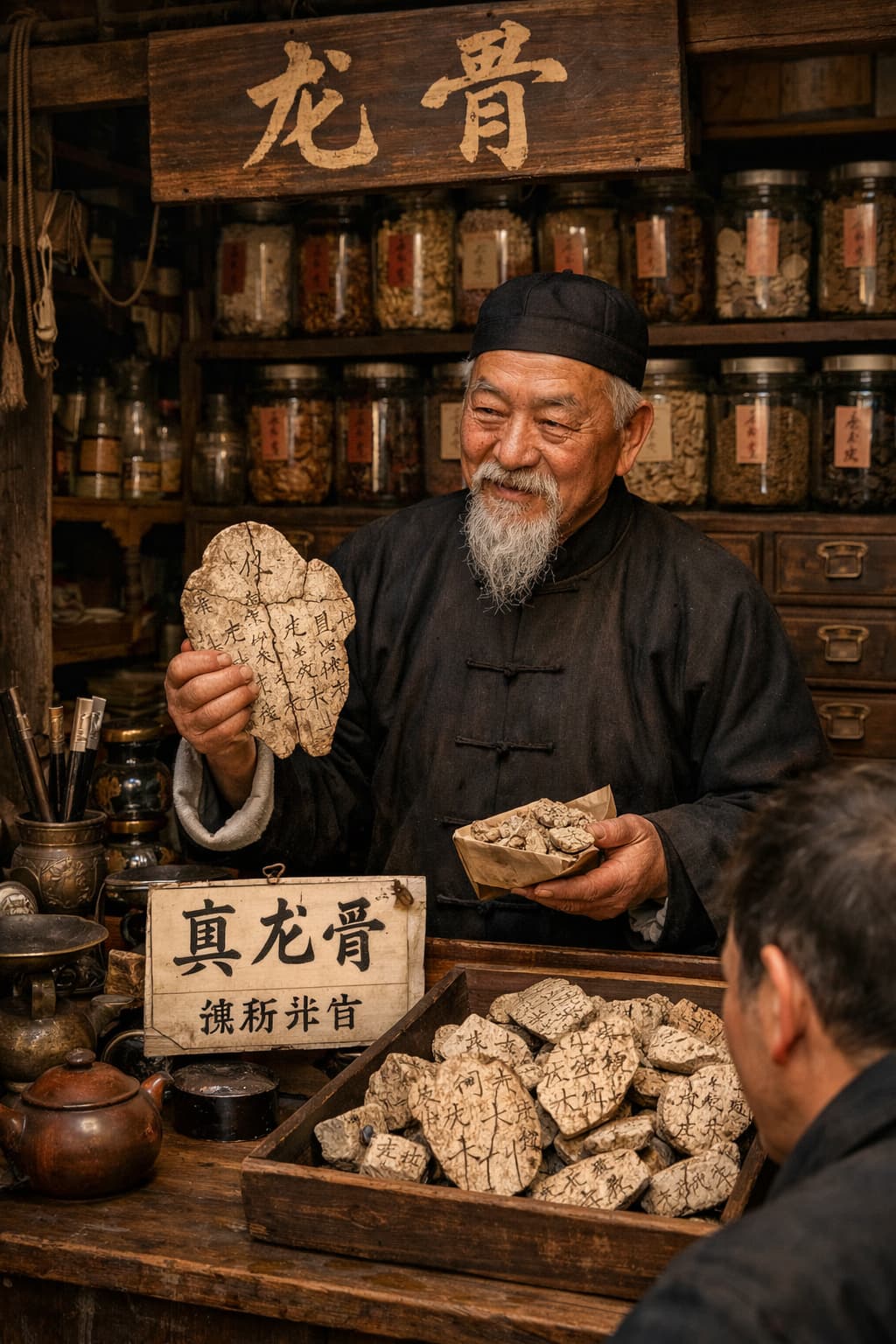
1899 : A Startling Discovery
was sick.
His doctor prescribed traditional medicine: powdered
Wang noticed something strange on the bone fragments...
📚 The Accidental Discovery
This slide sets up one of archaeology's most remarkable stories—how a sick scholar's trip to the pharmacy led to the rediscovery of China's oldest verified writing system.
🎯 Key Points to Emphasize
Wang Yirong wasn't just any patient—he was a trained epigrapher (expert in ancient inscriptions)
The irony: ancient artifacts were being literally consumed as medicine for centuries
Traditional Chinese pharmacies had unknowingly destroyed countless oracle bones over time
💡 Why This Matters
This discovery fundamentally changed our understanding of early Chinese civilization. Before 1899, the Shang Dynasty was considered semi-legendary. The oracle bones provided direct, material evidence of Shang society, religion, and—crucially—the earliest form of Chinese writing.
🎓 Teaching Strategy
Build suspense here! Don't reveal what he saw yet. Let students wonder: what could possibly be written on old bones from a pharmacy?
Oracle Bones Explained
VIDEO
Watch this 3-minute introduction to oracle bone divination
🎥 Video Summary
This video explains how Shang kings used oracle bones for divination. Key points students should catch:
Bones came from oxen or turtle shells (turtle plastrons)
Diviners carved questions, then heated the bones until they cracked
The pattern of cracks was "read" as the ancestors' answer
Questions covered warfare, harvests, sacrifices, weather, childbirth
🔗 Connection to Power
Only the king could perform these divinations—this gave him a monopoly on communicating with the spirit world. If you want to know if your harvest will succeed or if you should go to war, you NEED the king's help.
A Note on Dates
Before we go further, an important caveat:
The beginnings of Shang and Western Zhou are approximate (ca. 1500 BCE, ca. 1045 BCE).
end dates are firmer because they're recorded in later texts.
We're doing the best we can with archaeological + textual evidence!
📅 Why Dates Are Fuzzy
Ancient Chinese chronology is tricky. We don't have contemporary documents saying "The Shang Dynasty began on X date." Instead, historians use:
Archaeological evidence: Carbon-14 dating, pottery styles, bronze technologyLater texts: The Bamboo Annals, Records of the Grand Historian (written 1000+ years later)Astronomical records: Eclipse mentions that can be dated
🎓 Scholarly Debate
Different scholars propose different dates for the Shang's founding. The "ca. 1500 BCE" is a rough consensus, but you'll see variations (1600 BCE, 1556 BCE, etc.) in different books. That's normal in ancient history!
Geography of the Chinese Subcontinent
To understand WHERE the Shang developed, we need to see the big picture:
🗺️ The Big Picture
China is sometimes called a "subcontinent" (like India) because it's partially isolated by natural barriers. This affected how Chinese civilization developed—with less contact with other ancient civilizations compared to, say, the Mediterranean world.
🏔️ Natural Barriers
Himalayas & Kunlun Mountains (west/southwest): World's highest mountains, extremely hard to crossGobi & Taklamakan Deserts (north/northwest): Harsh, dry, dangerous to crossPacific Ocean (east): Until much later, no major seafaring neighbors
💡 Why This Matters
These barriers meant Chinese civilization developed somewhat independently. Unlike Egypt, Mesopotamia, Greece, and Rome (which constantly interacted), early China had fewer external influences. We'll see later that technologies like chariots and bronze-working probably came from the west, but the pace of exchange was slower.
Two Great River Systems
Yellow River (North)
— fertile, easy to work
Millet agriculture (dry farming)This is where Shang developed!
Yangtze River (South)
Wetter, warmer climate
Rice agriculture (wet farming)Different cultures (Lecture 3 topic!)
🌾 Agricultural Foundations
The north-south split in Chinese agriculture is HUGE and persists to this day. Northern China (Yellow River valley) grows wheat and millet. Southern China (Yangtze valley) grows rice. This creates different cuisines, different labor patterns, different settlement types.
🏺 Why the Yellow River for Shang?
Loess soil was perfect for early agriculture. You didn't need advanced plows or irrigation systems—just scratch the surface and seeds would grow. This allowed dense agricultural settlements to develop, which created the population base for complex states like Shang.
📍 Where Was Shang?
The Shang heartland was in what's now Henan Province, along the middle reaches of the Yellow River. The last Shang capital was at Anyang (modern name), where most oracle bones were found.
⏸ Pause & Process
Geography Check & Refocus
Partner Activity (60 seconds):
Turn to a neighbor and explain why the Yellow River valley became the Shang heartland. Use at least two geographic factors we just discussed.
I'll call on someone in a moment to share!
⏸ Pause & Process Instructions
What you're doing (2 minutes total):
Give students 60 seconds to talk with a partner
Circulate and listen to 2-3 pairs
Call on one student: "What's one barrier that isolated early China?"
Validate answer, then refocus: "Good! Now we're moving from WHERE the Shang developed to HOW we know about them. Eyes up here."
✅ Expected Answers
Students should mention: loess soil (fertile + easy to work), Yellow River (water source), good climate for millet, natural barriers creating isolation, etc.
🎯 Purpose
This break serves three functions: (1) checks comprehension of geography section, (2) resets attention after 15 minutes of lecture, (3) transitions from "where" to "how we know."
"How We Know" Checkpoint
The Shang is China's first historically verified dynasty.
What does "historically verified" mean?
Before Shang: Legendary
Xia Dynasty — mentioned in later texts, but no archaeological proof (yet!)
Shang: Verified!
Archaeology (Anyang ruins) Inscriptions (oracle bones) Real history
🔍 What Makes History "Real"?
This is a crucial methodological point. Historians distinguish between:
Legendary/mythical: Known only from later texts (which might be making stuff up)Historically verified: Confirmed by contemporary evidence (archaeology, inscriptions)
📜 The Xia Problem
Chinese historical texts say there was a Xia Dynasty before the Shang (traditionally 2070-1600 BCE). Some archaeological sites might be Xia, but we haven't found inscriptions saying "I am King X of the Xia Dynasty." So historians remain cautious.
✅ Why Shang Is Different
With Shang, we have:
Oracle bones with king names that match later historical records
Massive palace foundations at Anyang
Royal tombs with incredible bronze vessels
Contemporary evidence, not just stories written 1000 years later
🎓 Critical Thinking
This teaches students to ask: "How do we KNOW this?" It's the foundation of historical method—don't just believe what you read, demand evidence!
Shang Kings and the Spirit World
The Shang king wasn't just a political leader—he was a religious specialist :
Only the king could perform oracle bone divination
He communicated with Di (high god) and royal ancestors
The king = intermediary between humans and spirits
👑 Religious Monopoly = Political Power
Think about how clever this system is. If you're a Shang noble or farmer and you want to know:
Will my army win this battle?
Will the harvest be good?
Will my wife survive childbirth?
Should I offer sacrifices?
You NEED the king. He's the only one who can ask the ancestors and interpret their answers. This gives him enormous power—not just military or economic, but spiritual authority.
🔮 Oracle Bone Questions
Actual oracle bone inscriptions show questions like:
"If we attack the Qiang people, will we receive assistance?"
"Will there be disaster this year?"
"Should the king perform a rain sacrifice?"
"Lady Hao is giving birth—will it go well?" (Spoiler: it did! Lady Hao was a famous Shang queen/general)
💭 Comparison
This is similar to how Egyptian pharaohs claimed to be gods or sons of gods. But Shang kings didn't claim to BE divine—they claimed to have a special RELATIONSHIP with the divine. Subtle but important difference.
Bronze Vessels: Ritual Technology
Bronze wasn't just for making weapons—it was ritual technology :
Used in ancestor worship ceremonies
Held food and wine offerings to deceased ancestors
Displayed wealth and power of the elite
Required skilled craftsmen (bronze workers, designers)
🏺 What Are Bronze Ritual Vessels?
The Shang made elaborate bronze containers in various shapes, each with a specific ritual purpose:
Ding: Three-legged cauldrons for cooking meat offeringsJue: Tripod cups for heating and pouring wineGu: Tall beakers for drinking ritual wineZun: Wide vessels for serving wine
⚒️ Technological Marvel
Making these required incredible skill:
Mining copper and tin ore
Smelting at very high temperatures
Mixing exact ratios (usually 90% copper, 10% tin)
Creating clay molds with intricate designs
Casting (pouring molten bronze into molds)
Finishing and polishing
💰 Status Symbols
The number and size of bronze vessels you owned showed your status. A king might have hundreds. A minor noble might have a few. Commoners had none—they used pottery. When you died, your bronzes were buried with you to continue ancestor worship in the afterlife.
🔗 Connection to Power
Control over bronze production = control over ritual = control over spiritual power. The king controlled the bronze workshops, so he controlled who got access to ritual objects. It's all connected!
Evidence from Anyang
Archaeological excavations at Anyang (last Shang capital) revealed:
🏛️ Anyang (Yinxu)
Anyang was the last Shang capital (ca. 1300-1046 BCE). The archaeological site is called Yinxu ("Ruins of Yin"—Yin was the Shang's name for their capital). Excavations began in 1928 and continue today.
🔍 What Archaeologists Found
Palace foundations: Massive rammed-earth platforms (some 300+ feet long)Royal tombs: Cross-shaped underground chambers with elaborate grave goodsOracle bone pits: Tens of thousands of inscribed bones and shellsBronze workshops: Evidence of large-scale craft productionHuman sacrifices: Thousands of skeletons in sacrificial pits
💀 The Dark Side: Human Sacrifice
This is hard to talk about, but it's historically important. Shang elites practiced human sacrifice on a large scale:
Retainers buried alive with deceased kings (to serve them in afterlife)
War captives sacrificed to ancestors
Foundation sacrifices (people buried under buildings for spiritual protection)
This tells us about extreme social hierarchy—some lives were considered expendable to serve the elite.
Royal Tombs: A Window into Hierarchy
Shang royal tombs contained:
Bronze ritual vessels (hundreds in some tombs)Jade ornaments and weapons
Chariots with horses
Human sacrifices — retainers, war captivesEvidence of elaborate burial rituals
This reveals extreme social stratification — life and death determined by birth status.
👸 Case Study: Tomb of Fu Hao (Lady Hao)
One of the best-preserved Shang tombs belongs to Fu Hao, a consort of King Wu Ding (ca. 1200 BCE). Her tomb was discovered INTACT in 1976—a rare find!
🏺 What Was in Fu Hao's Tomb?
Over 460 bronze objects (ritual vessels, weapons, tools)
750+ jade objects
Nearly 7,000 cowrie shells (used as currency)
16 human sacrifices
6 dogs
⚔️ Fu Hao Was Remarkable
Oracle bone inscriptions reveal Fu Hao wasn't just a queen—she was a GENERAL who led armies of 13,000 soldiers! This shows that Shang gender roles weren't identical to later Chinese dynasties. Elite women could hold significant power.
💡 What This Tells Us
The wealth in these tombs is staggering. It required:
Extraction of surplus wealth from farmers
Specialized craftsmen (bronze workers, jade carvers)
Complex social organization
Belief system justifying this inequality (ancestor worship, divine kingship)
Chariot Warfare and Military Aristocracy
Chariots were a game-changing military technology:
Mobile platforms for archers
Psychological weapon (speed, noise, intimidation)
Expensive — only elites could afford them
Note: Chariot technology likely transmitted from Central Asia/steppe
🐴 Chariot Technology
Shang chariots were sophisticated war machines:
Two-wheeled vehicles pulled by two horses
Crew of 3: driver, archer, and defender (with shield/spear)
Bronze fittings and decorations
Spoked wheels (engineering marvel for the time)
🌍 Where Did Chariots Come From?
This is a scholarly debate! The chariot appears across Eurasia around the same time (2000-1500 BCE)—in the Near East, Central Asia, and China. Most scholars think the technology spread from west to east via the steppes, possibly through trade or migration. But we don't have a clear "chain of transmission," so it remains a plausible hypothesis rather than proven fact.
⚔️ Chariots = Elite Warfare
Chariots were EXPENSIVE:
Breeding and training war horses
Building the chariot (skilled woodworkers, bronze smiths)
Training the crew (years of practice)
Maintaining equipment
This created a military aristocracy—only nobles could afford chariot warfare. They dominated the battlefield and used this to maintain social power.
🔗 Big Picture Connection
Chariot technology is one of the few clear examples of Shang China interacting with the broader Eurasian world. Most Shang culture developed indigenously, but they weren't completely isolated.
Complex State Organization
Archaeological evidence reveals sophisticated craft specialization :
Specialized Occupations
Bronze workers
Jade carvers
Pottery makers
Diviners/priests
Scribes
Architects
What This Means
Complex state organization
Surplus agricultural production
Urban centers (Anyang)
Social stratification
Centralized authority
🏛️ Signs of a Complex State
When historians/archaeologists talk about a "complex state" or "civilization," they look for:
Specialization: Not everyone is a farmer—some people are full-time craftsmen, priests, soldiers, etc.Urbanization: Cities exist with concentrated populationsMonumental architecture: Large buildings requiring coordinated laborWriting system: For record-keeping and communicationSocial hierarchy: Clear class divisionsCentralized authority: A king or ruling class that organizes society
The Shang had ALL of these!
🌾 The Agricultural Base
All this specialization requires surplus food production. Farmers had to grow MORE than they needed to feed themselves so that bronze workers, priests, soldiers, etc. could eat without farming. This surplus was extracted through taxation, tribute, or forced labor.
📝 Literacy = Power
Oracle bone script was an early form of Chinese writing. Being literate was a rare, elite skill. Scribes were essential for:
Recording divinations
Keeping accounts
Transmitting royal commands
Knowledge = power, and literacy gave scribes special status.
⏸ Pause & Process
Comprehension Check & Stretch
Quick Write (90 seconds):
On a piece of paper: List three pieces of evidence that tell us the Shang had a complex, hierarchical society.
(This won't be collected—just for your own thinking!)
Then: Stand up and stretch for 15 seconds!
⏸ Pause & Process Instructions
What you're doing (3 minutes total):
Give 90 seconds silent writing time
Call on 2 students to share one piece of evidence each
Validate answers: "Yes! Bronze vessels show craft specialization AND ritual importance. Good thinking."
Physical break: "Everyone stand, stretch for 15 seconds."
Refocus: "Sit back down. The Shang seemed powerful—oracle bones, bronze, chariots, huge tombs. So what happened? Why did they fall?"
✅ Expected Answers
Students might mention: bronze vessels, oracle bones, royal tombs, human sacrifice, chariot warfare, palace foundations, craft specialization, writing system, etc. Any of these work!
🎯 Purpose
This break: (1) checks if they absorbed the Shang society material, (2) gives a physical reset after sitting 37 minutes, (3) transitions to the "Shang collapse" section.
Why Did the Shang Fall?
The Shang Dynasty ended around 1045 BCE when the Zhou conquered them.
Traditional Account (Zhou Version)
The last Shang king, Di Xin , was a cruel tyrant:
Excessive cruelty and torture
Extravagant lifestyle while people suffered
Ignored wise advisors
Lost the favor of Heaven and ancestors
Grain of salt: This is victor's history written by the Zhou!
📜 The "Evil Last King" Trope
Chinese historical texts paint Di Xin as a monster—torturing officials, throwing lavish parties while people starved, building a "Lake of Wine" and "Forest of Meat," etc. Classic villain stuff!
🤔 Skepticism Required
But historians are suspicious. Why? Because EVERY dynasty that conquers another writes the same story: "The last king was TERRIBLE, so we HAD to overthrow him!" It's a way to justify conquest and make yourself look like a hero rather than a conqueror.
💭 Critical Thinking
Think about it: If you just violently overthrew a 500-year dynasty, wouldn't you want to convince everyone it was justified? The easiest way is to make the last king sound like history's worst tyrant.
🎓 Scholarly Approach
Modern historians take these accounts with skepticism. Di Xin might have been a bad king, or he might have been perfectly fine and just lost a war. We don't have Shang sources defending him, only Zhou sources attacking him. That's a problem!
Alternative Explanations
Historians propose other factors beyond "bad last king":
Coalition politics: Zhou allied with disaffected Shang nobles who had grievances against the royal houseMilitary pressure from multiple fronts: Shang faced threats from various directions, not just the ZhouZhou strategic positioning over generations: The Zhou built power in the Wei River valley, forming alliances and waiting for the right momentPossible internal instability: Succession disputes, economic problems, or social tensions we don't fully understand
🎯 More Nuanced Understanding
The truth is probably complex—a combination of factors rather than one simple cause. This is typical in history!
🤝 Coalition Building
The Zhou didn't just show up and conquer. They spent generations building alliances with:
Disaffected Shang nobles (people who felt the king wronged them)
Neighboring states who resented Shang dominance
Their own Wei River valley power base
When they finally struck, it was coordinated and well-planned.
🗺️ Geography Matters
The Zhou heartland was in the Wei River valley (modern Shaanxi Province), west of the Shang core. This gave them a secure base to build strength before challenging Shang power.
💡 Lesson for Students
Be suspicious of simple explanations in history. "The king was bad so the dynasty fell" is too easy. Real historical causation is messy, multi-faceted, and often unknowable in full detail.
The Zhou's Big Problem
The Zhou conquered the Shang around 1045 BCE .
But now they faced a legitimacy crisis :
"How do you convince everyone you deserve to rule when you just violently overthrew a dynasty that claimed gods approved their kingship?"
The Zhou's solution: The Mandate of Heaven
We'll explore this revolutionary concept in our next lecture...
🎯 Setting Up Next Lecture
This is the perfect cliffhanger. The Zhou have just conquered China, but they have a PROBLEM: political legitimacy. How do you make people accept your rule when you got it through force?
💡 The Mandate of Heaven Preview
The Zhou's answer was brilliant—they invented (or at least formalized) the concept of the Mandate of Heaven. This idea will dominate Chinese political philosophy for 3,000 years, so it's worth building anticipation!
🔗 Thematic Thread
Notice the pattern: Shang kings claimed special access to ancestors and gods → Zhou needed a different justification → Mandate of Heaven. We're watching political ideology evolve in response to practical problems.
Summary: The Shang Dynasty
Key Takeaways
Historically verified through archaeology + inscriptionsKing = religious intermediary
Oracle bones + bronze vessels = ritual technology
Complex, hierarchical society
Chariot warfare (military aristocracy)
Fell to Zhou ca. 1045 BCE
Big Questions
How do we KNOW about the past?
How does ritual create political power?
What makes a state "complex"?
How do victors write history?
Next time: The Zhou Dynasty and the Mandate of Heaven
🎓 Wrapping Up
Use this slide to reinforce the main points and transition students to thinking about next lecture. The "Big Questions" column is especially important—these are transferable critical thinking skills, not just Shang-specific facts.
📝 Study Tips for Students
If students ask what to focus on:
Understand WHY Shang is "historically verified" (archaeology + inscriptions)
Know the relationship between ritual and political power
Be able to explain oracle bone divination
Understand bronze vessels as ritual technology, not just art
Think critically about "victor's history" problem