The Civil War (1861–1865)
Why the Union Won and What the War Did to America
HIST 101 — United States to 1877
The Civil War's Central Question
- Why did the Union win a war it was losing early?
- How did the war transform the nation?
- Political, military, social, and moral dimensions intertwine
- War as both national rupture and national rebirth
SECTION I
The Road to War
Long-Term Causes
- Expansion of slavery divides every national debate
- Failure of compromises (Missouri, Compromise of 1850)
The Slavery Question
By 1860, slavery defined American politics. The question wasn't just whether slavery should exist, but whether it would expand into new territories.
- Economic: Enslaved people were America's largest financial asset
- Political: Balance of free/slave states determined Senate and presidency
- Social: Shaped race relations, class, regional identities
- Moral: Increasingly seen as sinful (North) or divinely ordained (South)
Political Collapse of the 1850s
- Kansas-Nebraska Act shatters the old party system
- National parties replaced by sectional parties
- Violence in "Bleeding Kansas" and Congress
- Dred Scott and John Brown radicalize both sides
Kansas-Nebraska Act (1854)
Senator Douglas proposed "popular sovereignty" for Kansas and Nebraska territories, repealing the Missouri Compromise line.
Consequences: Destroyed the Whig Party, created the Republican Party, led to violent conflict in Kansas, convinced Northerners of "Slave Power conspiracy."
Election of 1860: The Breaking Point
- Four-way race fractures national politics
- Lincoln wins without Southern electoral votes
- Southern states see permanent minority status
- Secession begins within weeks
Secession Winter 1860–61
SECTION II
Early War: Overconfidence & Reality
"On to Richmond!" or First Bull Run (Manassas)
July 21, 1861
- Americans expect a short war
- Confederate victory shocks the North
- Demonstrates inexperience on both sides
- War becomes a long struggle
Early Union Struggles
- McClellan's caution slows momentum
- Poor coordination between armies
- Limited goals: restore Union, not end slavery
- Confederate morale and leadership advantage
Early Confederate Advantages
- Strong officer corps and early unity
- Defensive strategy fits Southern terrain
- High early enlistment and confidence
- Cotton diplomacy hopes for European aid
SECTION III
Turning the Tide (1862–63)
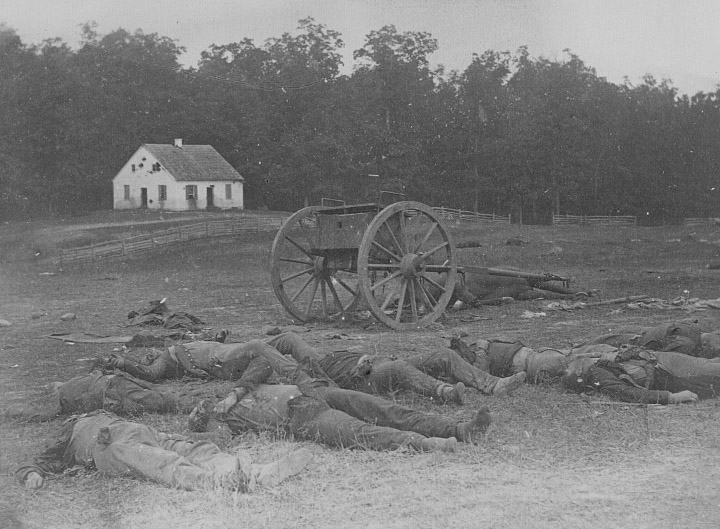
Antietam: Bloodiest Day
(Sharpsburg)
September 17, 1862
- Lee invades the North
- Tactical stalemate but strategic Union victory
- Lincoln gains opportunity for Emancipation
- Ends Confederate hopes for foreign recognition
Emancipation Proclamation
January 1, 1863
- Reframes the war around slavery
- Undermines Confederate labor system
- Prevents European intervention
- Opens enlistment to Black soldiers
Gettysburg & Vicksburg (1863)
Twin Turning Points - July 1863
Gettysburg (July 1-3)
- Lee's second invasion halted
- 51,000 casualties
- Pickett's Charge fails
- Lee never recovers strength
Vicksburg (July 4)
- Union controls Mississippi River
- Splits Confederacy in two
- Grant emerges as top general
- Opens Deep South to invasion
SECTION IV
Total War & The Home Front
War Becomes a National Effort
- Drafts and mass mobilization
- New taxes and national banking system
- Railroads and industry power the Union
- Enormous logistical demands
Northern Advantages Solidify
- Superior industrial output
- Larger population and immigrant manpower
- Greater financial capacity
- Effective naval blockade
Social Upheaval
- Women enter nursing and wartime industries
- Food shortages and inflation in the South
- Enslaved people flee plantations
- War reshapes daily life on both fronts
War as Social Revolution
- Collapse of slavery becomes inevitable
- Union armies act as agents of emancipation
- Southern social order destabilizes
- New definitions of freedom emerge
SECTION V
Endgame
Union Strategy Under Grant
- Coordinated offensives across all theaters
- War of attrition strains Confederate resources
- Relentless pressure on Lee's army
- Goal: destroy capacity to resist
Sherman's March
- March to the Sea targets infrastructure
- Breaks Confederate morale
- Psychological warfare as strategy
- Shows the shift to total war
Collapse of the Confederacy
SECTION VI
Legacy
The Human Cost
- ~750,000 deaths reshape the nation
- Wounded and amputee population enormous
- National cemeteries created
- Trauma becomes part of public memory
A New Birth of Freedom
- Slavery abolished; freedom's future contested
- Federal power dramatically expanded
- Black citizenship struggles begin immediately
- Reconstruction emerges from wartime debates
Competing Memories
- Union narrative vs. Lost Cause mythology
- Battle over meaning begins immediately
- Memory wars shape textbooks and monuments
- Legacy still contested today
Lost Cause Mythology
Post-war interpretation created by white Southerners to justify Confederacy and maintain white supremacy.
Claims: War was about states' rights, not slavery. Slavery was benevolent. Confederate soldiers were heroes. South lost only due to numbers. Reconstruction was corrupt disaster.
Reality: Confederate leaders explicitly said they seceded to preserve slavery.
Closing Question
Did the Union win the war but lose the peace?
The Confederacy was defeated militarily, but many of the ideas it fought for—white supremacy, racial hierarchy—survived and shaped the post-war South.
Next lecture: Lost Cause Historiography: Myth, Memory, and Power