Section I
French rule, the road to partition, Diem, the coup, and Westmoreland's war
Vietnam Under French Rule, 1858–1954
- France conquered Vietnam, Laos, and Cambodia piecemeal between 1858 and 1893, consolidating them into a single colonial federation it called French Indochina
- Colonial economy: rubber, rice, and coal extraction for French markets; Vietnamese barred from most professional and administrative roles
- Nationalist resistance never ceased — multiple uprisings suppressed in the 1900s, 1930s, and 1940s
- Ho Chi Minh founded the Viet Minh in 1941 — a nationalist coalition that was simultaneously communist-led
- WWII: Japan occupied French Indochina (1940–1945); France largely collaborated; the Viet Minh fought Japan with support from the Office of Strategic Services (OSS) — the U.S. wartime intelligence agency and predecessor to the CIA

French Indochina · 1887–1954 · Vietnam, Laos, Cambodia
Dien Bien Phu: The End of French Indochina
- First Indochina War (1946–1954): France vs. the Viet Minh — a guerrilla war France could not win on Vietnamese terms
- March–May 1954: French forces fortified a remote valley at Dien Bien Phu to draw the Viet Minh into conventional battle
- Viet Minh General Vo Nguyen Giap surrounded the garrison with artillery — dragged up jungle mountains by hand — and cut off the French position
- French garrison surrendered May 7, 1954 — 11,721 prisoners taken; Geneva Accords signed two months later
- Eisenhower refused to intervene — no U.S. air strikes, no combat troops
The first time a European colonial power was defeated militarily by an Asian independence movement in the modern era

Dien Bien Phu · French garrison position · March–May 1954
The Geneva Settlement, 1954
- Temporary partition at the 17th parallel — North Vietnam (communist) and South Vietnam (non-communist)
- ~900,000 Catholics and anti-communists fled south; ~130,000 Viet Minh cadres moved north
- Nationwide elections promised for 1956 to reunify the country under one government
- Elections never happened — Diem, with U.S. backing, refused, calculating Ho Chi Minh would win decisively
- "Temporary" division hardened into permanent confrontation
By cancelling the elections, Saigon handed North Vietnam a permanent propaganda weapon — and a justification for armed reunification

Vietnam divided at the 17th parallel · Geneva Accords, 1954
The American Commitment, 1950–1960
Already Entangled
- The U.S. was not a bystander during the French war — by 1954 America was funding roughly 80% of France's war costs
- U.S. Military Assistance Advisory Group (MAAG) in Indochina from 1950 — advisers helping the French train Vietnamese national forces
- When France collapsed at Dien Bien Phu, the U.S. inherited an entanglement, not a blank slate
- China fell to communism (1949); Korea proved communist states would use military force to absorb divided neighbors (1950–1953)
- Domino theory: if South Vietnam fell, Laos, Cambodia, Thailand, and beyond were at risk
Eisenhower's Response
- Committed ~700 military advisers to train South Vietnamese forces
- Provided economic and military aid to Saigon
- Backed Diem's government as the viable non-communist alternative
- Drew a firm line: no combat troops, no intervention to rescue the French
- Judgment: the strategic interest was real — but a ground war in Asia was unwinnable on favorable terms
The Insurgency Takes Hold, 1954–1960
North Vietnam's Strategy
- Hanoi organized southern communist sympathizers — many Viet Minh veterans who stayed south after 1954 — into the National Liberation Front (NLF)
- Americans called them the Viet Cong — South Vietnamese communists
- NLF tactics: selective assassination of government officials, tax collection, political organizing in villages
- By 1960: large areas of the South Vietnamese countryside effectively outside Saigon's control
Kennedy's Inheritance
- January 1961: Kennedy took office with the insurgency already serious and growing
- Eisenhower's 700 advisers were clearly insufficient — the question was what came next
- Kennedy escalated to ~16,000 advisers and authorized counterinsurgency programs
- Then made the decision that made everything worse: the 1963 coup against Diem
The insurgency Kennedy inherited was manageable — the political chaos his administration created was not
Who Were We Actually Fighting on the Ground?
The Real Enemy, 1965–1968
- For most U.S. troops in the field, the primary enemy was the Viet Cong — South Vietnamese communists, not Northern invaders
- They lived among the civilian population — in the same villages, farming the same land
- Wore the same black peasant clothing as everyone else — no uniforms, no insignia, no way to identify them visually
- Fought as guerrillas: hit-and-run attacks, booby traps, mines, assassinations — then disappeared back into the villages
The Defining Problem
- American soldiers often could not tell friend from foe — the farmer in the field and the Viet Cong fighter were frequently the same person
- "How do you tell who the enemy is?" became the central tactical problem of the war
- A village that seemed peaceful by day could harbor fighters, weapons caches, and tunnel networks by night
- This reality drove the logic of free-fire zones, search-and-destroy, and — at its worst — My Lai
Ngo Dinh Diem: The Revisionist Case
- Standard portrait: autocratic, unpopular Catholic mandarin who alienated the Buddhist majority and made South Vietnam an illegitimate U.S. client state
- Archival evidence tells a different story: capable and patriotic leader who built a functioning government from essentially nothing after 1954
- Defied American advisers on multiple occasions — not a puppet
- Strategic Hamlet program showed genuine counterinsurgency promise before being undermined by flawed American implementation

Ngo Dinh Diem · President of South Vietnam, 1955–1963 · Public Domain
The Strategic Hamlet Program, 1962–1963
The Concept
- The government moved rural villagers into fortified, walled settlements — cutting off the Viet Cong from the food, recruits, and intelligence they drew from the countryside
- Core logic: separate the population from the insurgency — and the insurgency starves
Promise, then Collapse
- ~8.7 million South Vietnamese enrolled by mid-1963 — measurable Viet Cong disruption where implemented carefully
- American pressure drove construction far faster than security could follow — many hamlets fortified in name only
- In some areas — notably Cu Chi district near Saigon — hamlets were built directly above existing Viet Cong tunnel networks; the enemy could emerge inside the perimeter at night and vanish by dawn
- November 1963: Diem and Nhu killed in the coup — program lost its leadership and collapsed within months
The Buddhist Crisis — Why the Coup Happened
- June 11, 1963: Buddhist monk Thích Quảng Đức burns himself to death at a Saigon intersection — protesting the Huế Vesak shootings of May 8, in which government forces killed nine Buddhists for flying religious flags that Catholic officials had just flown freely
- Seven more self-immolations followed — the images dominated American press coverage for months
- Diem's sister-in-law publicly called the immolations "barbecues" — accelerating the press narrative that Diem was a callous persecutor of Buddhism
- American journalists convinced Washington that Diem had lost the population and was losing the war
- Kennedy advisers concluded Diem was a political liability — and began signaling to South Vietnamese officers that a change of government would not be opposed

Thích Quảng Đức · Saigon · June 11, 1963 · Photo: Malcolm Browne / AP
The Coup of November 1, 1963
- South Vietnamese military officers overthrew and murdered Diem and Nhu
- Carried out with explicit encouragement from U.S. State Department and CIA
- Kennedy was reportedly shocked by the murders — he had authorized the coup, not the killings
- Kennedy himself assassinated three weeks later
- 11 different governments in South Vietnam between 1963 and 1966
- Political chaos allowed North Vietnam to consolidate its position
- Viet Cong expanded countryside control during the instability
- Strategic Hamlet Program collapsed without Diem and Nhu's leadership
- Directly caused the escalation that followed
Dean Rusk on the Coup
as quoted in Mark Moyar, Triumph Forsaken (2006)
Westmoreland's Strategy, 1965–1968
- General William Westmoreland — commander of U.S. forces in Vietnam (Military Assistance Command, Vietnam — MACV), 1964–1968; decorated WWII and Korea veteran who applied conventional military doctrine to an unconventional war
- Large-unit search-and-destroy operations — find, fix, and destroy enemy main-force units
- Attrition logic: kill the enemy faster than it can be replaced
- Won virtually every major engagement — but failed to produce strategic progress
- McNamara's metrics: body counts, kill ratios, pacification percentages rewarded favorable statistics, not strategic objectives

Gen. William Westmoreland · MACV Commander, 1964–1968 · Public Domain
⏸ Pause & Reflect
McNamara managed the war through body counts, kill ratios, and pacification percentages — a system that rewarded favorable statistics rather than strategic progress.
What does this approach assume about how military success translates into political outcomes? What would a fundamentally different approach require?
Section II
A military disaster misread as defeat — and the war that was actually won
Tet 1968: Two Realities
- January 30–31, 1968: North Vietnam and Viet Cong launched simultaneous attacks on 100+ cities and towns
- Expected popular uprising did not materialize
- Viet Cong suffered 40,000–58,000 killed — never recovered
- South Vietnamese forces performed creditably; cleared attackers within weeks
- North Vietnam's political objective — collapse Saigon — failed completely
- TV cameras filmed the chaos of the first days — Embassy compound breach, Saigon street chaos
- Cronkite declared a "stalemate" — factually wrong at the moment he said it
- Johnson: "If I've lost Cronkite, I've lost Middle America"
The Most Trusted Man in America
CBS Evening News editorial, February 27, 1968

Walter Cronkite · CBS News · 1966 · Public Domain
1968: The Year the War Came Home
The Political Unraveling
- February 27: Cronkite declares stalemate — Johnson reportedly says "If I've lost Cronkite, I've lost Middle America"
- March 31: Johnson shocks the nation — announces he will not seek re-election and halts bombing of North Vietnam
- April 4: Martin Luther King assassinated — riots in 110 cities
- June 5: Robert F. Kennedy assassinated the night he wins the California primary
- August: Democratic National Convention in Chicago — police clash with anti-war protesters on national television
Nixon and the Election
- Richard Nixon wins the presidency in November 1968 — promising "peace with honor" and a secret plan to end the war
- The American public was exhausted — they wanted out, but not humiliation
- Nixon's answer: don't abandon South Vietnam — transfer the fighting to the South Vietnamese
- The policy would be called Vietnamization
Vietnamization: Building a War to Hand Off
The Policy
- Nixon's answer to the war: build up South Vietnamese forces — the Army of the Republic of Vietnam (ARVN) — so American troops could come home
- ARVN massively expanded, re-equipped with modern weapons including M-16 rifles, and retrained under American advisers
- The logic: South Vietnam should be able to defend itself with American material support — without American combat troops
- Announced by Nixon, June 1969 — first U.S. troop withdrawals begin
The Withdrawal
- 543,000 U.S. troops in Vietnam at peak (1968)
- 156,000 by end of 1971
- 49,000 by end of 1972
- Paris Peace Accords, January 1973 — last U.S. combat troops withdrawn
- American military advisers and airpower remained available — until Congress cut them off
Vietnamization was not abandonment — it was a transfer of responsibility that depended on continued American material support to work
General Abrams: A Different War
- General Creighton Abrams — Westmoreland's replacement as MACV commander, June 1968; Patton's favorite tank commander in WWII, regarded by peers as the superior battlefield soldier
- "One war" concept: military operations, pacification, and Vietnamization integrated into a single strategy
- Central objective: population security — not body counts
- Hamlet Evaluation System reoriented; correlated with measurable Viet Cong infrastructure decline

Gen. Creighton Abrams · MACV Commander, 1968–1972 · Public Domain
The 1972 Easter Offensive
- Most massive conventional assault of the war
- 14 divisions and 200 tanks
- Intended to deliver a knockout blow and collapse South Vietnam by conventional force
- Defeated by South Vietnamese ground forces supported by U.S. airpower
- ARVN had been re-equipped, retrained, and expanded under Vietnamization
- Proved South Vietnam, properly supported, could fight and win
⏸ Pause & Reflect
Cronkite's February 1968 editorial declared stalemate at the moment of North Vietnam's greatest military defeat. What does the gap between his editorial and the battlefield reality tell us about how television shapes public understanding of complex military situations?
Section III
How images shaped what Americans believed — and what they got wrong
Photography and War: The Persistent Problem
The Promise
- Photography arrived in the mid-19th century with a radical claim: the camera doesn't lie — the mechanical eye captures reality as it is
- Unlike painting, which required an artist's interpretation, photography seemed to offer direct access to truth
- This authority made war photography politically explosive from the beginning
The Problem
- Every photograph involves human choices: where to stand, when to click, what to include, how to caption, which images to distribute
- The mechanical process conceals those choices — it doesn't eliminate them
- Framing, selection, and context shape what an image means — but audiences read photographs as unmediated fact
The Civil War established this problem — Vietnam intensified it. → Civil War Photography Lecture
Vietnam Changes the Equation
What Was New
- Television + speed: Brady's photographs took days or weeks to reach the public — Vietnam footage arrived in living rooms within 24–48 hours, before any analytical framework could form
- Three networks commanded combined audiences that dwarf anything achievable today — when images reached Americans, they reached nearly all Americans simultaneously
- The emotional gut-punch arrived before the context could follow
What Made It Harder
- Unlike Gardner's staged photographs, Vietnam's iconic images were not fabricated — they recorded real events, honestly
- You couldn't say "he moved the body" — the body was where it was
- The problem wasn't staging — it was decontextualization: real images producing systematically wrong conclusions
- This made the distortion nearly invisible — the images felt like proof
The camera showed the what — it could not show the why
Photograph 1: The Burning Monk, 1963
- June 11, 1963 — Thích Quảng Đức burns himself to death at a Saigon intersection protesting the Huế Vesak shootings
- AP photographer Malcolm Browne was tipped off in advance by Buddhist leaders — the image's circulation was strategically planned
- President Kennedy reportedly said it was the most disturbing photograph he had ever seen
- The image destroyed Diem's standing in Washington — contributing directly to the U.S.-backed coup four months later
Thích Quảng Đức · June 11, 1963 · Photo: Malcolm Browne / AP · Pulitzer Prize 1963
Photograph 2: The Loan Execution, 1968
- February 1, 1968 — AP photographer Eddie Adams photographs South Vietnamese National Police Chief General Nguyen Ngoc Loan shooting a Viet Cong officer on a Saigon street
- Pulitzer Prize 1969 — ran on front pages worldwide — became an icon of South Vietnamese government brutality
- What the frame excluded: the executed officer had been captured near a mass grave of at least 34 people he was identified as having killed that morning — civilians, police officers, and their families
- Adams later called it the photograph that haunted him: "The general killed the Viet Cong; I killed the general with my camera"
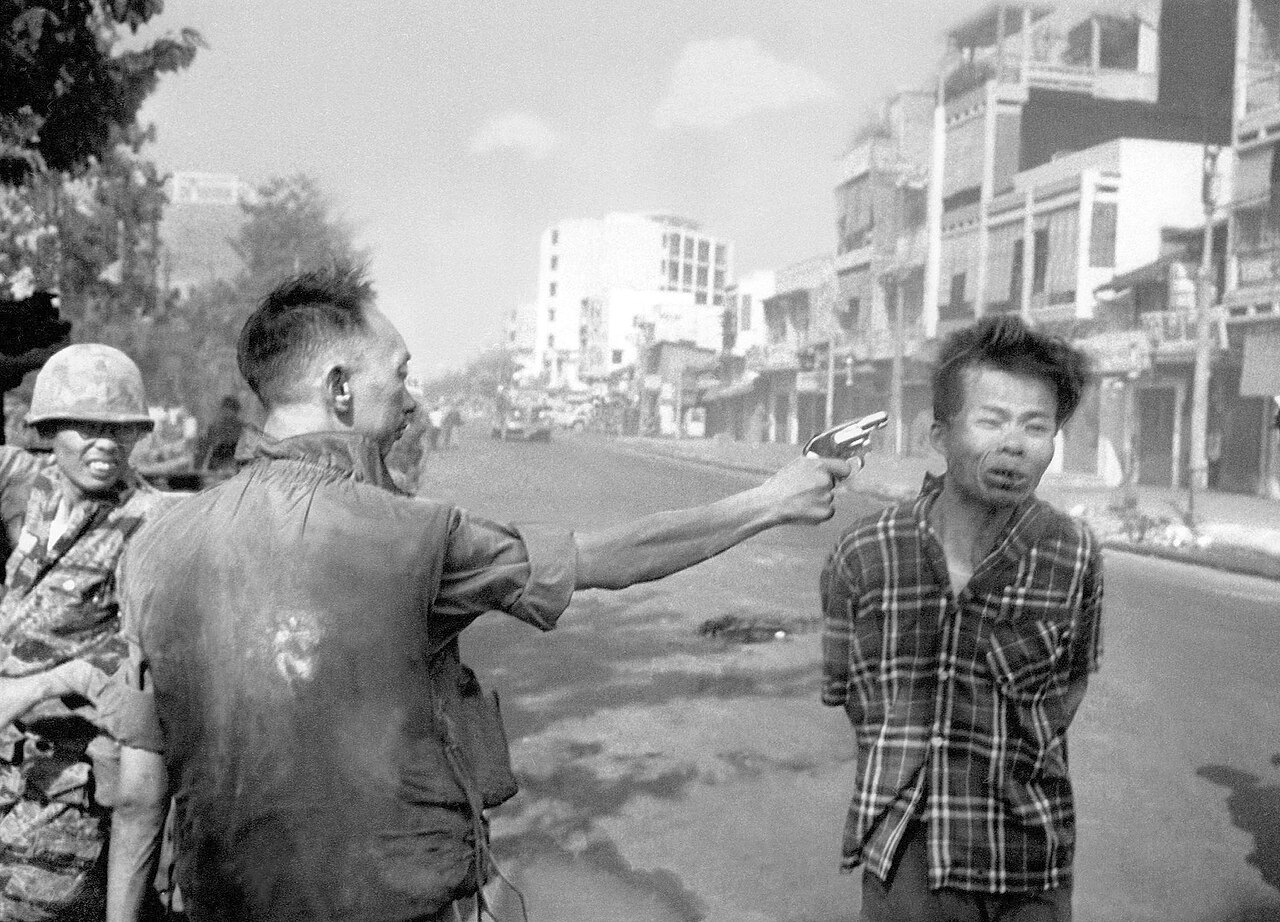
General Nguyen Ngoc Loan · Saigon · February 1, 1968 · Photo: Eddie Adams / AP · Pulitzer Prize 1969
Photograph 3: The Napalm Photograph, 1972
- June 8, 1972 — AP photographer Nick Ut photographs nine-year-old Kim Phúc running from a napalm strike near Tràng Bàng
- Pulitzer Prize 1973 — became one of the most reproduced anti-war images in history
- What the frame excluded: the strike was carried out by the South Vietnamese air force — not Americans — and was a targeting error, not deliberate policy
- Nick Ut drove Kim Phúc to a hospital after taking the photograph — she survived

Kim Phúc · Tràng Bàng · June 8, 1972 · Photo: Nick Ut / AP · Pulitzer Prize 1973
Photograph 4: The Fall of Saigon, 1975
- April 29, 1975 — Dutch photographer Hubert van Es photographs a helicopter on a Saigon rooftop as crowds surge up a ladder to board it — Operation Frequent Wind
- Became the defining image of the war's end — burned into a generation of American policymakers as evidence of the limits of American power
- What the frame excluded: the causal chain — a congressional funding decision in 1974 that degraded South Vietnamese military capacity to the point of collapse
- The image looks like military defeat — it was political abandonment
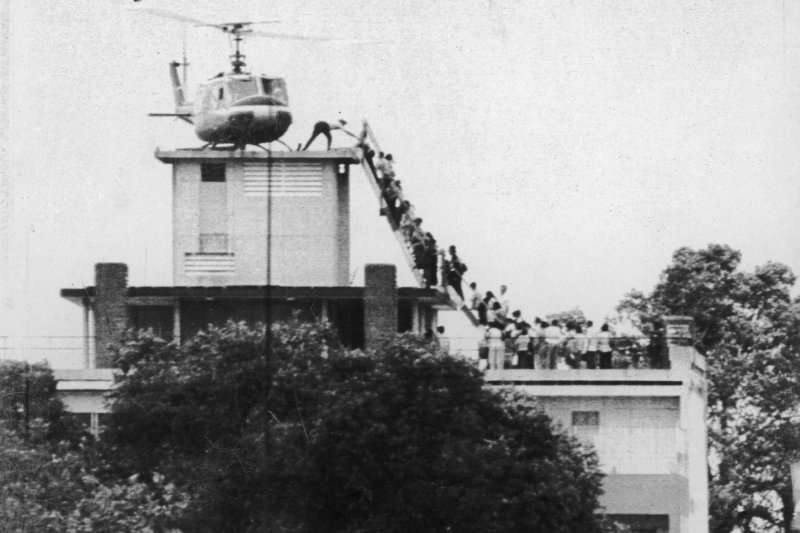
Saigon evacuation · April 29, 1975 · Photo: Hubert van Es / UPI
What the Frame Left Out
What All Four Had in Common
- All four photographs were real — none were staged or fabricated
- All were taken by skilled, ethical journalists doing their jobs
- All produced political conclusions that the specific events they depicted did not actually support
- The camera showed the what — it could not show the why
The Structural Problem
- Television rewarded emotional immediacy over analytical depth
- Images reached audiences before context could follow
- The medium's apparent objectivity made its distortions invisible
- A burning village is compelling television; 500 enemy killed and a hamlet secured is not
The Civil War Parallel
- Gardner staged bodies to tell an emotional truth about war's tragedy — the facts were fabricated, the feeling was real
- Vietnam's photographers recorded honest facts — and the conclusions audiences drew were wrong
- The problem was never dishonesty — it was the gap between what a frame can show and what an event means
The question is never "Is this photograph true?" — it is "What did this frame leave out, and what false conclusion did that absence produce?"
⏸ Pause & Reflect
All four photographs in this section were real — taken by ethical journalists recording what was in front of them. None were staged. All produced political conclusions the events they depicted didn't actually support.
If the images were real but the conclusions were wrong — who bears responsibility for that gap? The photographers? The editors? The networks? The audience?
Closing Synthesis
The anti-war movement • Giap's strategy • The aid cutoff • What the fall cost
The Anti-Vietnam War Movement
- 1965–1969: Campus-based protest movement grew from tens of thousands to millions — SDS, draft card burnings, teach-ins, marches on Washington
- April 4, 1967: Martin Luther King Jr. publicly opposes the war — links it to racial injustice and the drain on the Great Society
- May 4, 1970: National Guard kills four students at Kent State — over 450 universities shut down; Congress bars further Cambodia operations
- Vietnam Veterans Against the War: decorated veterans throwing medals on Capitol steps — "How do you ask a man to be the last man to die for a mistake?"
- Nixon's "silent majority" pushed back — polling consistently showed majority support for the war among non-protesters
The Enemy's Own Assessment
as cited in Lewis Sorley, A Better War (1999)
The Congressional Aid Cutoff
- 1973: Case-Church Amendment prohibits further U.S. military operations in Southeast Asia after August 15
- FY 1973: Military aid to South Vietnam — $2.27 billion
- FY 1975: Military aid cut to $700 million — ammunition rationed; artillery fired at fractions of required rates; aircraft grounded for lack of parts
- March 1975: North Vietnam launches final offensive — explicitly expecting no U.S. airpower response
- April 30, 1975: Saigon falls
⏸ Pause & Reflect
General Giap later acknowledged that American domestic opposition was central to North Vietnam's strategy. Does this change how you evaluate the anti-war movement? Can a political movement be morally sincere and strategically beneficial to one's adversaries at the same time?
What Followed the Fall of Saigon
- South Vietnam: Saigon renamed Ho Chi Minh City; 200,000–400,000 died in "re-education camps"; hundreds of thousands imprisoned for years
- Laos: Fell to the Pathet Lao within months — the domino fell
- Cambodia: Khmer Rouge took power and killed 1.5–2 million people — 20–25% of Cambodia's total population — between 1975 and 1979
- The domino theory: Not paranoid fantasy — it was accurate prediction
Military Defeat or Political Failure?
The lesson Vietnam teaches is not that counterinsurgency is unwinnable
It is that democratic societies can lose winnable wars when political will collapses before military objectives are achieved
Final Discussion
South Vietnam fell not because its military was defeated in the field, but because Congress withdrew the material support that made its operations sustainable.
Does this change the lesson Vietnam teaches — and does it change how you evaluate American commitments to allies?
Independent Study
A Better War: The Double Meaning • Anti-War Movement (full) • My Lai • Agent Orange • Strategic Context • Containment • The Revisionist Case • Eisenhower's Restraint • The Escalation Pattern • Historiographical Debate • The Paris Peace Accords • Peter Braestrup and the Tet Media Record
Strategic Context
Containment • The Revisionist Case • Eisenhower's Restraint • The Escalation Pattern
The Cold War Logic of Containment
- Containment: U.S. policy since 1947 — prevent Soviet-sponsored communist expansion into new regions
- 1954: French defeat at Dien Bien Phu ends French Indochina; Geneva Accords partition Vietnam at the 17th parallel
- North Vietnam backed by Soviet Union and China; South Vietnam non-communist
- Korean War (just ended) proved communist forces would use military means to reunify divided nations
Vietnam divided at the 17th parallel · Geneva Accords, 1954
Was Vietnam a Real Cold War Conflict?
- Unwinnable civil war, misframed as a Cold War conflict
- South Vietnam was an illegitimate U.S. client state
- The domino theory was paranoid fantasy
- Soviet and Chinese material support was decisive for North Vietnam
- South Vietnam had genuine popular support, capable military, viable government
- After 1975: Laos and Cambodia did fall — the domino theory was accurate prediction
The Eisenhower Contrast
- Committed ~700 military advisers; provided economic and military aid
- Regarded South Vietnamese viability as a genuine U.S. interest
- Refused to commit combat troops; rejected intervention to rescue the French at Dien Bien Phu
- Judgment: ground war in Asia unwinnable on favorable terms; open-ended commitments would undermine U.S. economic strength

Dwight D. Eisenhower · 34th President · Public Domain
Eisenhower vs. Kennedy vs. Johnson
- ~700 advisers
- Aid and training
- No combat troops
- Clear strategic limits
- ~16,000 advisers
- Authorized counterinsurgency programs
- Approved 1963 coup against Diem
- Escalated without clear endgame
- Combat troops 1965
- Over 500,000 by 1968
- No political will to win — or to define winning
- Rules of engagement prevented decisive pressure
⏸ Pause & Reflect
Eisenhower refused to commit combat troops to Vietnam despite regarding South Vietnamese viability as a genuine U.S. interest. Kennedy and Johnson both escalated. Using what you know about Eisenhower's governing philosophy — was he right to draw the line where he did?
A Better War — The Double Meaning
- Abrams's war was genuinely better than Westmoreland's
- Better tactics, better integration, better results
- The 1972 Easter Offensive's defeat is the proof
- Came too late — constrained by political damage the earlier phase had done
- Abandoned by a political class committed to withdrawal before the situation warranted it
- Allies who were winning on the battlefield were abandoned to end a domestic political problem
My Lai: March 16, 1968
What Happened
- Charlie Company, 1st Battalion, 20th Infantry — 23rd (Americal) Division — entered the hamlet of Mỹ Lai on a search-and-destroy mission expecting to engage the 48th Viet Cong Battalion
- No enemy combatants were present — the village contained only civilians: elderly men, women, children, and infants
- Over four hours, soldiers killed between 347 and 504 unarmed civilians — women were raped, homes burned, livestock slaughtered
- The sole U.S. casualty: a soldier who shot himself in the foot
- Warrant Officer Hugh Thompson landed his helicopter between soldiers and remaining civilians, ordered his crew to open fire on any American who continued shooting, and evacuated survivors — the only thing that stopped the killing
The Cover-Up and Consequences
- Army filed an after-action report claiming 128 Viet Cong killed — "Task Force Barker crushes enemy stronghold"
- Cover-up involved officers at brigade and division level — including a report by then-Major Colin Powell finding "relations between soldiers and the Vietnamese people are excellent"
- Hidden for 18 months until Ron Ridenhour — a soldier who heard of it secondhand — wrote letters to Congress and the Pentagon
- Journalist Seymour Hersh broke the story publicly, November 1969 — Pulitzer Prize 1970
- 26 soldiers charged — only Lieutenant William Calley convicted; sentenced to life, served 3.5 years under house arrest after Nixon commuted his sentence
Agent Orange: Operation Ranch Hand, 1962–1971
The Program
- Operation Ranch Hand: U.S. Air Force aircraft sprayed ~20 million gallons of herbicides over South Vietnam between 1962 and 1971
- Strategic purpose: strip jungle canopy to deny cover to North Vietnamese troops; destroy crops along infiltration routes
- Agent Orange — named for the colored stripe on its 55-gallon drums — was the most widely used formulation: a mixture of two herbicides contaminated with dioxin, one of the most toxic substances known
- The defoliants were believed to be harmless to humans — military and civilian personnel were exposed without protective equipment
- Over 7.7 million acres of tropical forest and mangrove — roughly the size of Maryland — were defoliated
The Human Cost
- Vietnamese government: up to 4 million Vietnamese exposed; 3 million suffered illness as a result
- Cancers linked to dioxin exposure: leukemia, Hodgkin's lymphoma, non-Hodgkin lymphoma, prostate cancer, lung cancer, and others
- Birth defects passed across generations — children and grandchildren of exposed individuals show elevated rates of disability
- U.S. veterans: hundreds of thousands exposed; VA now recognizes 19 conditions linked to herbicide exposure
- Chemical companies (including Dow and Monsanto) produced Agent Orange knowing the dioxin contamination — litigation resulted in a $180 million settlement with U.S. veterans in 1984; Vietnamese victims received nothing
The Anti-Vietnam War Movement
Origins, 1964–1966
- Began on university campuses — early protesters were students, intellectuals, and civil rights activists
- 1964: Students for a Democratic Society (SDS) holds first national anti-war march — 25,000 in Washington
- Draft resistance emerges — young men publicly burn draft cards, flee to Canada
- Civil rights leaders including Martin Luther King Jr. link the war to racial injustice — Black soldiers dying disproportionately for a country that denied them equal rights at home
Escalation, 1967–1970
- October 1967: March on the Pentagon — 100,000 protesters; 647 arrested
- 1968: Democratic National Convention, Chicago — police beat protesters on national television; the country watches in horror
- November 1969: Moratorium to End the War — largest single-day protest in American history, over 500,000 in Washington
- May 4, 1970: Kent State — National Guard kills four student protesters; campuses across America shut down
Who Was Involved
- Students and campus radicals — SDS, the counterculture
- Vietnam Veterans Against the War (VVAW) — the most politically powerful voice; impossible to dismiss as cowardice or ignorance
- Civil rights organizations, labor unions, religious groups, Democratic politicians
- Nixon's "silent majority" pushed back — polling consistently showed majority support for the war among non-protesters
The movement did not end the war — but it made sustained political commitment to the war progressively more costly, ultimately shaping the congressional decisions that did
The Historiographical Debate
Orthodox School
- Vietnam was an unwinnable civil war mistaken for a Cold War conflict
- South Vietnam lacked legitimacy and popular support
- U.S. military force could not compensate for political failure in Saigon
- Key texts: Halberstam (The Best and the Brightest); Sheehan (A Bright Shining Lie); Ellsberg (Secrets)
Revisionist School
- Vietnam was a genuine Cold War conflict; South Vietnam was a viable state
- The post-1968 war achieved real strategic progress under Abrams
- South Vietnam fell because of congressional aid cutoffs, not military failure
- Key texts: Moyar (Triumph Forsaken); Sorley (A Better War); Davidson (Vietnam at War)
The orthodox school dominated academic and journalistic treatment through the 1990s; revisionist scholarship has significantly reshaped the debate since 2000
The Paris Peace Accords (1973)
What Was Agreed
- Signed January 27, 1973 — ended direct U.S. military involvement
- Ceasefire in place; North Vietnamese troops could remain in South Vietnam
- U.S. prisoners of war to be released
- South Vietnam's political future to be determined by the Vietnamese people
What Was Not Agreed
- North Vietnam had no intention of honoring the ceasefire long-term
- Nixon's private assurances to Thieu — that the U.S. would respond militarily to North Vietnamese violations — were rendered worthless by Watergate and congressional constraints
- The Accords gave the U.S. a face-saving exit, not a durable peace
Braestrup and the Tet Media Record
- Peter Braestrup, Big Story (1977) — the definitive documentary study of Tet media coverage
- Braestrup covered Tet himself for the Washington Post; then spent years comparing press and TV reports against the military record
- Finding: coverage systematically distorted the battle's military outcome — catastrophic North Vietnamese defeat reported as American defeat or stalemate
- His findings have not been successfully refuted in 45 years
Not a critique of dishonesty — a structural argument about how the medium selects and frames information
