Section I
Were the "Happy Days" real or a myth waiting to be debunked?
Two Readings of the 1950s
- "Age of conformity" repressed dissent
- Prosperity concealing racial injustice
- Cold War paranoia driving policy
- A façade not a genuine achievement
- Real wages rose for all income groups
- Black poverty fell 40 points before 1965
- Crime at postwar lows; family stability high
- Prosperity rooted in specific, replicable choices
The Corrective
- Free enterprise
- Constitutional restraint
- The nuclear family
- Local civic organization
- A shared Judeo-Christian moral framework
Lecture Arc
- Political Leadership: Eisenhower's "dynamic conservatism" and Cold War prudence
- Economic Boom: Broad-based prosperity who gained and why
- Social Vitality: Family, faith, and the foundations of a confident republic
⏸ Pause & Reflect
Historians often call the 1950s an "age of conformity." What assumptions does that label carry and what evidence would you need to evaluate it?
Section II
Governing from strength quietly
Dwight D. Eisenhower
- Supreme Allied Commander to 34th President
- Led through the "Hidden Hand" active behind the scenes
- Ended the Korean War; avoided new large-scale wars
- Governed by the principle of the "Middle Way" — exercising restraint from the pragmatic center, avoiding extremes on both the left and right

Eisenhower | AI-generated illustration
A President Who Balanced the Books
- Three balanced budgets: 1956, 1957, 1960
- Low inflation monetary stability preserved
- Unemployment averaged below 5%
- Deficits minimal by any modern comparison
- Defense strong but as share of GDP, controlled
- "New Look" nuclear deterrence over mass armies
- Resist service-branch budget inflation
- Fiscal discipline = national security
The Interstate Highway System, 1956
- Authorized by the Federal Aid Highway Act of 1956
- Rationale: national security evacuation routes, defense mobility
- Inspired by Eisenhower's 1919 convoy and the German Autobahn
- Enabled private commerce, mobility, and suburban expansion

Interstate Highway System, 1956 | AI-generated illustration
Sputnik The Measured Response
- Oct. 4, 1957: USSR launches Sputnik — political shock wave; if the Soviets can orbit a satellite, they can deliver a nuclear warhead anywhere on Earth
- The "Missile Gap": Democrats and military leaders claimed the USSR had surged ahead in ballistic missiles — American survival was at risk and demanded emergency defense spending
- 1958: NASA created — fragmented rocket programs unified; National Defense Education Act funds science and math education
- The Reality: Classified U-2 reconnaissance showed Eisenhower that no missile gap existed — the Soviets were behind, not ahead. He resisted panic spending and kept the response measured.

Sputnik, 1957 | AI-generated illustration
The Farewell Address, 1961
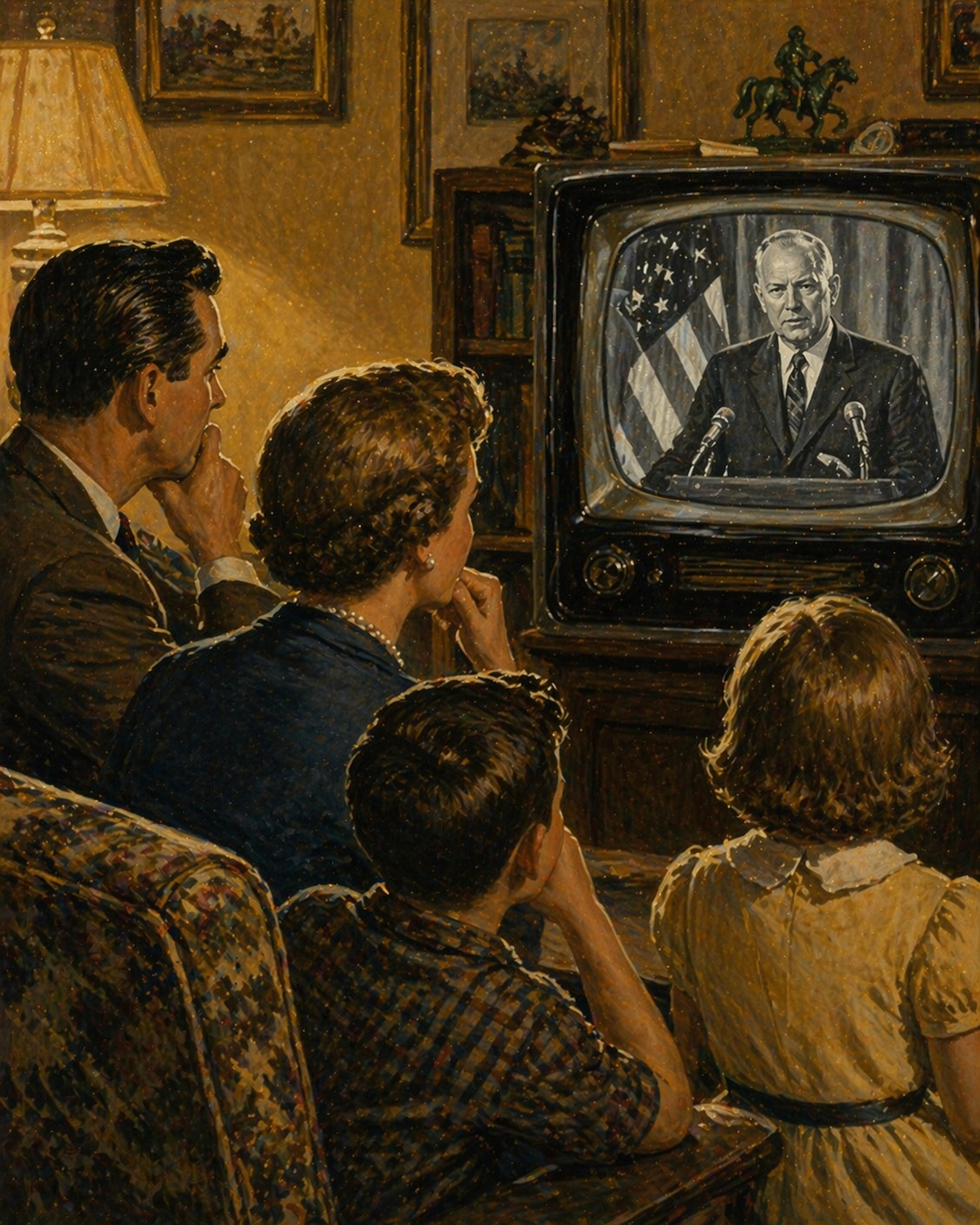
Farewell Address, January 17, 1961 | AI-generated illustration
⏸ Pause & Reflect
Eisenhower's farewell address warned primarily about:
- The Soviet nuclear threat
- Unwarranted influence by the military-industrial complex
- The dangers of television in politics
- Federal deficit spending and inflation
Section III
Growth that reached ordinary families not just the wealthy
The Numbers Don't Lie
- Real median incomes rose consistently across the decade
- Middle quintiles gained at rates comparable to the top — broad distribution
- Mild recessions in 1954 and 1958 — quickly recovered
Why Did Prosperity Happen?
- Postwar Dominance
- Export Advantage
- Tax Structure
- Stable Money
- High Savings Rates
- Limited Regulation
The Homeownership Surge
- 44% homeownership in 1940 to 62% by 1960
- Largest decade-over-decade increase in American history
- GI Bill mortgages + private builders (Levittown model)
- Rising real wages and job security gave young families the confidence to marry, buy homes, and have children — household formation surged at a scale only a genuinely prosperous economy could support

Levittown, Pennsylvania | AI-generated illustration
The Suburb Was Not Conformity — It Was Community
- Local schools expanded rapidly under locally elected school boards
- Churches and synagogues formed at rates that outpaced population growth
- Civic life thrived: PTAs, Boy Scout troops, Little Leagues, volunteer fire departments
- The suburb was a new form of community — organized around the nuclear family rather than the urban block
The Democratic Luxury
- 9% of households in 1950
- 90%+ by 1960
- Information and culture democratized
- 40M registered vehicles (1950)
- 74M by 1960
- Car ownership to working-class standard
- Refrigerators, washers, ranges
- Moved from luxury to household standard
- Mass production met rising real wages
⏸ Pause & Reflect
The 1950s consumer abundance happened within a relatively light federal regulatory framework — the major regulatory expansions came later, in the 1960s and 1970s.
Consumer prosperity of this kind requires a stable monetary system, enforceable property rights, deep capital markets, and a skilled, incentivized workforce. It does not obviously require a large administrative state directing investment or redistributing income.
What does this suggest about the relationship between government activism and prosperity — and does it challenge what most textbooks imply?
Section IV
The data that changes the standard story
Black Poverty Rates, 1940-1970
- A 40-point reduction in two decades — accomplished before the Great Society programs
- Rate of decline slowed in the 1970s precisely as federal anti-poverty spending peaked
Black Americans and the Great Migration
- Millions of Black Americans moved from the agricultural South to industrial North and West
- Northern factory wages dwarfed Southern sharecropping income
- An act of rational self-determination not government-directed
- Detroit, Chicago, Pittsburgh, California defense industries
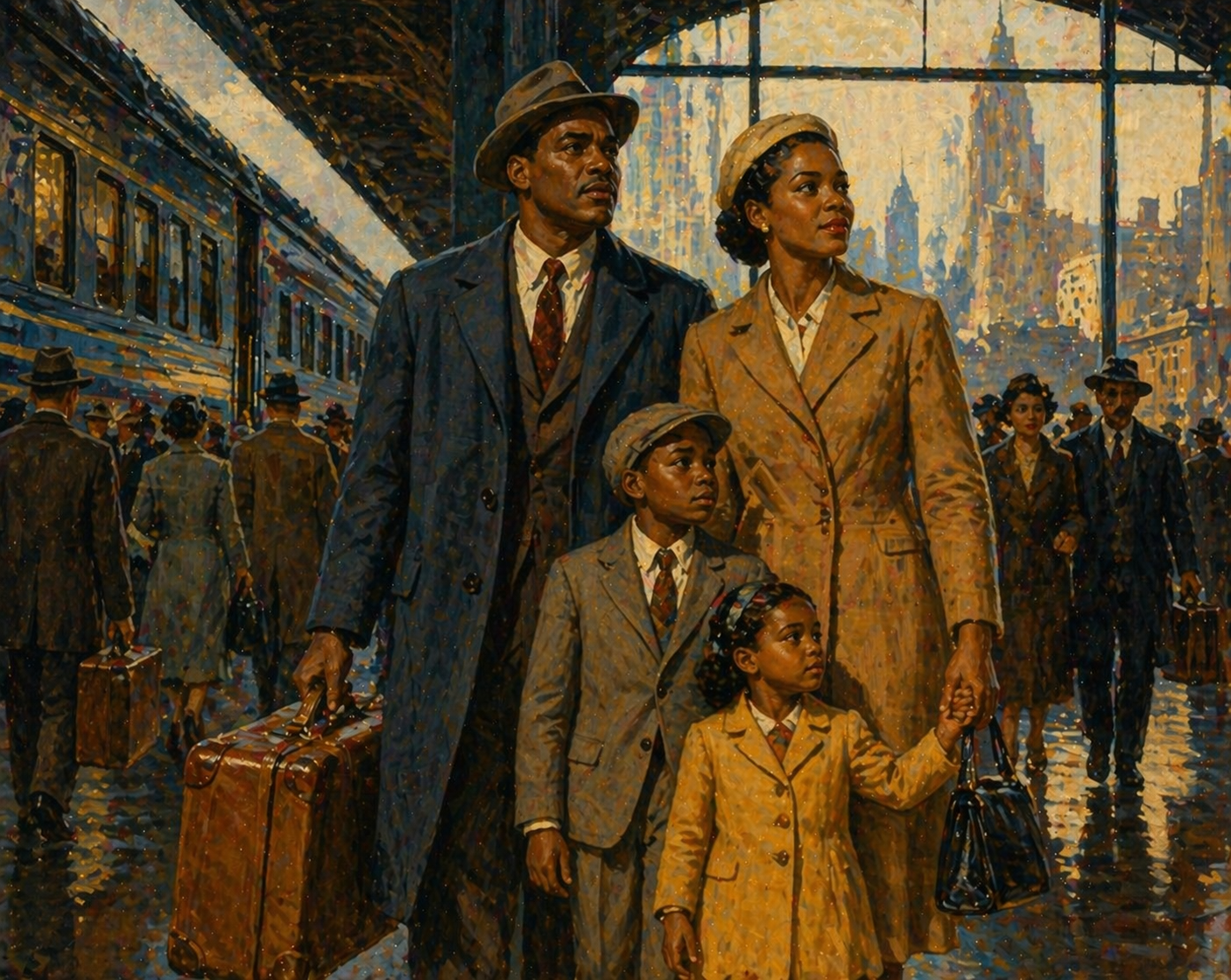
The Great Migration | AI-generated illustration
Down the Rabbit Hole

Reconstruction to 1970
Two Engines of Black Advancement
- Full-employment economy pulled workers regardless of race
- Rising education to occupational advancement
- Wages set by labor-market competition, not government mandate
- ~78% of Black families: two-parent households in 1950
- Two earners to faster savings accumulation
- Stable households to better child development outcomes
⏸ Pause & Reflect
According to Thomas Sowell's data, the primary mechanism driving Black poverty reduction before 1965 was:
- Federal anti-poverty programs and welfare expansion
- Migration to industrial labor markets and rising real wages
- Civil rights legislation mandating equal employment
- Affirmative action hiring preferences
Section V
Family, faith, and the foundations of social order
The Baby Boom, 1946-1964
- 76 million births between 1946 and 1964 — a cohort that reshaped every institution it passed through
- Elementary schools in the 1950s, colleges in the 1960s, the labor market in the 1970s, Medicare in the 2010s
- Not a demographic accident — a deliberate social choice: millions of couples who had survived the Depression and won the war believed the future would be better than the past
- They owned homes their parents had never imagined owning. They had jobs with rising wages. They formed families.
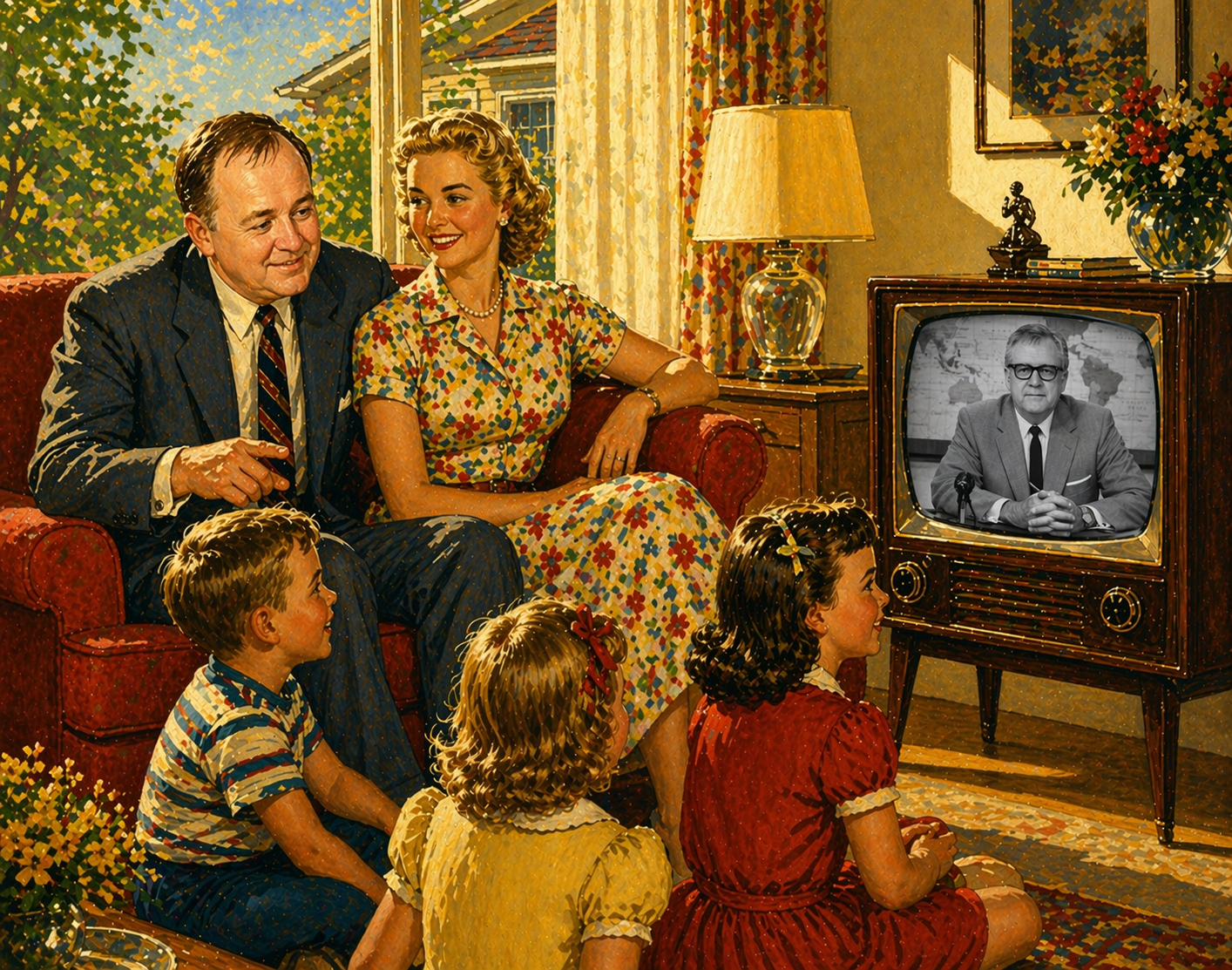
The Baby Boom | AI-generated illustration
The Nuclear Family Under the Microscope
- The bored housewife
- The absent breadwinner father
- The conformist suburb
- A society concealing dysfunction beneath a cheerful surface
- Married women reported higher life satisfaction than unmarried counterparts in survey research
- Child poverty rates declining; educational attainment rising
- Violent crime at postwar lows through the entire decade
- Social indicators across the board pointed in the right direction
A Nation at Worship
- ~49% of Americans attended religious services weekly in the mid-to-late 1950s
- Church membership grew faster than the population
- Billy Graham crusades: tens of thousands in person; millions on television
- "In God We Trust" added to paper currency 1957
- "Under God" added to the Pledge of Allegiance 1954
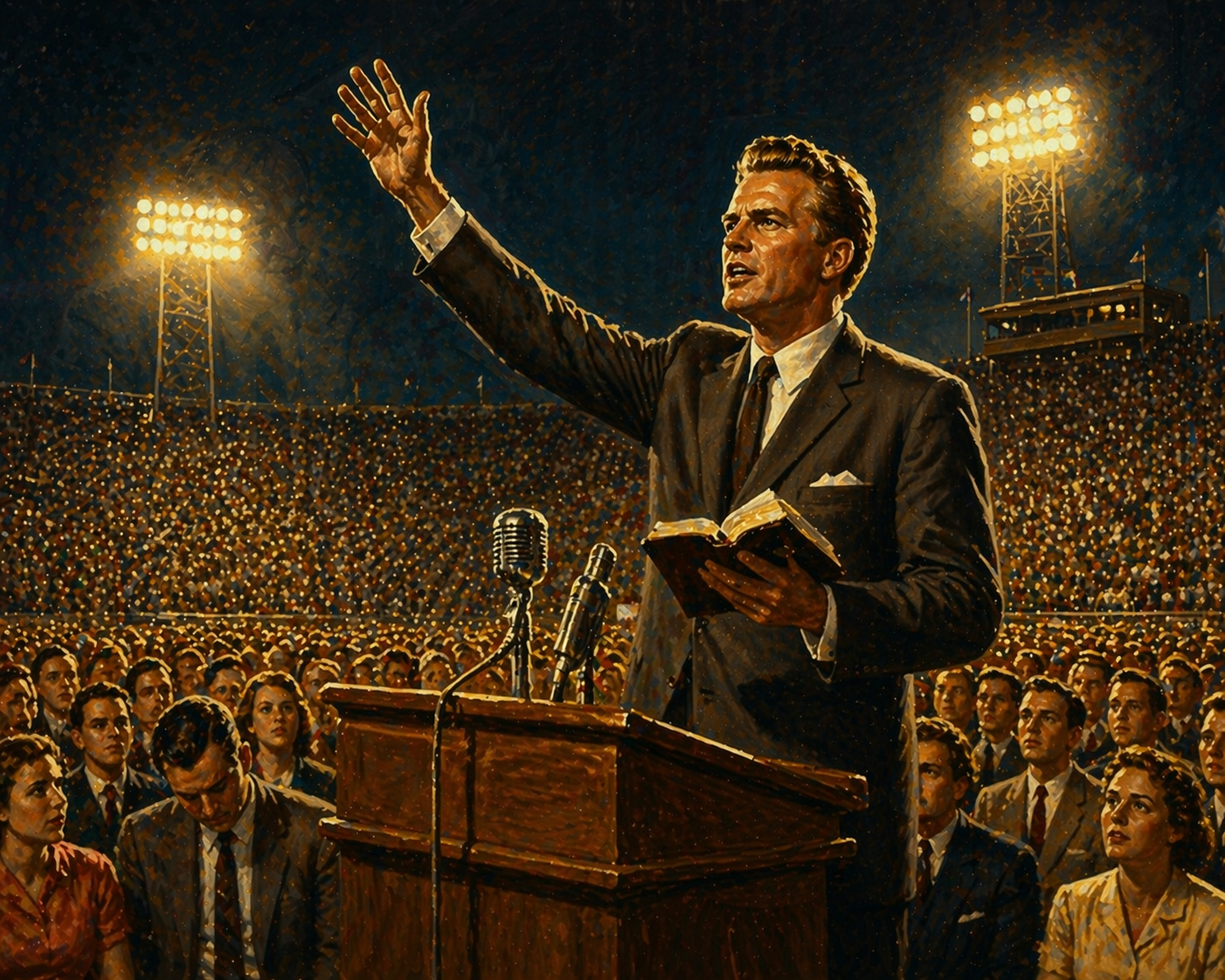
Billy Graham Crusade | AI-generated illustration
Popular Culture as Norm-Modeling
- Leave It to Beaver, Father Knows Best, Ozzie and Harriet
- Stable families, responsible parents, community accountability
- Not documentaries models of how households could function
- Rock 'n' roll: energetic but within mainstream moral limits
- The Beats: celebrated by critics; rejected by most Americans
- Mainstream culture knew what it stood for and said so
⏸ Pause & Reflect
If social order in the 1950s was maintained primarily by informal institutions family, church, community what happens to social order when those institutions weaken? Who or what fills the gap?
The Happy Days Were Earned
- Next lecture: How television spread and amplified this achievement into every American living room
- And began to reshape what Americans expected of their leaders