What Was the Cold War?
- Not a hot war — but not peace either
- Proxy conflicts, espionage, economic competition, arms races
- Stakes: the political future of the post-WWII world
The Core Question
Was containment a prudent realist check on Stalinist imperialism —
or did its defensive character reflect dangerous half-measures after Yalta's failures?
Section I
How did wartime optimism enable postwar Soviet dominance?
Roosevelt's Gamble
- FDR believed personal diplomacy could convert Stalin
- Rejected Churchill's requests for Anglo-American coordination
- Noblesse oblige model: generosity → reciprocity
- Fatal category error: democratic norms applied to a totalitarian partner

Joseph Stalin · 1943 · Public Domain · Wikimedia Commons
FDR on Stalin
Yalta Conference, February 1945
- U.S. needed Soviet entry against Japan — gave Stalin leverage
- Concessions: Outer Mongolia, S. Sakhalin, Kurils, Manchurian rights
- Poland: Soviet-controlled Lublin government as basis for postwar administration
- FDR rejected international supervision of promised Polish elections
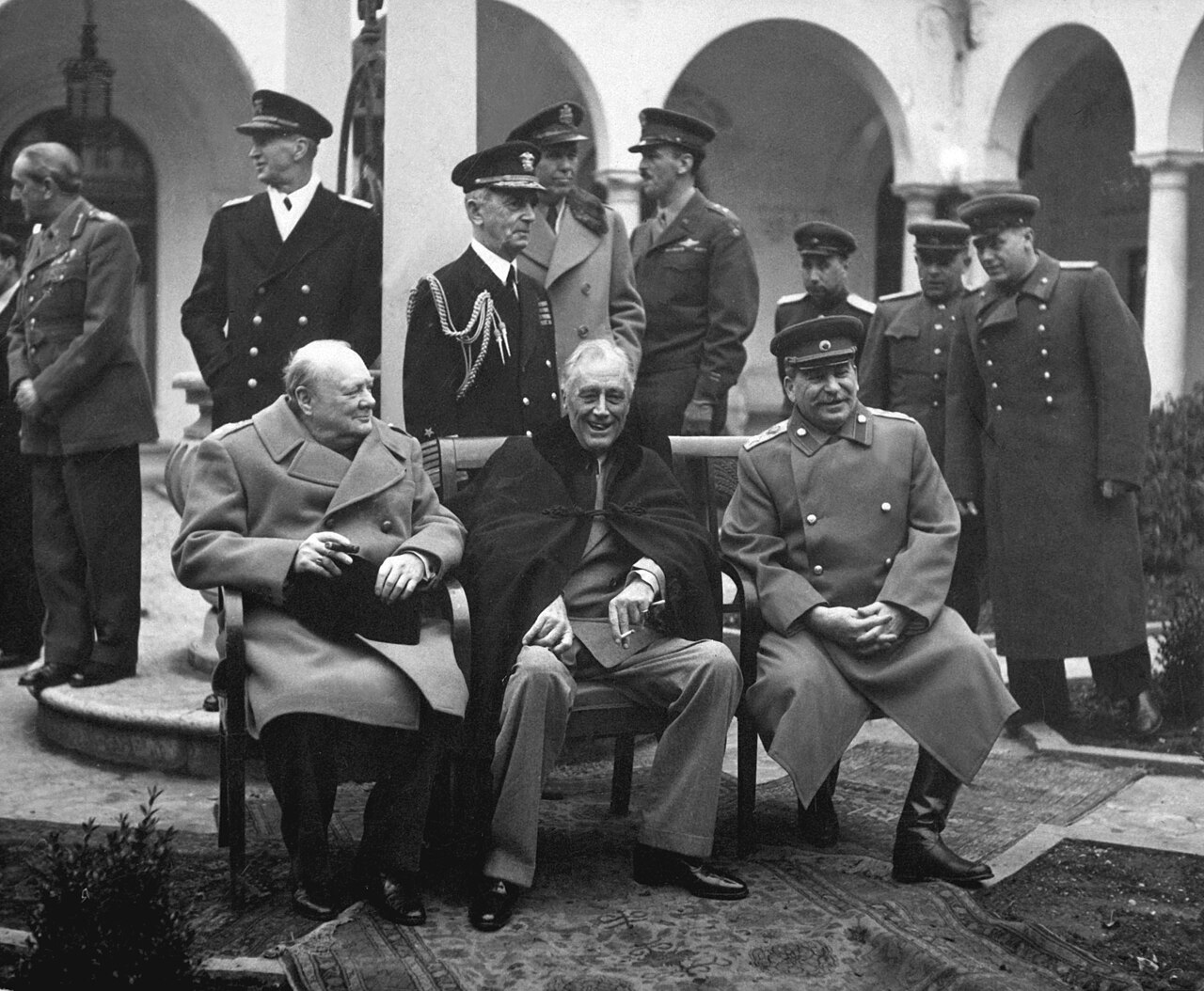
The Big Three at Yalta · February 1945 · Public Domain · Wikimedia Commons
The Strategic Vacuum
- 12 million → 1.6 million troops by end of 1946
- 87% reduction in under 18 months
- Atomic monopoly created false sense of security
- Slow, selective demobilization
- Troops already occupying Poland, Romania, Bulgaria, Hungary, East Germany
- Fait accompli before diplomacy could respond
⏸ Pause & Reflect
Soviet forces already occupied Eastern Europe before Yalta ended. Does this fact vindicate FDR's concessions — or indict them?
What would a harder American negotiating posture have required, and what might it have achieved?
Section II
From Roosevelt's optimism to Truman's firm realism, 1946
Truman's Decisive Shift
- Soviet troops refused to withdraw from northern Iran per wartime agreement
- Pressure on Turkey for joint control of the Dardanelles Strait
- Communist insurgency in Greece backed by Soviet-aligned Yugoslavia
- Soviet stripping of East German industry as reparations

Harry S. Truman, 33rd President · Public Domain · Wikimedia Commons
Truman's Reorientation
Stalin's Declaration, February 9, 1946
- Vowed to overcome the American lead in weaponry "no matter the cost"
- Confirmed the ideological incompatibility Kennan would diagnose two weeks later
- Stalin was already planning long-term military competition — while the U.S. was still demobilizing
Churchill's Iron Curtain, March 5, 1946
- Delivered with President Truman on the platform — not a private warning
- Publicly declared Soviet domination of Eastern Europe was already a fait accompli
- Called for Anglo-American resolve — the most famous early public statement of the new reality
Kennan's Long Telegram, February 22, 1946
Kennan's Containment: Diagnosis Correct — Prescription Insufficient
- Patient, primarily political and economic resistance
- Selective engagement at points of genuine strategic value
- Wait for Soviet internal contradictions to resolve themselves
- Patience accepted an immoral status quo in Eastern Europe
- Abandoned captive nations to indefinite Soviet rule
- Defensive posture invited further probes
⏸ Pause & Reflect
Kennan's Long Telegram argued Soviet expansion was ideologically driven, not reactive. Which best captures the strategic implication?
- The U.S. should avoid any provocation that might alarm the Soviets
- Creating firm resistance would redirect Soviet pressure without war
- Rollback was the only effective response to Soviet expansion
- Soviet behavior would moderate once Stalin felt economically secure
Section III
Why anti-communist fear was rational — not hysterical
Fear Grounded in Evidence
- Survivor accounts, diplomatic cables, journalistic reporting all documented
- Pattern of Soviet terror was structurally integral to the regime — not an aberration
- Key distinction: rational anti-communism ≠ paranoid domestic witch-hunting
The Holodomor, 1932–1933
- Not a natural famine — the result of forced collectivization
- Armed brigades seized grain reserves from Ukrainian villages
- Blacklists restricted food distribution to targeted communities
- Estimated 3.5 to 7+ million deaths — internal Soviet documents confirm deliberate policy

Holodomor documentation · 1932–33 · Public Domain · Wikimedia Commons
The Great Terror, 1937–1938
- NKVD conducted mass operations targeting entire social categories
- 681,000–750,000 executed — figures from NKVD operational reports opened after 1991
- 1.3 million more sent to the Gulag, where mortality from cold and overwork was catastrophic
- Red Army officer corps decimated: 3 of 5 marshals, 13 of 15 army commanders shot or imprisoned
The Katyn Massacre, 1940
- Following Soviet invasion of eastern Poland under the Molotov-Ribbentrop Pact
- ~22,000 Polish officers, police, and professionals systematically executed
- Shot in the back of the head at three sites: Katyn Forest, Kalinin, Kharkiv
- Targeted Poland's professional class — capacity for organized resistance was the target
The Full Stalinist Record
- Mass deportations of entire ethnic groups: Volga Germans, Chechens, Crimean Tatars
- Gulag system: structurally integral to Soviet governance — not an excess
- ~20 million deaths attributed to Stalin era in traditional accounts
- Show trials, secret police terror replicated across Eastern Europe 1945–1948
- Eight nations transformed into Soviet satellites through systematic suppression
- The Black Book of Communism (1997): global communist toll approaching 100 million
The Black Book of Communism: 20th-Century Death Toll
| Regime | Period | Estimated Deaths |
|---|---|---|
| 🇨🇳 China (Mao) | 1949–1976 | ~65,000,000 |
| 🇷🇺 USSR (Soviet Union) | 1917–1991 | ~20,000,000 |
| 🇰🇭 Cambodia (Khmer Rouge) | 1975–1979 | ~2,000,000 |
| 🇰🇵 North Korea | 1948–present | ~2,000,000 |
| 🌍 Africa (Marxist regimes) | 1960s–1990s | ~1,700,000 |
| 🇦🇫 Afghanistan (PDPA) | 1978–1992 | ~1,500,000 |
| 🇻🇳 Vietnam | 1945–1980s | ~1,000,000 |
| 🇪🇺 Eastern Europe (satellites) | 1945–1989 | ~1,000,000 |
| 🌏 Latin America (Marxist) | 1950s–1990s | ~150,000 |
| 🌏 Other communist states | various | ~150,000 |
| TOTAL (Courtois et al. estimate) | ~94,000,000 | |
⏸ Pause & Reflect
The United States was allied with Stalin's USSR during World War II. How should policymakers weigh strategic necessity against moral consistency?
Does wartime alliance with a genocidal regime create moral obligations in the postwar settlement — or does existential threat override them?
Section IV
1947–1949: Four instruments of a single strategic architecture
The Truman Doctrine, March 1947
- Trigger: Britain could no longer fund Greece and Turkey (February 21, 1947)
- Communist insurgents gaining ground in Greece; Soviet pressure on Turkey's Dardanelles
- Senator Vandenberg: must "scare the hell out of the country" to get congressional support
- $400 million in military and economic aid appropriated
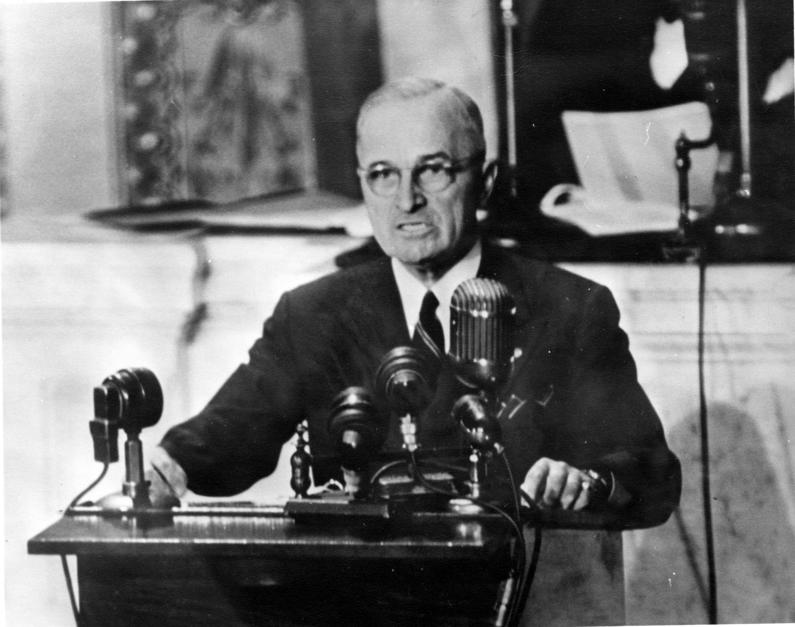
Truman addresses Congress · March 12, 1947 · Public Domain · Wikimedia Commons
The Doctrine's Promise
National Security Act, 1947
- Unified Army, Navy, Air Force under civilian secretary
- Joint Chiefs of Staff as unified military command
- National Security Council
- Coordinated foreign and military policy at executive level
- Central Intelligence Agency
- Centralized intelligence collection and analysis
The Marshall Plan, 1947–1952
- Marshall's Harvard speech (June 5, 1947): offered aid to all European nations — including USSR
- Stalin refused after initial interest; Molotov walked out of Paris planning conference
- $13–17 billion rebuilt France, West Germany, and Italy
- Economic recovery denied communist parties the exploitation of postwar misery

European Recovery Program · ca. 1948 · Public Domain · Wikimedia Commons
The Division of Germany
- Yalta (Feb. 1945) & Potsdam (Aug. 1945): Germany divided into four occupation zones — U.S., British, French, Soviet
- Intended as temporary administration pending a peace treaty; no permanent partition planned
- Soviet zone stripped of industry; Western zones pursued reconstruction under the Marshall Plan
- Western Allies moved to unify their zones into a single West German state — triggering Soviet alarm
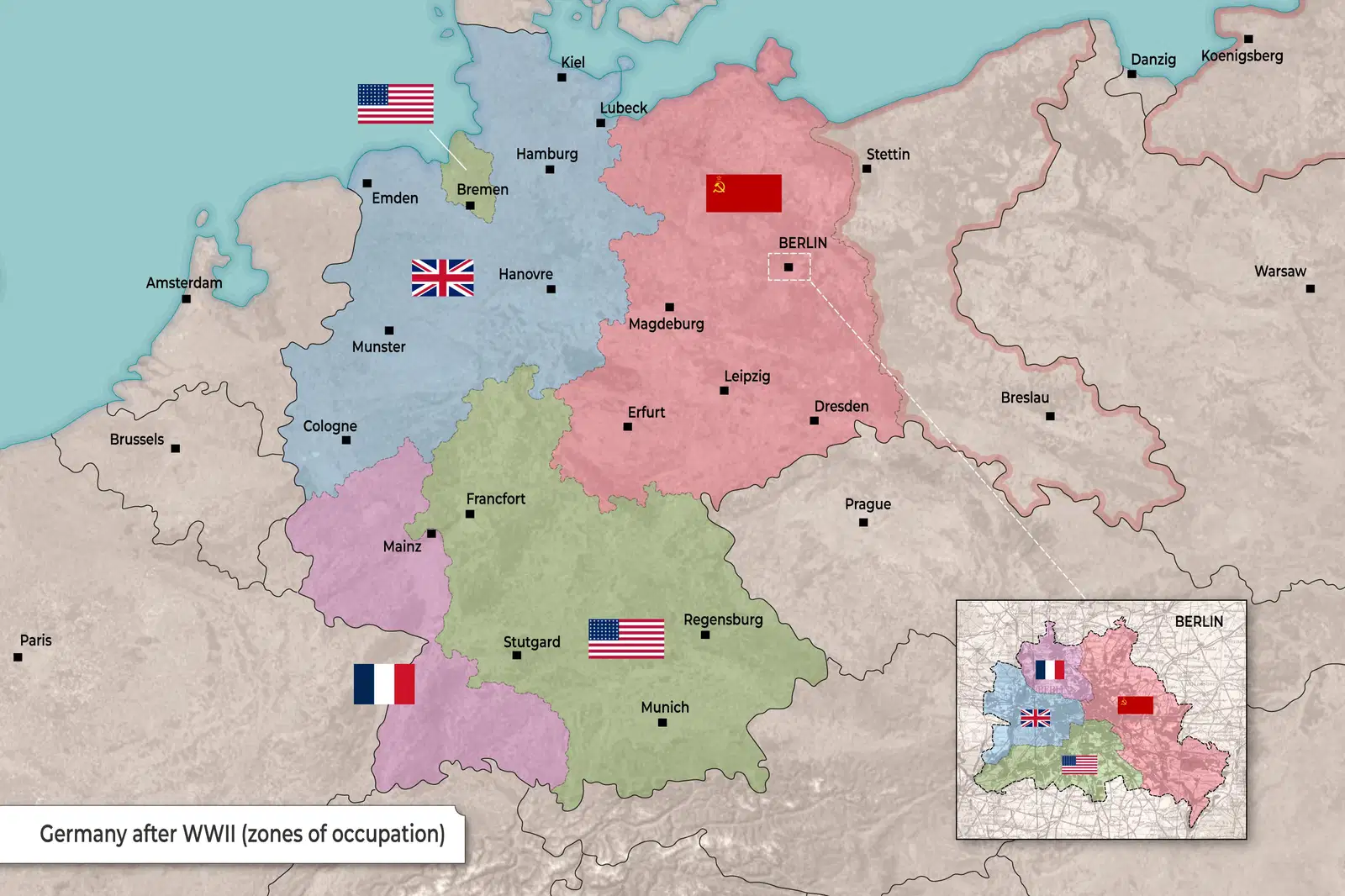
Germany: Four Allied Occupation Zones, 1945 · Chapter 27 Course Materials
The Berlin Crisis, 1948–1949
- Stalin blockaded all land and water routes to West Berlin, June 1948
- Goal: force Western abandonment of plans for a West German state
- Operation Vittles: supplied entire city by air — peak 8,100+ tons/day
- Stalin lifted blockade May 1949 — achieved nothing; temporary occupation zones solidified into two sovereign states

C-54 at Rhein-Main Air Base · 1948 · Public Domain · Wikimedia Commons
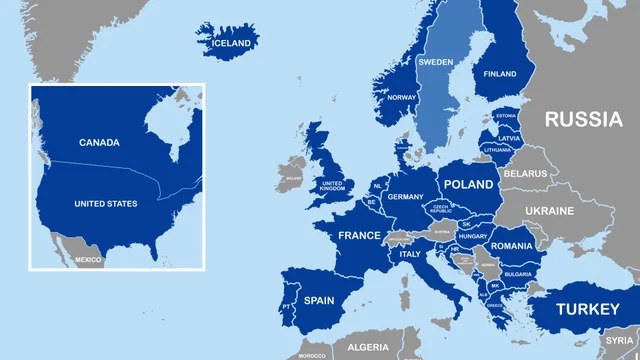
NATO, April 4, 1949
- Article 5: attack on one = attack on all
- 12 founding nations; first U.S. peacetime military alliance in history
- Senate ratified 82–13 — bipartisan consensus that isolationism was finished
- Greece, Turkey (1952) and West Germany (1955) later added
 >>>>>> a3fd3a34d3376b244e4f1659f5597513b069d9cc
alt="North Atlantic Council founding meeting 1949 NATO formation Washington D.C."
style="max-width:100%;max-height:520px;object-fit:contain;border-radius:6px;"
onerror="this.style.display='none';this.nextElementSibling.style.display='block';">
>>>>>> a3fd3a34d3376b244e4f1659f5597513b069d9cc
alt="North Atlantic Council founding meeting 1949 NATO formation Washington D.C."
style="max-width:100%;max-height:520px;object-fit:contain;border-radius:6px;"
onerror="this.style.display='none';this.nextElementSibling.style.display='block';">
North Atlantic Council · April 1949 · Public Domain · Wikimedia Commons
Four Instruments, One Architecture
- Truman Doctrine — ideological commitment to free peoples
- Marshall Plan — economic stability denies communist political opportunity
- Berlin Airlift — demonstrated commitment was real and costs bearable
- NATO — institutionalized the alliance to deter future tests
⏸ Pause & Reflect
The Marshall Plan offered aid to the Soviet Union — which Stalin refused.
What constraints — ideological, political, imperial — made Soviet participation effectively impossible? Does the offer change the moral calculus of American policy?
The Arc of This Lecture
- Yalta's compromises + rapid demobilization created the postwar vulnerability
- Kennan's diagnosis: Soviet expansion was structural, not reactive — containment was the answer
- The human cost of communism made strong anti-communist policy a moral imperative, not just a strategic one
- Containment's architecture (Doctrine → Marshall Plan → Berlin → NATO) achieved limited but genuine successes in Europe
Looking Ahead: Lecture 2
- The 1949 shocks intensified domestic fears of internal subversion
- Whittaker Chambers, Alger Hiss, and the espionage controversy
- The Korea question: how external war became domestic political crisis