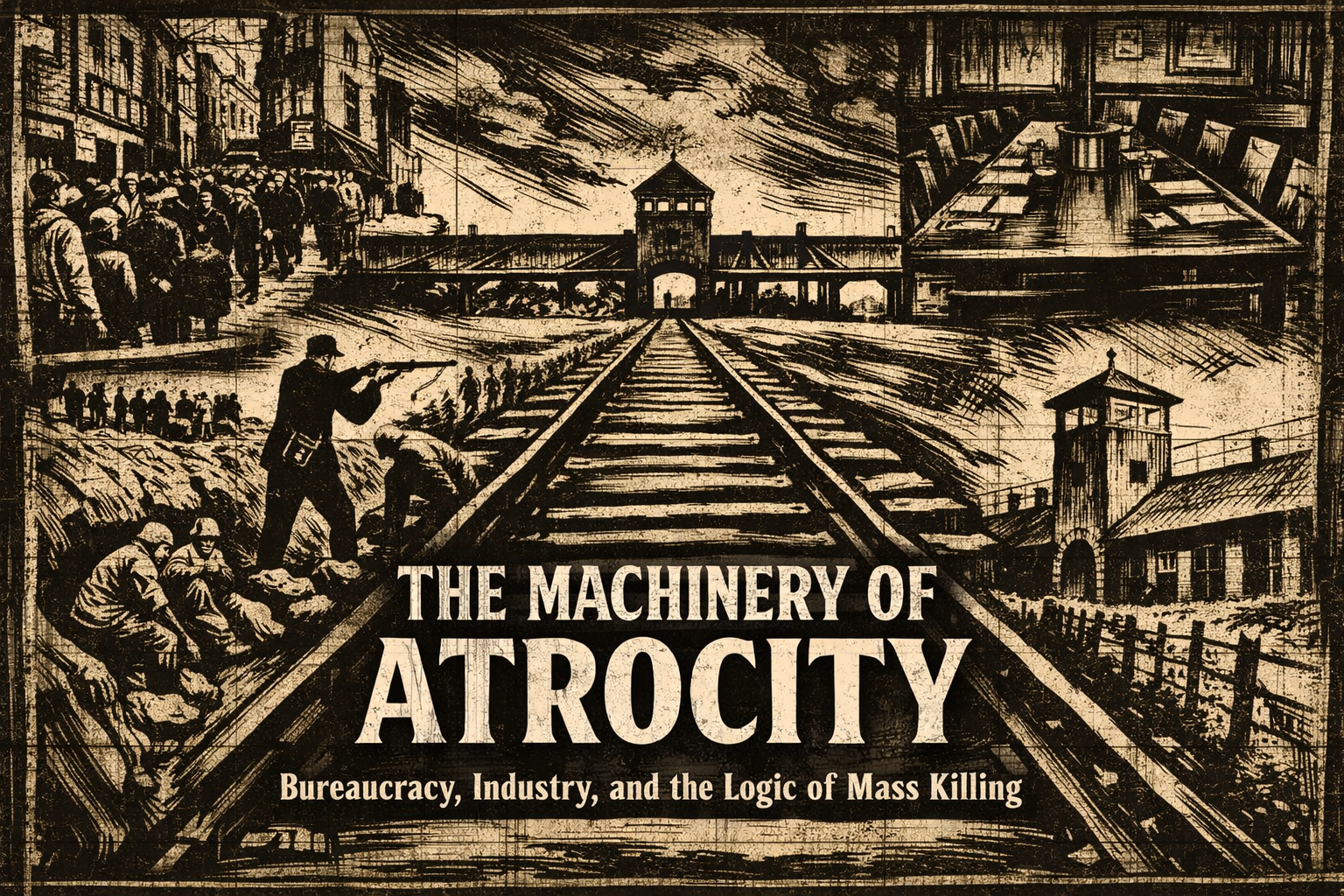
Section I
The true nature of fascist violence — and why it demanded a total response
What Were We Fighting?
- The war against expansionist fascism was not only a struggle against aggressive dictatorships — it was a war against regimes that made **mass murder and racial conquest** central policy
- Nazi Germany and Imperial Japan both pursued systematic campaigns of terror, enslavement, and extermination on a staggering scale
- Understanding the full scope of these atrocities helps explain why the United States ultimately had to fight a total war — and why partial measures or appeasement could not suffice

Raising the Flag on Iwo Jima · Joe Rosenthal, 1945 · Public Domain
Section II
The Holocaust did not begin with gas chambers. It began with paperwork.
Phase 1 — Legal Persecution (1933–1939)
- April 1933 — nationwide boycott of Jewish businesses; Jews purged from civil service, law, and medicine by state decree
- Nuremberg Laws (1935) — Jews stripped of citizenship; marriage between Jews and non-Jews criminalized
- Laws were carefully engineered to be enforceable — racial definitions, documentation systems, administrative apparatus
- Race was not metaphor — it was law
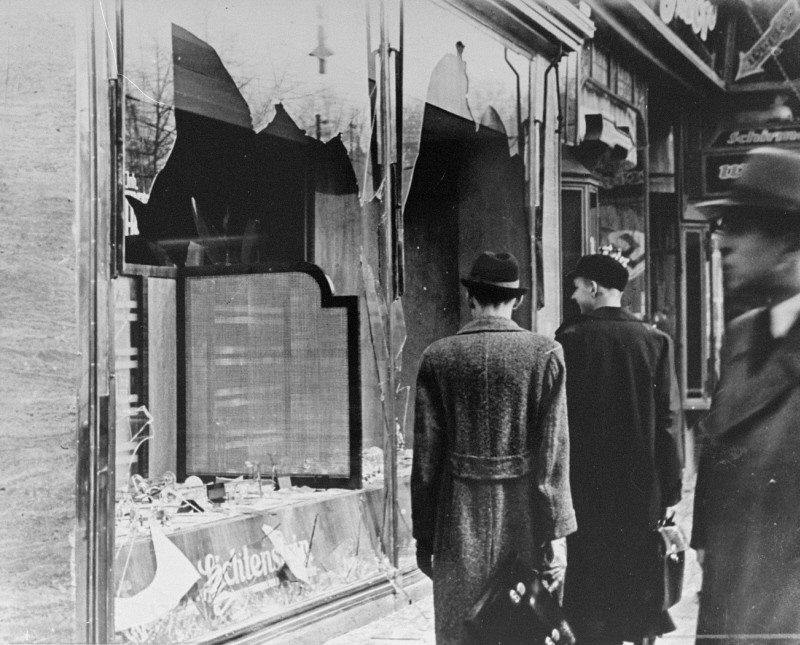
Destroyed Jewish Businesses · Berlin · Bundesarchiv · Wikimedia Commons
Kristallnacht — November 9–10, 1938
- SA and SS units destroy 7,500+ Jewish businesses, burn 267 synagogues, kill at least 91 Jews outright
- 30,000+ Jewish men arrested and sent to Dachau, Sachsenhausen, Buchenwald — first mass incarceration
- Presented as spontaneous popular uprising — it was a coordinated state operation
- The message: legal apparatus would be supplemented by physical terror
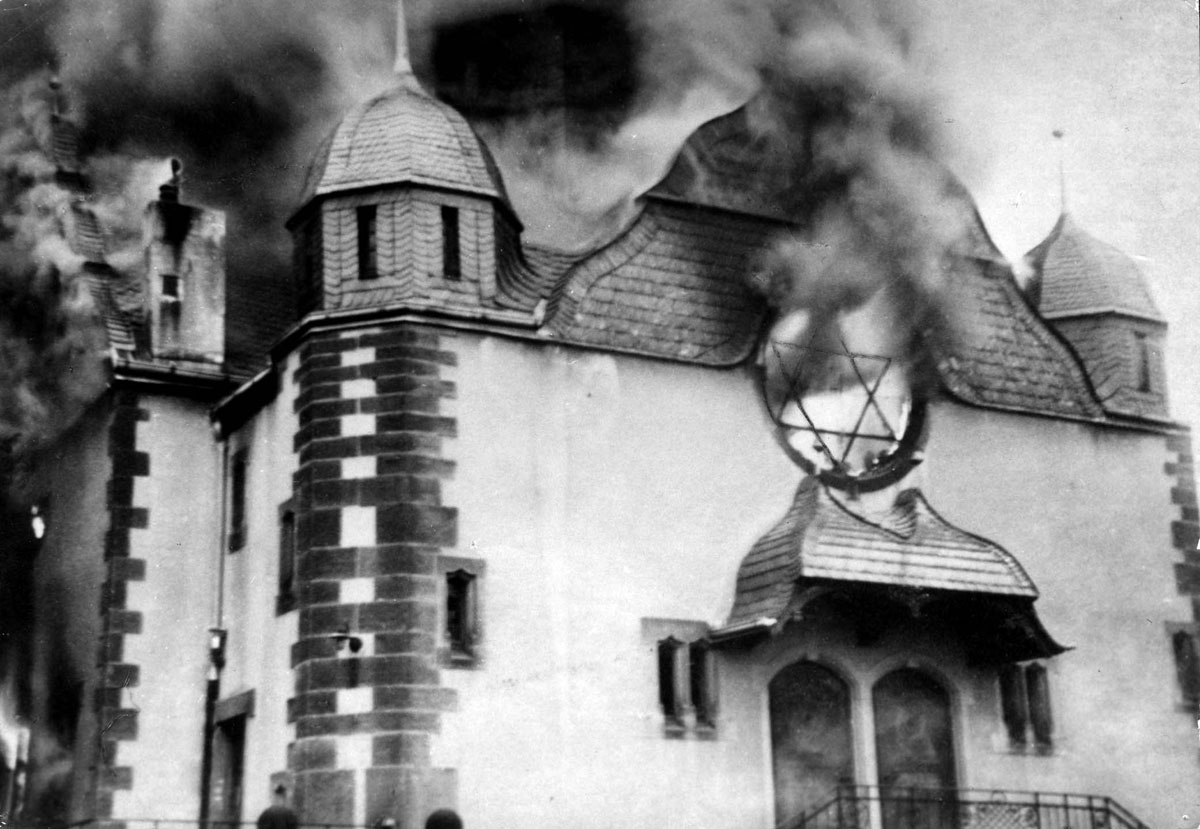
Aftermath of Kristallnacht · Berlin · Bundesarchiv · Wikimedia Commons
Phase 2 — Ghettos and Genocide by Starvation
- Invasion of Poland (Sept. 1939) brings 3.3 million Polish Jews under German control — too large for emigration policies
- Warsaw Ghetto — 400,000 people confined to 1.3 square miles; density 20x that of Manhattan
- Food allocations calculated deliberately below subsistence — starvation was policy, not accident
- 100,000+ died in Warsaw Ghetto from starvation and disease before deportations began
- The Hunger Plan (1941) — German forces would feed themselves by seizing Soviet food supplies; planners coldly projected 31–45 million "racially inferior" civilians would starve; ~4.2 million deaths resulted
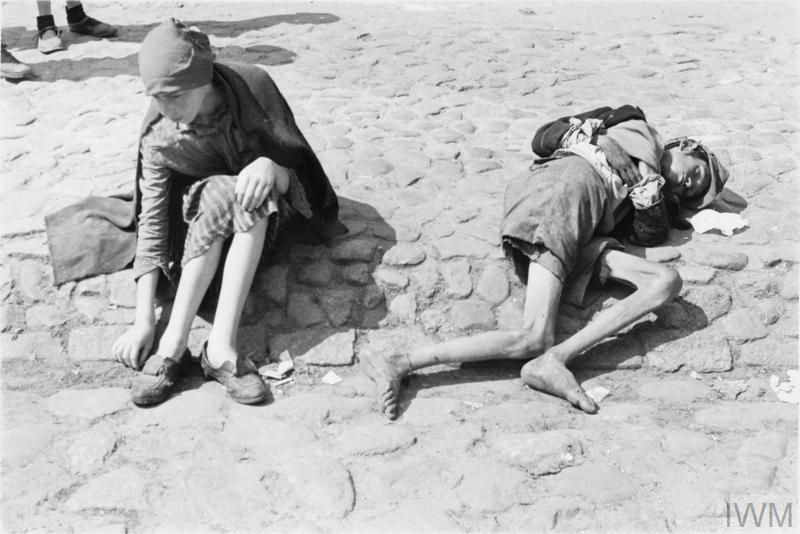
Warsaw Ghetto
The Einsatzgruppen — Mobile Killing Squads
- Invasion of Soviet Union (June 1941) — SS deploys four Einsatzgruppen across the entire Eastern Front
- Method: communities assembled, marched to pre-dug pits, shot, buried — direct, local, face-to-face killing
- Victims: Jewish communities, Soviet commissars, Roma, and others designated racially dangerous
- By end of 1941: 500,000 murdered; by war's end: 1.5 million+
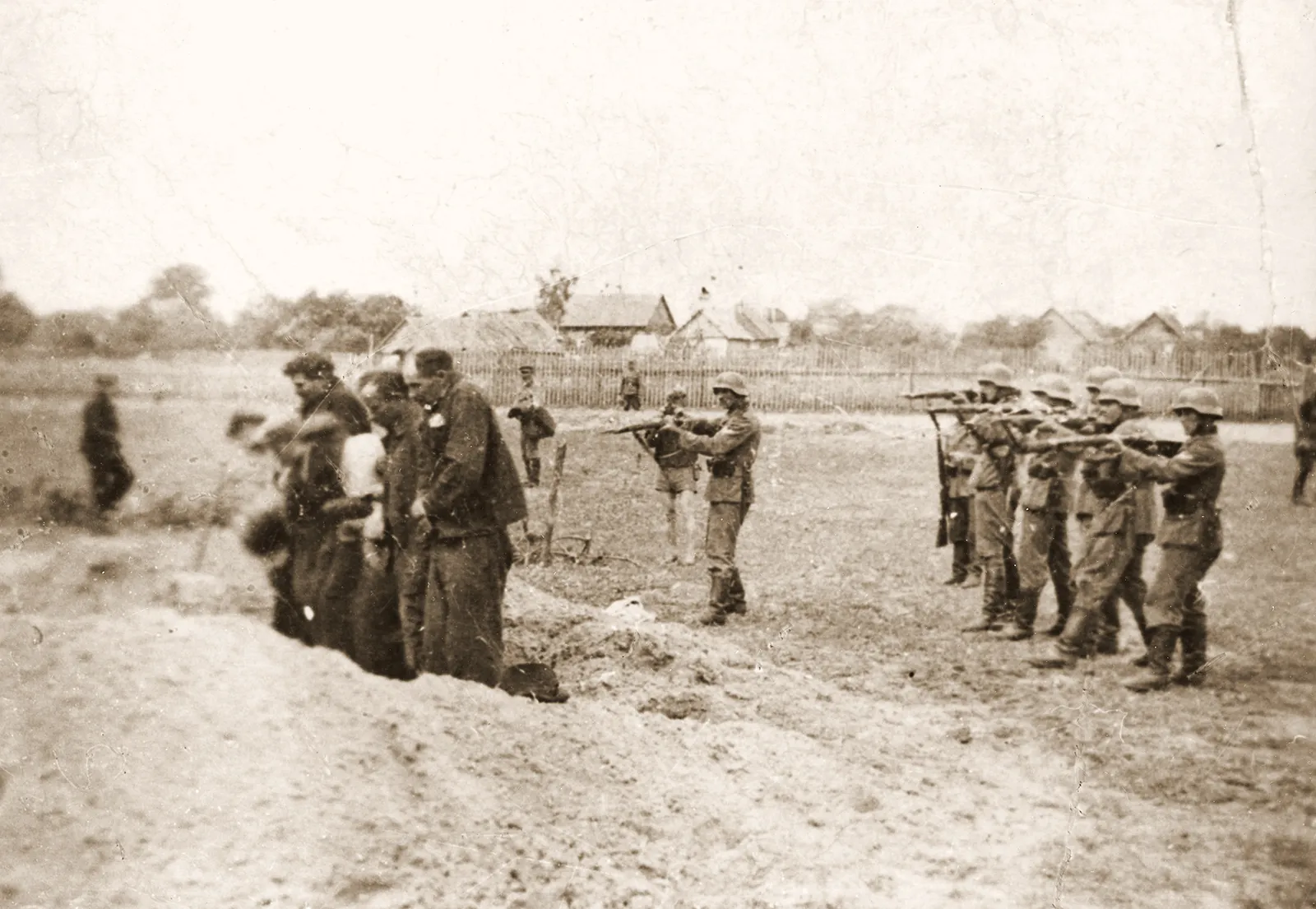
German troops executing a group of Poles.
Babi Yar — 33,771 in Two Days
- September 29–30, 1941 — Einsatzgruppe C and German Order Police assemble 33,771 Jewish men, women, and children outside Kyiv
- Marched to the Babi Yar ravine — shot over two days
- Operation meticulously documented in German field reports — the numbers recorded as routine administration
- Babi Yar was not an anomaly — it was a template, repeated at hundreds of sites across the Soviet Union
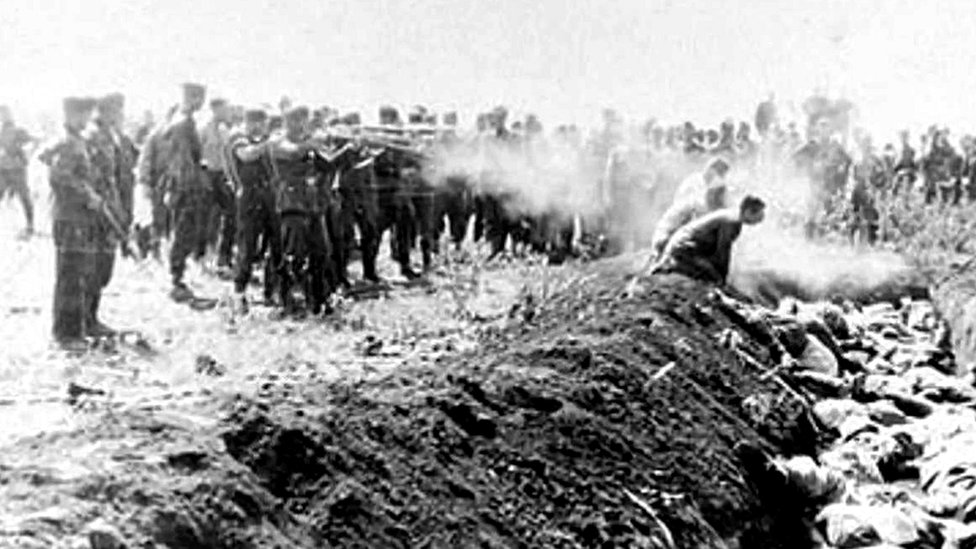
Babi Yar Massacre Site · 1941 · Wikimedia Commons
Wannsee — Coordinating the Final Solution
- January 20, 1942 — Reinhard Heydrich convenes 15 senior Nazi officials to coordinate the logistics of extending killing across all of German-occupied Europe
- The conference lasted ninety minutes
- The Wannsee Protocol survives in its entirety — a document of bureaucratic casualness about the murder of eleven million people
- Wannsee did not decide to kill the Jews — that decision was already being implemented. It coordinated.
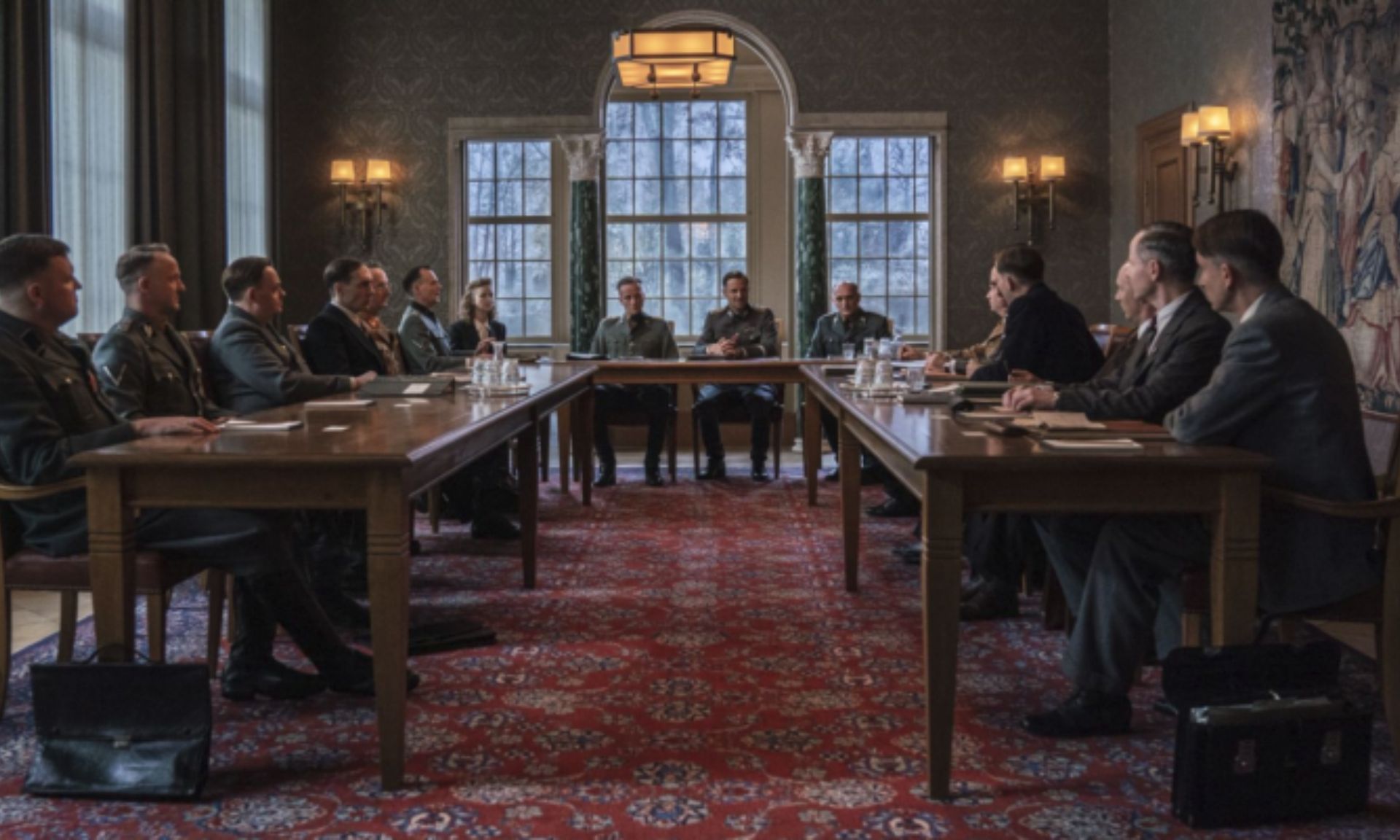
Wannsee Conference Room · Berlin · Wikimedia Commons
Auschwitz — Industrial Extermination
- Extermination camps — purpose-built killing facilities distinct from concentration camps; Treblinka, Sobibor, Belzec, Chelmno, Auschwitz-Birkenau
- Auschwitz process: arrival by train, selection on the platform — fit for labor spared temporarily; all others proceeded directly to gas chambers
- Killed with Zyklon B; bodies cremated; gold teeth extracted; hair used for industrial purposes
- 1.1 million murdered at Auschwitz — approximately 90% Jewish
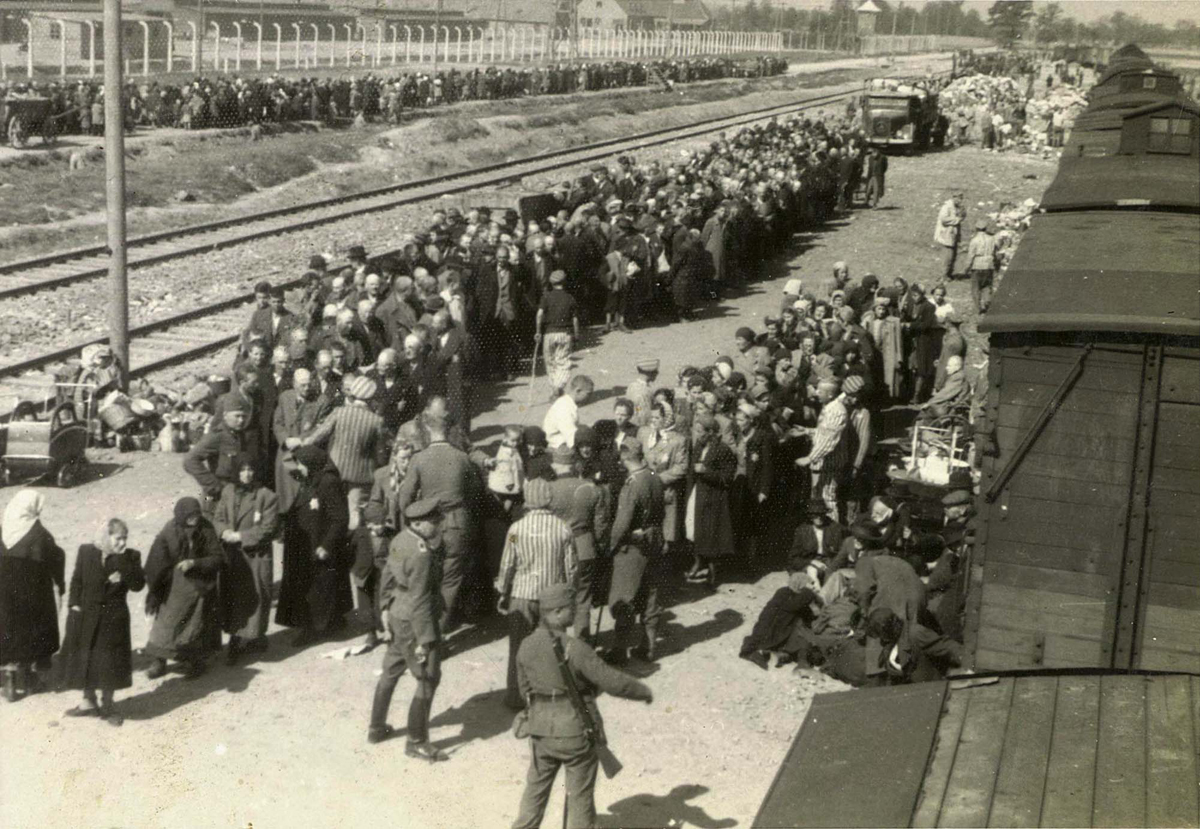
Selection at Birkenau · 1944 · Wikimedia Commons
The Scale of the Killing
- Jews — ~6,000,000
- Soviet civilians — ~5,700,000
- Polish civilians — ~1,800,000–2,000,000
- Political prisoners — ~1,500,000+
- Roma & Sinti — ~220,000–500,000
- Disabled persons (T4 program) — ~250,000–300,000
- Gas chambers — ~2.7–3.0 million
- Einsatzgruppen shootings — ~1.5–2.0 million
- Starvation / ghettos — ~800,000+
- Forced labor deaths — ~2–3 million
- Hunger Plan — ~4–5 million
- Death marches — ~250,000–500,000
⏸ Pause & Reflect
The Holocaust began with boycotts and paperwork in 1933. It ended with gas chambers and cremation ovens in 1945.
How does a modern state arrive at industrial genocide through a sequence of steps that each seemed, at the time, like a manageable policy decision?
Section III
Who actually did this — and what kind of people were they?
Eichmann — The Bureaucrat of Genocide
- SS-Obersturmbannführer, head of Section IV B4 — Jewish Affairs; chaired the Wannsee Conference
- His job: identify, document, concentrate, transport, and deliver the Jewish populations of occupied Europe to the extermination camps — he took pride in his efficiency
- Escaped to Argentina after the war; kidnapped by Israeli Mossad in 1960; tried in Jerusalem 1961
- In the glass booth: spoke in bureaucratic clichés, insisted he merely followed orders, denied personal responsibility for any murder

Adolf Eichmann at Trial · Jerusalem · 1961 · Wikimedia Commons
Mengele — Medicine as Atrocity
- Doctorates in both medicine and anthropology from respected German universities; arrived at Auschwitz-Birkenau May 1943
- Stood on the arrival platform, directing prisoners with a flick of the wrist — labor or immediate death
- Conducted medical experiments on thousands of prisoners with full institutional support of the Nazi medical establishment
- Escaped to South America after the war; never tried; died in Brazil 1979

Josef Mengele · SS Physician, Auschwitz · Wikimedia Commons
Mengele's Experiments — What He Actually Did
- Assembled 1,500+ twin pairs at Auschwitz
- Infected one twin with typhus, malaria, or tuberculosis — used the other as a control — then killed both with chloroform injection to the heart for simultaneous autopsy
- Attempted to surgically join twins to create artificial conjoined pairs
- Injected toxic dyes into children's eyes to change brown irises to blue — causing blindness and death
- Exposed men and women to massive X-ray doses; injected caustic chemicals into reproductive organs — Nazi sterilization research
- Infected Roma children with noma — a gangrenous facial disease — and performed disfiguring surgeries without anesthesia
- Research written up as scientific reports and presented at medical conferences
- Primary evidence: testimony of twin survivors, beginning at Nuremberg
⏸ Pause & Reflect
Eichmann managed deportation schedules. Mengele held medical doctorates. Lawyers drafted the Nuremberg Laws. Engineers designed the crematoria. Railroad administrators kept the trains running.
What does the participation of credentialed professionals in atrocity tell us about the relationship between expertise and moral responsibility?
Section IV
What most American students were never taught — and why that silence is itself a historical fact
Japanese Imperial Violence — Structure and Scale
- No single directive equivalent to the Final Solution — violence was decentralized, embedded in military operations and occupation policy
- Driven by military command culture, imperial ideology, and the racial classification of Chinese and other Asian peoples as inferior and expendable
- Tokyo War Crimes Tribunal — prosecution more complex; U.S. protected Emperor Hirohito and Unit 731 scientists from trial
- Chinese civilians — ~10–15 million killed
- Southeast Asian civilians — ~3–5 million
- Forced laborers — ~2–4 million
- Korean civilians — ~500,000–1,000,000
- Filipino civilians — ~500,000–1,000,000
- Estimated total: ~15–20+ million
The Rape of Nanking — December 1937
- Japanese forces capture Nanking December 13, 1937 — seven weeks of systematic murder, rape, looting, and arson follow
- 200,000–300,000 Chinese civilians and POWs killed — mass shootings, beheadings, bayonet practice on living prisoners, burning
- 20,000–80,000 women and girls raped
- Japanese newspapers reported it as a military triumph — including officer beheading competitions covered as sport
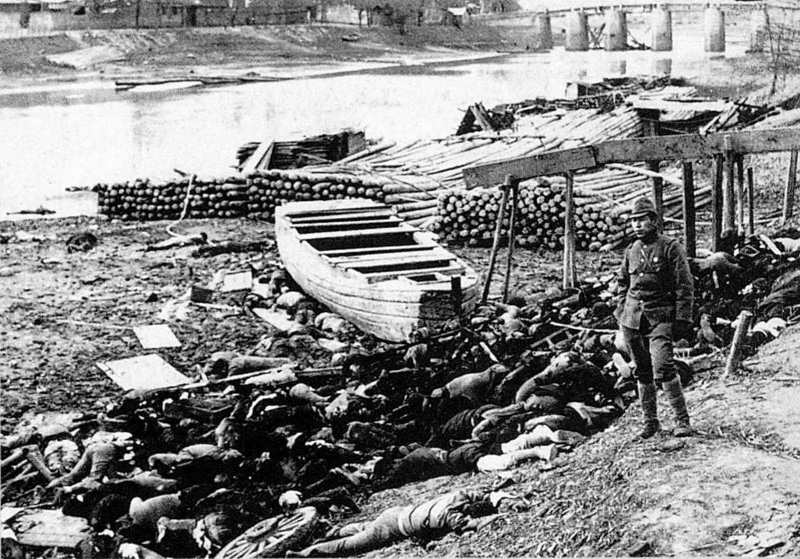
Nanking Massacre · December 1937 · Wikimedia Commons
A Witness in the City
Unit 731 — Human Experimentation as State Policy
- Imperial Japanese Army's secret biological and chemical warfare research program, headquartered near Harbin, Manchuria
- Cover name: Epidemic Prevention and Water Purification Department of the Kwantung Army
- Commanded by General Shirō Ishii — victims referred to in Japanese military documents as maruta — "logs"
- Field-tested biological weapons on Chinese civilian populations — plague-infected flea bombs caused outbreaks killing an estimated 200,000–300,000
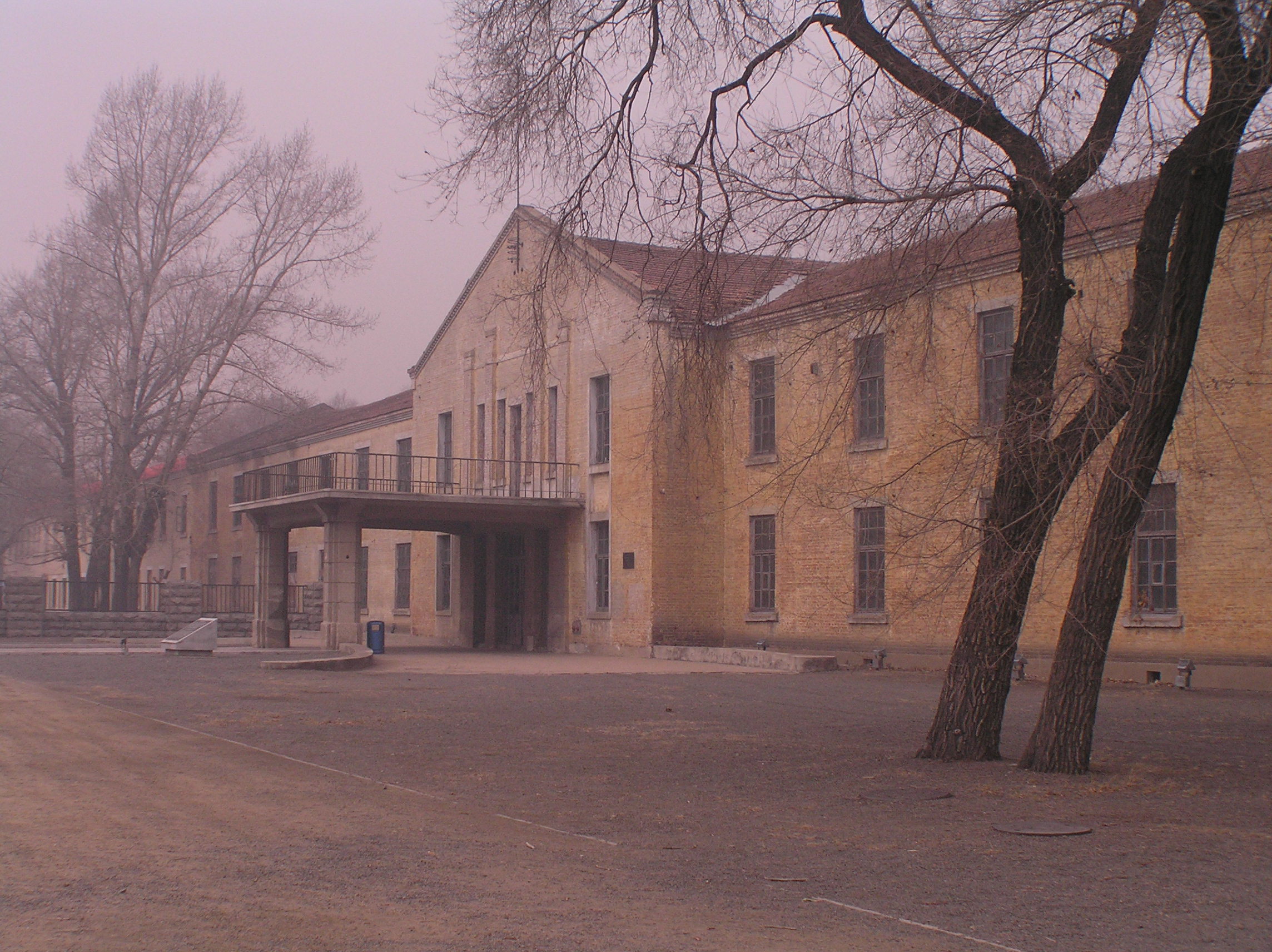
Unit 731 Facility · Harbin, Manchuria · Wikimedia Commons
Unit 731 — What They Actually Did
- Vivisection of living subjects without anesthesia — organs removed while subjects were conscious
- Deliberate infection with plague, cholera, typhoid, and anthrax to study disease progression in living subjects
- Frostbite experiments — subjects exposed to freezing conditions; flesh removed to study tissue damage
- Pressure chamber experiments — rapid decompression to study effects on the body
- Results written as scientific reports and presented at medical conferences — same as Mengele
- Victims: Chinese civilians, Soviet POWs, Korean laborers — all classified as maruta
- General MacArthur authorized immunity for Ishii and Unit 731 scientists — existence suppressed until the 1980s
- Scientists returned to civilian life; several had distinguished postwar careers in Japanese medicine
The Comfort Women System
- Imperial Japanese Army operated an official network of military brothels across occupied territories — direct military policy, not private enterprise
- Estimated 200,000 women and girls — primarily Korean, Chinese, Filipino, and Dutch — forced into sexual slavery
- The army organized recruitment (frequently through deception or coercion), transportation, medical inspection, and regulation
- Women assigned to service multiple soldiers daily; many killed on Japanese retreat to prevent testimony

Korean Women Under Japanese Annexation · Wikimedia Commons · Public Domain
The Bataan Death March — April 1942
- 75,000 American and Filipino troops surrender on the Bataan Peninsula, Philippines — April 9, 1942
- Forced march of 65 miles to Camp O'Donnell — no food, almost no water, no medical care; tropical heat exceeding 90°F
- Japanese guards beat, bayoneted, and shot prisoners who fell or lagged; prisoners who stopped to drink from roadside puddles were killed
- 7,000–10,000 died on the march; thousands more died in the camp in the weeks that followed

Bataan Death March · April 1942 · U.S. Army · Wikimedia Commons
⏸ Pause & Reflect
The Holocaust and Japanese wartime atrocities are roughly comparable in scale. The Holocaust is taught in virtually every American school. Japanese imperial violence is largely absent from standard curricula.
What explains this disparity? What does it tell us about how nations choose which atrocities to remember?
Section V
Hannah Arendt and the horror of ordinary perpetrators
Extreme Evil
- Atrocities committed by totalitarian regimes on a massive scale
- Necessarily involve the actions of otherwise normal, good people
- Raises the unsettling question: Are we just like them?
- Arendt insists: this can and must be understood

Hannah Arendt · 1975 · Public Domain · Wikimedia Commons
The Banality of Evil
- What causes good people to do evil? Most often: ideology
- Any ideology that subordinates the individual to some "greater good" produces atrocities
- Totalitarian regimes create superfluous people — those who have lost the ability to think
- Examples: Communist Russia, Nazi Germany, Fascist Japan
The Superfluous Human
- Under totalitarianism, the human as a human being becomes superfluous
- This applies to both victim and perpetrator
- Eliminates all spontaneity, creativity, and individuality
- It dehumanizes everybody
Men Made Superfluous
The Inability to Think
- Totalitarianism desires to destroy this inner dialogue
- It creates citizens who no longer judge between right and wrong — who simply serve the state
Adolf Eichmann & the Banality
- Arendt's concept arrived from observing the Eichmann Trial, 1961
- Not the evil monster she expected — a mindless bureaucrat
- Proud of his loyalty and efficiency in "just following orders"
- Capable of moving millions to their death without even holding a grudge
Search: "Adolf Eichmann trial Jerusalem 1961"
Source: Wikimedia Commons, Getty Images
⏸ Pause & Reflect
Hannah Arendt concluded that most perpetrators of atrocity were not monsters — they were ordinary people who had stopped thinking. What does that imply about us?
Section VI
Memory, education, and the courage to think
Education Is Key
- Education is essential — but not education for its own sake
- Dr. Joseph Mengele & Dr. Shiro Ishii were both highly educated
- Education must teach people how to think — critical reasoning and moral courage
- We need citizens with the ability, liberty, and courage to act on moral choices
Memory & History
- The lesson of atrocity is not hatred of a people — but hatred of ideologies that devalue the individual
- Fascism, communism, and any creed that makes the individual expendable
The Standing Warning
- Any ideology that subordinates the individual to a "greater good"
- Suppression of free thought and dissent
- Creation of superfluous classes of people
- Protect and defend individual rights
- Cultivate the inner dialogue — the habit of moral thinking
- Act — good people who do nothing enable evil
⏸ Pause & Reflect
There is good in the world. Go take part in it.