Today's Argument
- The New Deal didn't just intervene in the economy — it seized the camera
- FSA photography was propaganda, not journalism
- Private culture — swing, Hollywood, radio — delivered what the state could not
- New Deal's most durable product: the story of how it saved America
Section I
When economic policy fails, manage perception instead
The State’s Turn to Cultural Management
- Depression persisted despite a decade of federal programs; Roosevelt turned to culture as a political instrument
- New Deal planners recognized that perception was as important as policy
- Goal: If the state could not restore prosperity, it could at least manage how Americans interpreted its failure.
- and build public support for New Deal relief and reform programs
- Not neutral governance — manufactured consent

NRA Blue Eagle · 1933 · Public Domain · Wikimedia Commons
The New Deal Cultural Apparatus
- Federal Art Project
- Federal Theatre Project
- Federal Music Project
- Federal Writers' Project
- FSA Historical Section
- Created 1935 under Roy Stryker
- 160,000–270,000 images, vast majority never published
- Stryker's office selected, captioned, and distributed for maximum political effect
- Not spontaneous democratic creativity
- Federal agencies staffed by government employees
- Directed by politically appointed administrators
- Funded by taxpayer dollars via Congress
- Designed to demonstrate New Deal success or support for programs
The International Context
- The Soviet Union had pioneered state-directed cultural production in the 1920s and early 1930s
- Soviet Union — Socialist Realism as official aesthetic doctrine
- Fascist Italy — architecture and spectacle as legitimation
- Both used art to justify expanding state power
- Neither Stalinist nor fascist
- But same intellectual climate
- Same premise: the state has a legitimate role in shaping culture
⏸ Pause & Reflect
The Soviet Union, Fascist Italy, and the New Deal all developed state-sponsored cultural programs in the 1930s.
Is it unfair to make that comparison — or is the comparison itself the point?
Section II
The FSA Photography Program
Roy Stryker's Operation
- Columbia economics instructor — no photography training
- Embedded in FSA's Information Division
- Explicit Mandate: build congressional and public support for programs
- Photographers were federal employees with assigned scripts
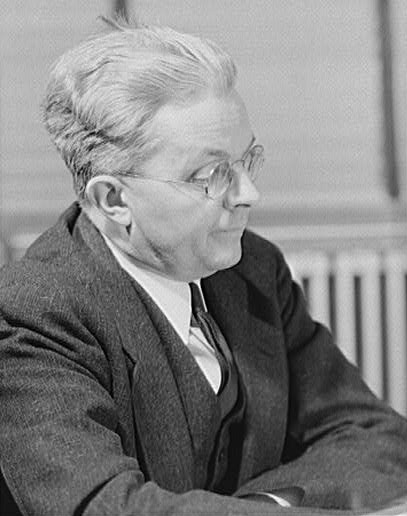
Roy Stryker · c. 1940s · Public Domain · Wikimedia Commons
Photography as Propaganda
- Stryker wrote detailed pre-assignment scripts: what to find, what to feel
- Not the language of documentation — the language of a communications operation
- The story was decided before the shutter clicked
- FSA photographers arrived with a script, prescribed narrative, and returned the images to a federal office
- Federal office, not the photographers, culled, captioned, and distributed for maximum political effect
What the Archive Excluded
- White Dust Bowl migrants
- White Southern tenant farmers
- Destitution, desperation — suffering that justified federal spending
- White faces only — because photographs of Black poverty would have cost FDR the Southern votes that kept the New Deal alive
- Private recovery, local charity — Americans helping each other without Washington
- Black sharecroppers displaced by AAA crop restrictions — the program's own casualties
- Small businesses crushed by NRA codes written by their corporate competitors
- The families taxed to fund the propaganda machine documenting their neighbors' suffering
⏸ Pause & Reflect
Roy Stryker punched holes in negatives he considered "unusable." What does this tell us about the FSA archive?
- Stryker was a careful editor protecting photographic quality
- The archive is a curated political argument, not a neutral record
- FSA photographers had too much creative freedom
- Depression-era film was scarce and had to be managed carefully
Section III
When the state pays the photographer, who speaks?
Migrant Mother and the Mechanics of Icon-Making
- Reproduced more than any other photograph in the collection; shorthand for entire Depression era
- Government directed photography converts a specific woman's suffering into a universalized argument for federal intervention
- Six exposures in ten minutes — one selected in Washington
- Thompson was never named in any initial distribution
- Identified only as "a migrant worker" / "the face of the Depression"

Subject: Florence Owens Thompson, age 32
Lange's Own Words
- Did not consent to having her image distributed nationally, had no control over captions attached to her picture, and recieved no compensation
- Asymmetrical exchange: Lange built a career; Thompson got nothing
- "She helped me" — who was serving whom?
- Thompson came forward in 1978 to object to her representation
Staging, Cropping, Manipulation
- Earlier frames show Thompson looking directly at camera — too confrontational
- Lange guided children into position for maximum maternal desperation
- Arthur Rothstein's skull (1936): moved to cracked earth for dramatic effect
- When exposed, Republican press attacked entire FSA program as fraudulent
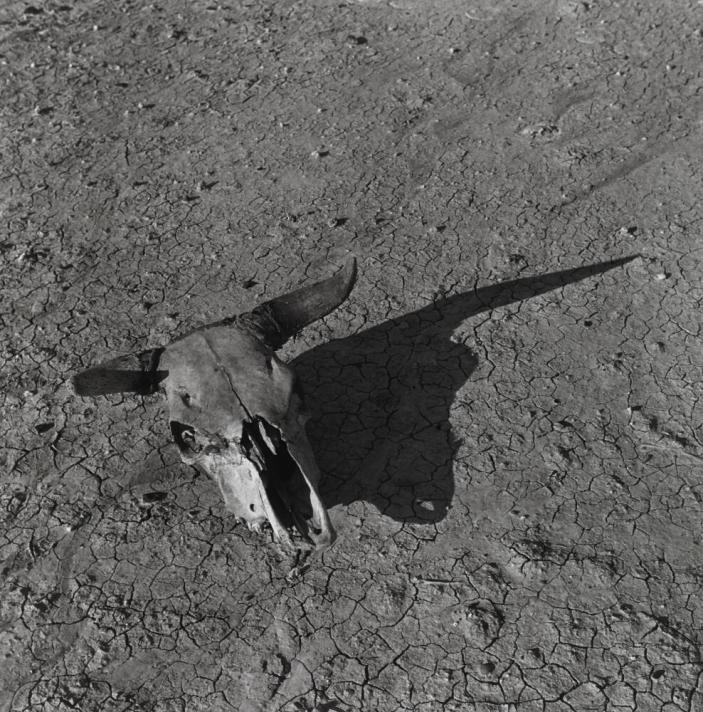
Arthur Rothstein · Cimarron County, Oklahoma · 1936 · Public Domain · FSA / Wikimedia Commons
⏸ Pause & Reflect
Lange · Migrant Mother · 1936 · Public Domain

McCurry · Afghan Girl · 1984 · Nat. Geographic
- Both photographed by someone with institutional power — government payroll, major media
- Both published without meaningful consent — Thompson unnamed for decades, Gula's name unknown for 17 years
- Both made the photographer famous — the subject received little or nothing
- Gula expressed anger, not gratitude when found in 2002 — her face seen by millions of men, a cultural violation she never agreed to
- Thompson: "I wish she hadn't taken my picture. I can't get a penny out of it."
When does the power of an image justify the cost to the person in the frame?
Walker Evans in Alabama, 1936
- Evans documented sharecroppers in Hale County
- Assigned under FSA shooting script
- Published in Let Us Now Praise Famous Men (1941)
- Images selected in Washington — not by Evans in the field

Walker Evans · Hale County, AL · 1936 · Public Domain · Library of Congress / Wikimedia Commons
The Counter-Image: Gordon Parks, 1942
- American Gothic (1942) — Ella Watson, charwoman at a federal building in Washington D.C., standing with mop and American flag
- Parks was the first Black photographer hired by the FSA — joining seven years after the program began
- The title echoes Grant Wood's 1930 painting of white rural dignity — Parks inverts that iconography deliberately
- Watson was cleaning the offices of the government that had excluded her from its programs — the AAA, the NRA, Social Security
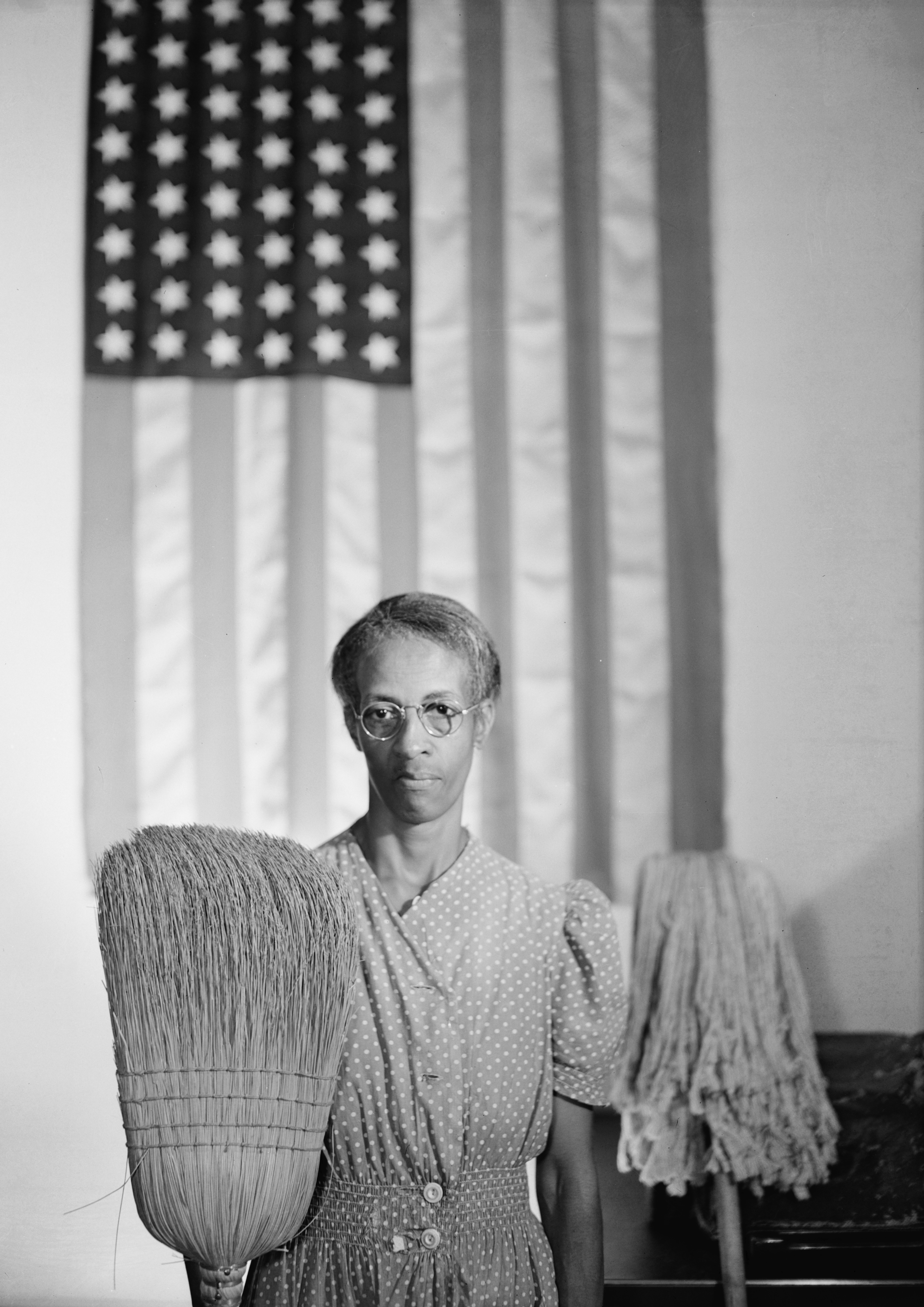
Gordon Parks · American Gothic · 1942 · Public Domain · Library of Congress / Wikimedia Commons
Named and Unnamed
Lange · Migrant Mother · 1936 · unnamed in all initial distributions
- No name → universal symbol — she could mean every suffering American
- Anonymity converted a specific woman's suffering into a general political argument
- Reproduced in national newspapers, wire services, magazines — immediately
Parks · American Gothic · Ella Watson · 1942 · named, specific, politically unusable
- A name → specific person — her story indicted the programs, not justified them
- Named Black poverty was particular and limited — not Everyone's Problem requiring federal remedy
- Circulated in limited venues — largely invisible in the official archive
The archive's rule: White poverty was rendered anonymous and universal — a justification for federal spending. Black poverty, when it appeared at all, was rendered specific and named — and therefore limited, particular, someone else's problem.
⏸ Pause & Reflect
Both Migrant Mother and American Gothic are FSA photographs of poverty and dignity. Why did Migrant Mother become the face of the Depression — and American Gothic did not?
- Migrant Mother was taken earlier, giving it more time to circulate and embed in the national press before the FSA wound down
- Stryker distributed Migrant Mother through national wire services; American Gothic depicted suffering that contradicted the New Deal's own programs
- American Gothic was a less technically accomplished photograph and did not meet FSA distribution standards
- Migrant Mother depicted white rural suffering that served the coalition's political narrative; Black poverty implicated the programs rather than justified them
Section IV
What bottom-up democratic culture actually looked like
Swing: No Federal Agency Required
- No congressional appropriation, no shooting script, no political mandate
- Roots in Black musical tradition — Kansas City jazz, Chicago dance bands
- August 1935: Benny Goodman at the Palomar Ballroom — the Swing Era begins
- Market-driven, bottom-up, genuinely responsive to popular desire
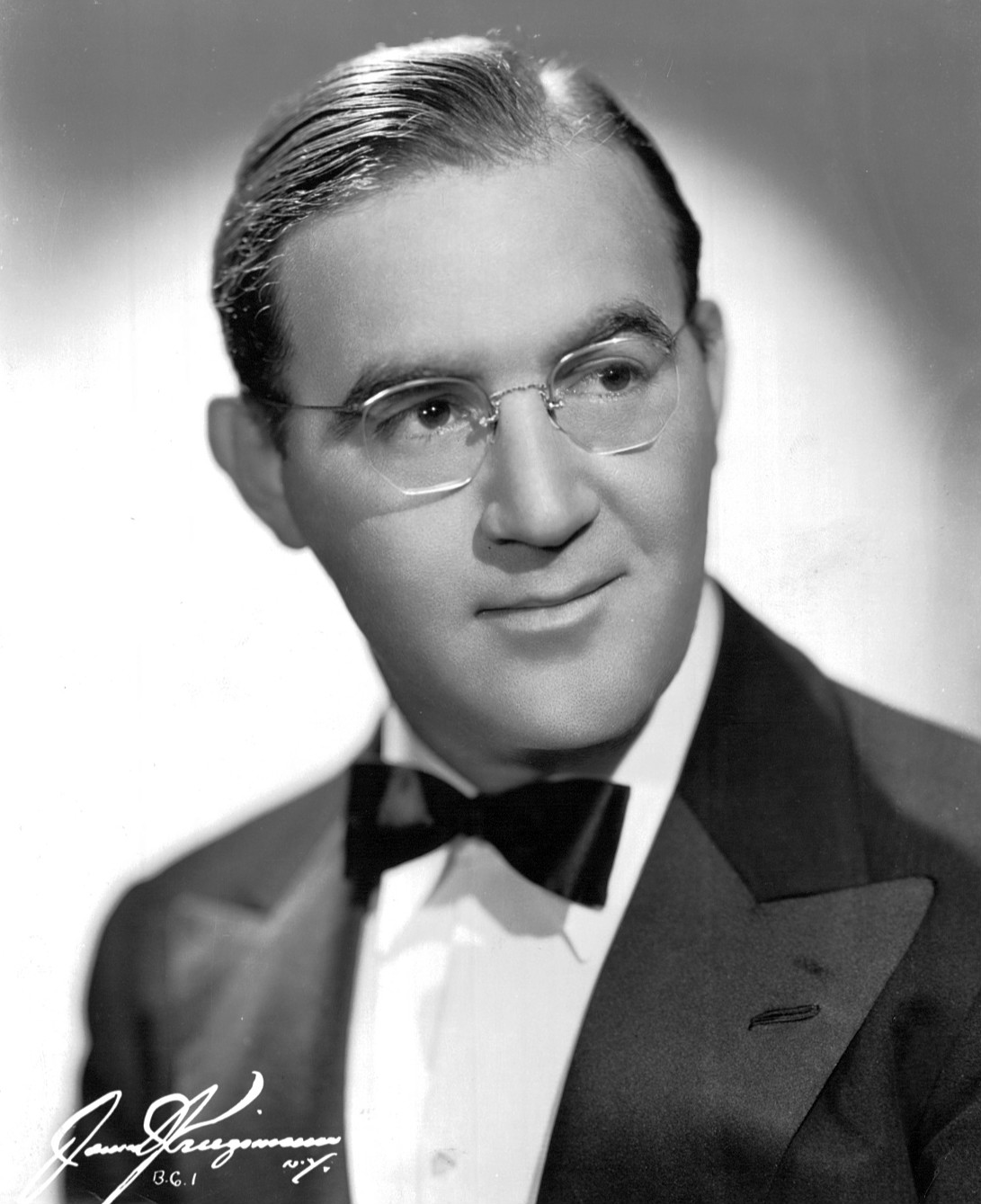
Benny Goodman · 1942 · Public Domain · Wikimedia Commons
The Savoy Ballroom
- Harlem's Savoy Ballroom — opened 1926, integrated by the mid-1930s
- Black and white dancers on the same floor — not because Washington ordered it
- Integrated because the music was that good
- The dance floor integrated faster than the New Deal
Savoy Ballroom · Harlem, New York
Ellington and Basie: No Subsidy Needed
- Duke Ellington produced Reminiscing in Tempo (1935), Diminuendo and Crescendo in Blue (1937)
- Sustained a touring organization employing dozens — no New Deal subsidy
- Fletcher Henderson, whose arrangements drove Goodman, was Black
- Market incentivized genius; the state's Federal Music Project funded community bands
Duke Ellington · Diminuendo and Crescendo in Blue
The Race Argument
- Black artistic genius drove the entire vocabulary of swing
- Imperfect but genuine integration through shared musical experience
- Market rewarded talent across the color line
- FSA photographs of white Dust Bowl migrants
- AAA, NRA, Social Security excluded most Black Americans
- Cultural programs reflected the same political calculus
⏸ Pause & Reflect
Duke Ellington produced some of the most ambitious American music of the 20th century — without a dollar of federal subsidy.
What does that tell us about the relationship between government funding and cultural quality?
Section V
The movie palace as democratic space — no taxpayers required
Escapism Is Not Trivial
- 15 cents bought two hours in which the Depression was not the organizing fact of life
- Private studios chasing profit delivered emotional sustenance the New Deal could not
- To escape temporarily is to restore psychological resources — hope, pleasure, possible futures
- Hollywood cost taxpayers nothing
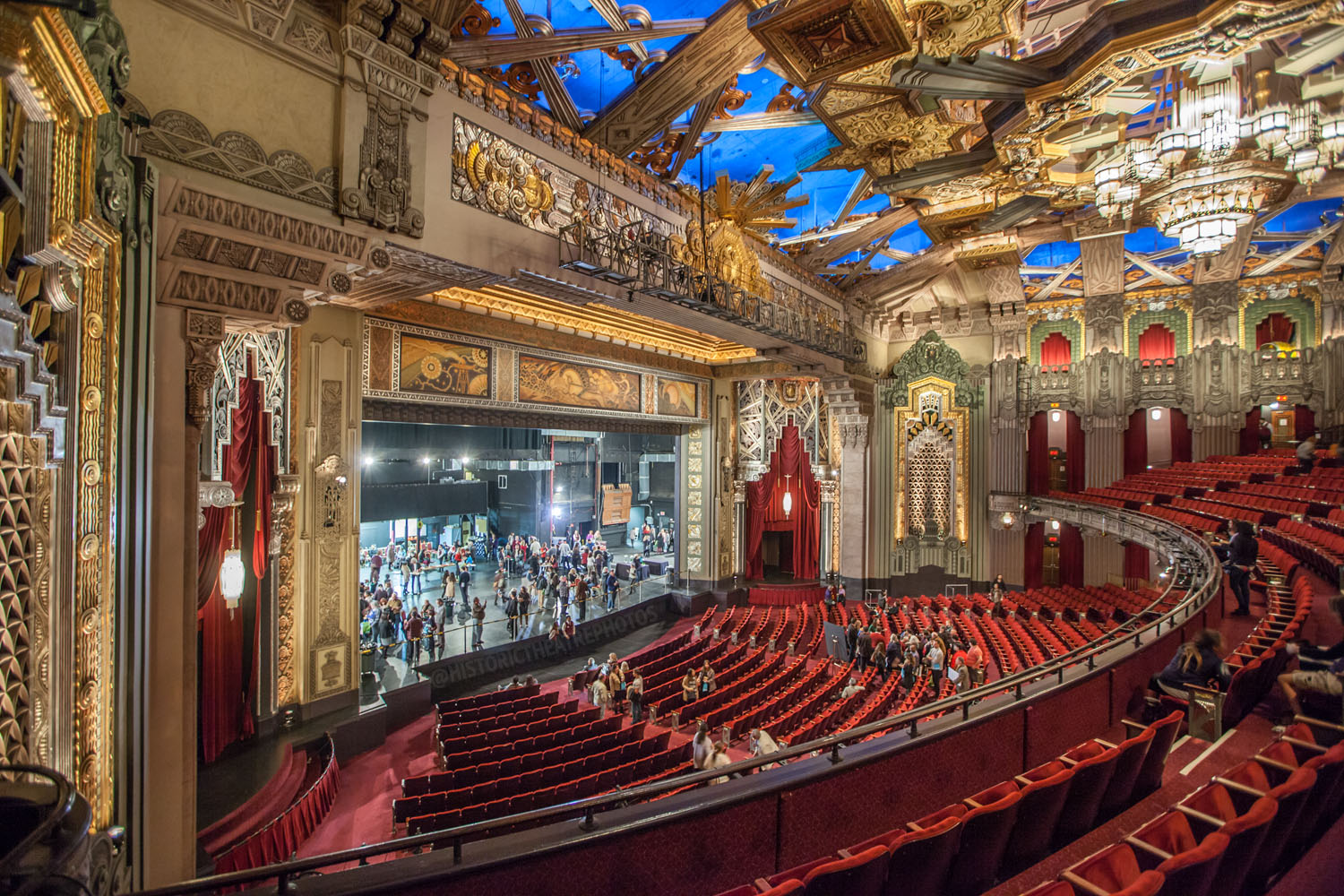
Pantages Theatre · Hollywood, California · 1930 · Public Domain · Wikimedia Commons
Pre-Code Hollywood: More Honest Than the FSA
- Warner Bros. social problem films depicted suffering without political management
- I Am a Fugitive from a Chain Gang (1932) — brutal, unsentimental
- Wild Boys of the Road (1933) — homeless youth, unvarnished
- Pre-Code era, 1930–1934 — commercially driven exploration of social reality

I Am a Fugitive from a Chain Gang · 1932 · Public Domain · Wikimedia Commons
The Government's Real Role in Hollywood
- The Production Code (Hays Code) enforced with new rigor from July 1934
- Shut down pre-Code social realism — replaced it with ideologically managed fantasy
- Federal government's most consequential act in Hollywood: censorship, not subsidy
- Hollywood's Golden Age was partly what the Code prohibited
⏸ Pause & Reflect
The Hays Code banned "sympathy for criminals," "lustful kissing," and "ridicule of the clergy." The FSA suppressed images that complicated New Deal policy. What do these acts of censorship have in common?
- Both were reactions to public demand for wholesome content
- Both were private industry decisions with no government involvement
- Both represent institutions shaping culture to protect their own authority
- Both were temporary measures quickly reversed by market pressure
Section VI
FDR's medium — but not FDR's creation
Private Broadcasting Unites America
- NBC and CBS — privately owned, advertising-supported
- National simultaneous broadcasting by 1933
- Built by private enterprise, not federal planning
- Jack Benny — 1932; millions weekly
- Lux Radio Theatre — 30–40 million weekly listeners
- Comedy, drama, music, soap opera
- Pleasure and laughter — not federal instruction

Click to play · 1930s radio broadcast
The Shadow
- Debuted 1930 — one of the most popular radio dramas of the Depression era
- "Who knows what evil lurks in the hearts of men? The Shadow knows."
- Orson Welles voiced the Shadow from 1937–1938 before his infamous War of the Worlds broadcast
- Radio gave Americans shared mythology — 30 million listeners, same story, same night
The Shadow · CBS Radio · 1930–1954 · click to play
Buck Rogers in the 25th Century
- Debuted 1932 — the first science fiction serial on American radio
- Americans escaping bread lines tuned in to interplanetary adventure — escapism as survival strategy
- Spawned comic strips, toys, and film serials — one of the first true media franchises
- The Depression audience didn't just want distraction — they wanted a future worth imagining
Buck Rogers in the 25th Century · CBS Radio · 1932–1947 · click to play
Section VII
The New Deal's most durable product
The New Deal Cultural Imaginary
- White Southern tenant farmers
- Dust Bowl migrants (the political coalition)
- Federal compassion and decisive action
- The narrative that government saved America
- Urban industrial unemployment
- AAA-displaced Black sharecroppers
- Small businesses crushed by NRA
- The families taxed to fund the propaganda machine itself
The Myth-Making Machine
- Yet the FSA archive, FWP oral histories, and FAP murals produced a durable national mythology
- The myth: federal intervention, through compassion and decisiveness, saved ordinary Americans
- The FSA photographs did not document the Depression — they produced it as a political object
- The photographs are magnificent. They are also propaganda. Both are true.
Two Cultural Formations
- FSA, Federal Theatre, FWP
- Serves the state that funds it
- Suppresses contradictory evidence
- Produces the myth of its own success
- Swing, Hollywood, radio
- Serves popular desire
- No obligation to Washington's narrative
- Delivered what the state could not
⏸ Pause & Reflect
Does government support for the arts produce culture that enriches democratic life — or culture that serves the state that pays for it?
The New Deal's answer was not ambiguous. Is ours?
The Social Security Act as originally passed explicitly excluded agricultural laborers and domestic servants from its old-age insurance provisions. These occupational categories were not chosen arbitrarily: they were the categories in which the majority of Black workers in the South were employed. The exclusion was the direct result of Congressional pressure from Southern Democrats who refused to support any federal program that would provide equal benefits to Black and white workers. Approximately 65% of Black workers in the South were initially ineligible for Social Security coverage. The exclusions were not corrected until 1950 and 1954 amendments.