The Influenza Pandemic
HIST 102 — U.S. History Since 1877 | Chapter 23, Lecture 2
Richland Community College
A Cliff in the Data
- American life expectancy dropped 10–12 years in a single calendar year
- From roughly 51 years … to roughly 39. In 1918. Just one year.
- More Americans dead than all U.S. combat deaths in all 20th-century wars combined
That has never happened before or since in recorded American history.
,_National_Museum_of_Health_and_Medicine_(5857153474).jpg)
National Museum of Health and Medicine
Pandemic Mortality Chart · 1918 · Public Domain · NMHM / Wikimedia Commons
Three Acts
- Act I: The Story — waves, bodies, cities, armies
- Act II: Institutional Collapse — medicine, governance, failure of expertise
- Act III: The Experience — how Americans actually lived through it
- Act IV: The Forgetting — why this catastrophe nearly disappeared from memory
Central question: Why did the infrastructure of total war become the infrastructure of pandemic death?
Section I
Where did it come from? What did it do?
Naming the Pandemic
- U.S., Britain, France, and Germany all had wartime censors suppressing bad news
- Spain was neutral, had a free press, reported openly — including King Alfonso XIII's illness
- The world concluded Spain was the source; it was not
- Spain was simply the only country telling the truth
The name encodes a political fact, not a geographic one
Where Did It Start?
- Leading hypothesis: Haskell County, Kansas — severe respiratory illness, Jan–Feb 1918
- Draftees sent to Camp Funston — 56,000 troops in crowded, poorly ventilated barracks
- Other hypotheses: northern France, northern China labor corps
- We don't know for certain where it began — we know where it went

Influenza Ward, Camp Funston, Kansas · 1918 · Public Domain · Wikimedia Commons
First Wave — Spring 1918
- March: soldiers at Camp Funston report symptoms; most recover within a week
- April–May: Americans cross the Atlantic in packed troopships — virus crosses with them
- By June: a mild flu moves through Allied and German units on the Western Front
- Medical establishment classifies it as ordinary grippe — a catastrophic misreading
Second Wave — Fall 1918
- Appears simultaneously in late August at three separated points: Brest (France), Freetown (Sierra Leone), Boston
- Same mutated virus moving along arteries of the global military supply network
- A soldier could feel fine at dawn and be dead by midnight
- Total war's infrastructure was functioning as a delivery mechanism for a lethal pathogen

Influenza Ward, Camp Hospital No. 24, Langres, France · 1918 · Public Domain · Wikimedia Commons
The Cytokine Storm — Why Young Adults Died
- W-shaped mortality curve
- Catastrophic spike: adults 20–40
- Strongest immune systems = most vulnerable
- Hours from onset to cyanosis to death
The immune system overreacts catastrophically — attacking the body's own lung tissue. Lungs fill with fluid. Oxygen stops reaching the blood. The stronger the immune system, the more destructive the response.
Death from drowning in one's own inflammatory response.
The healthiest bodies were, literally, the most dangerous bodies to be in
The Great Lakes Naval Station — Illinois
- One of the nation's largest military installations — north of Chicago on Lake Michigan
- Sept–Oct 1918: thousands of sailors infected within days of the second wave
- Sent home on medical leave — took trains south and west through the Midwest
- The regional rail network built for prosperity became the delivery system for a lethal pathogen
The connection between economic infrastructure and pandemic spread was not incidental — it was structural
Third Wave — Winter 1919
- Less lethal than the second — strikes an already exhausted, depleted population
- Global toll: 50–100 million dead (range reflects minimal documentation in South Asia and sub-Saharan Africa)
- U.S. toll: 675,000 dead — more than all American combat deaths in all 20th-century wars combined
⏸ Pause & Reflect
The same military infrastructure that gave the U.S. wartime power also accelerated the pandemic. Which best describes this relationship?
- Coincidence — the timing was unfortunate
- Structural — mobilization created the conditions for viral spread
- Intentional — government chose war over public health
- Inevitable — all modern wars produce pandemics
Section II
Medicine, governance, and the failure of expertise
The Doctor's Problem
- Virology was in its infancy — viruses only theorized since the 1890s, none yet visible or isolatable
- Dominant consensus: flu caused by Pfeiffer's bacillus — physicians were looking for the wrong thing
- No effective treatment — aspirin sometimes prescribed at doses that caused hemorrhaging
- This is not a story of bad doctors — it is what happens when genuine expertise meets something outside its explanatory framework
Victor Vaughan — Camp Devens, September 1918
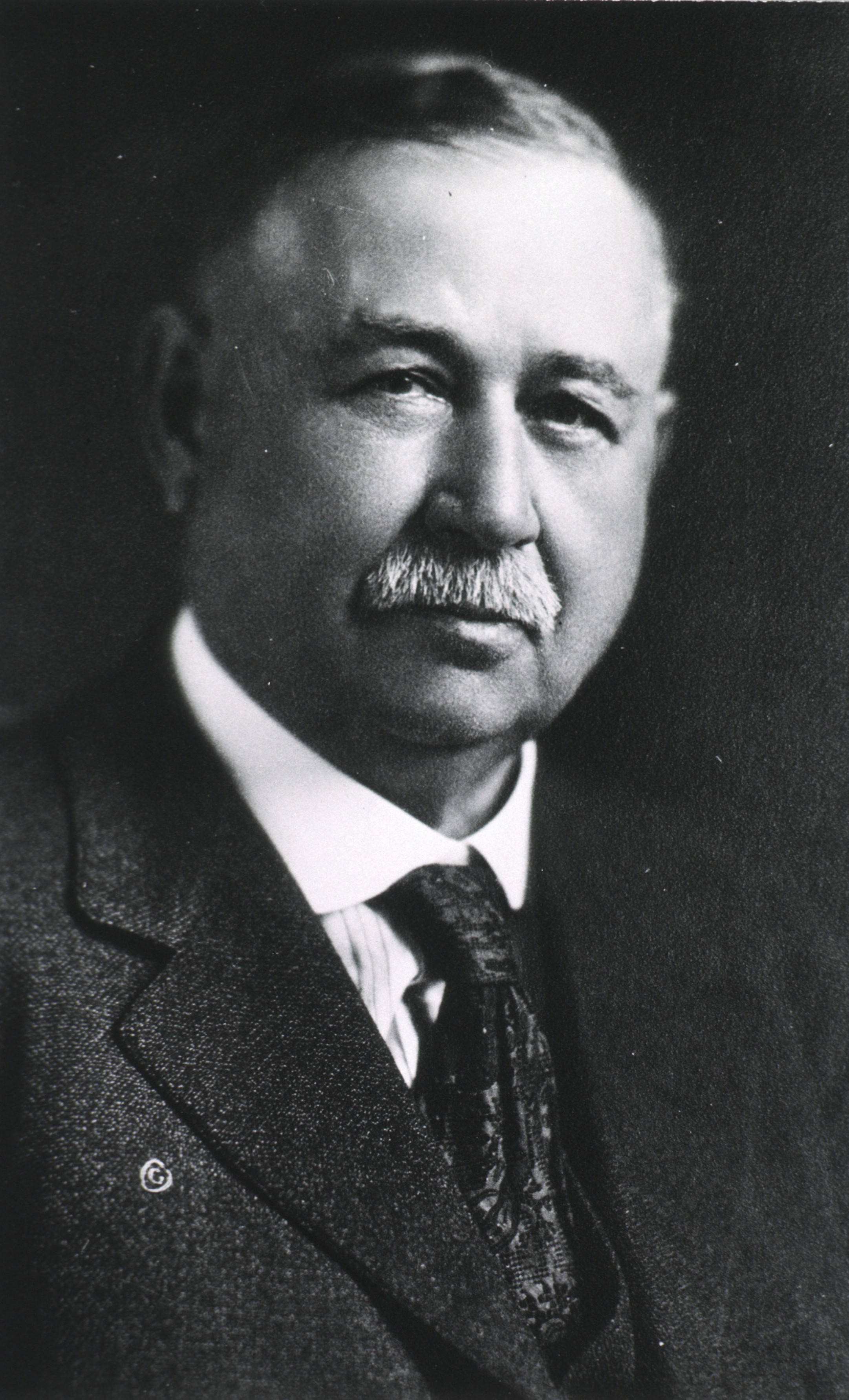
Dr. Victor C. Vaughan · Former AMA President · Public Domain · Wikimedia Commons
City Responses — A Patchwork of Failure
- Philadelphia: held Liberty Loan parade (200,000 people) despite explicit warnings — every hospital bed full within 72 hours; city ran out of coffins
- San Francisco mandated gauze masks with fines — public resistance collapsed within weeks
- Kansas City closed theaters, schools, and churches
- 2007 JAMA study: cities that acted earliest fared measurably better — but political will to act before visible crisis was nearly impossible to sustain

"Since There's No Place to Go" · San Francisco · October 1918 · Public Domain · Wikimedia Commons
Wilson's Silence and the Sedition Act
- Wilson never publicly acknowledged the pandemic — not once in a major address or official statement
- The Committee on Public Information had conditioned Americans to treat any expression of doubt as unpatriotic
- Honest pandemic reporting risked federal prosecution under the Sedition Act
- Result: systematic false reassurance while neighbors died and hospitals collapsed
Total War, Total Silence
The modern state that just demonstrated it could organize armies could not tell citizens the truth about a disease.
The censorship infrastructure built for war turned out to be perfectly designed for suppressing a pandemic.
Total war and total silence arrived together.
⏸ Pause & Reflect
When the government suppressed pandemic information to protect wartime morale, who paid the price — and who made the decision that it was worth paying?
Section III
How Americans actually lived — and died — through the pandemic
Speed and Isolation
- A person who woke up healthy could be dead within 24 hours — families watched violence, not slow decline
- Public health closures shut theaters, schools, and churches — eliminating the infrastructure through which communities normally grieve
- No funerals, no last rites, no extended family past quarantine lines
- People died without the communal rituals that give death meaning in virtually every human culture
.jpg)
Nurse and Patient, Spanish Flu Ward, Walter Reed · 1918 · Public Domain · Wikimedia Commons
When the Infrastructure Breaks
- Hospitals fill → nurses and physicians fall ill (cytokine storm targets healthy adults — the healthcare workforce)
- Medical students and Red Cross volunteers with weeks of training deployed into overwhelmed wards
- Philadelphia: Catholic priests drove horse-drawn carts collecting bodies from doorsteps
- A city of over a million people, with a modern public health infrastructure, ran out of coffins
The Red Cross Response
- Red Cross Emergency Ambulance Stations mobilized across American cities
- Volunteers with minimal training serving as the last line of care
- The same civilian infrastructure that mobilized for the war now mobilized — inadequately — for the crisis at home
- The war had hollowed out the civilian workforce doing the mobilizing

Red Cross Emergency Ambulance Station, Washington D.C. · 1918 · Public Domain · Library of Congress / Wikimedia Commons
Jim Crow and the Unequal Pandemic
- Black patients routinely denied admission to primary municipal hospitals — not because beds were full, because they were Black
- Segregated wards: chronically underfunded, no surge capacity whatsoever
- A separate Black Red Cross network and Black physicians organized their own response under structural exclusion
- Once hospitalized, case-fatality rates for Black patients significantly exceeded white patients — not because they were sicker, but because resources were inferior by institutional design
Native Americans — Catastrophe Without Infrastructure
- Office of Indian Affairs: decades of underfunded reservation medicine — most reservations had no hospital, no resident physician
- Mortality rates among Native Americans ran four to five times higher than the U.S. general population
- Some communities lost 10–20% of their entire population within weeks
- Boarding schools — concentrated students from multiple nations in crowded dormitories — became flu vectors in the fall of 1918
1918 in Native America — A Longer Emergency
- 1918 arrived in communities already reduced by epidemic disease, dispossession, forced removal, and a boarding school system still actively operating
- For many Native Americans, this was not an interruption — it was another chapter in a continuous emergency running for generations
⏸ Pause & Reflect
The pandemic's differential mortality followed structural lines — Jim Crow segregation, underfunded reservation medicine. What does "everyone suffered equally" tell us about American catastrophes?
- Largely true — disease transmission does not discriminate
- False — structural inequalities consistently shape who survives
- Situational — depends on the nature of the catastrophe
- A useful simplification that promotes national unity
Section IV
Why did a catastrophe this large nearly disappear from memory?
America's Forgotten Pandemic
- No monuments to flu victims — unlike war dead
- No films reconstructing the pandemic in the 1920s
- No commemorative ceremonies, no national day of mourning
- Alfred Crosby titled his 1976 study America's Forgotten Pandemic — a literal description, not rhetoric
How does a civilization forget something this large?
.jpg)
Newspaper Boy in Flu Mask, Seattle · 1918 · Public Domain · MOHAI / Wikimedia Commons
Why the Forgetting? — Crosby
- No heroes — no general who turned the tide, no scientist who found a cure
- No identifiable villain — no enemy army, no responsible party to blame
- No turning point where human agency overcame the threat — it simply ran its course
- Deaths happened in private spaces — homes, quarantine wards — not on battlefields where witnesses and photographs accumulate
Why the Forgetting? — Barry
- The Wilson administration prevented Americans from developing an honest public language for the pandemic while it was happening
- Communities told not to express fear or acknowledge death found themselves after the crisis with no language for their grief
- Silence externally imposed became the silence that internally persisted
- Without public language, collective memory cannot form
._Original_from_Library_of_Congress._Digitally_enhanced_by_rawpixel._(50636591831).jpg)
St. Louis Red Cross Motor Corps · 1918 · Public Domain · Library of Congress / Wikimedia Commons
What Was Left Behind
- The wound was never publicly addressed — only privately endured
- Americans had survived: 100,000+ combat dead, 675,000 pandemic dead, and a government that lied through both
- Trust, once broken at that scale, does not automatically repair when the emergency ends
- What Americans carried into the 1920s was not explicit pandemic memory — but the distrust it produced
⏸ Pause & Reflect
A society that has suffered at scale and has no public language for that suffering does not heal — it waits.
What does the culture of the 1920s — its cynicism, withdrawal from public idealism, appetite for escapism — tell us about what Americans were carrying forward?
Closing
What total war proved — and what it could not do
What the Modern State Can Do
- Draft armies, mobilize industries, manage information across a continent
- Turn automobile factories into artillery shell plants
- Move millions of human beings with organizational precision toward a single purpose
- Redirect virtually every corner of American life toward a unified goal
What the Modern State Cannot Do
- Stop a pathogen that moves faster than information
- Protect a population it has committed to lying to
- Provide meaning for deaths with no battlefield, no flag, and no enemy
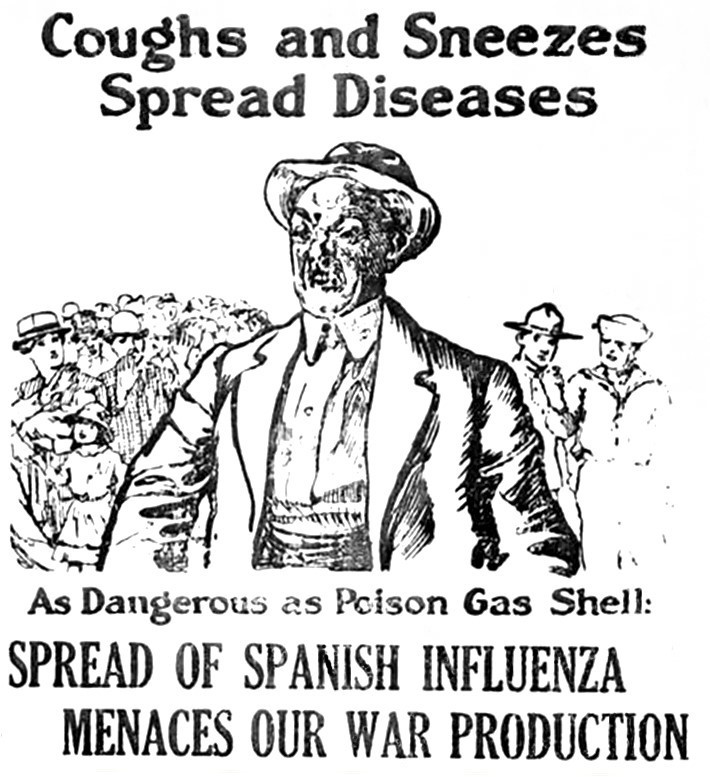
"Coughs and Sneezes Spread Diseases" · British Public Health Poster · Public Domain · Wikimedia Commons
The Unanswered Question
If a government builds its legitimacy on the promise of protection — and then fails, visibly and catastrophically, to protect —
what happens to the consent of the governed?
We will be asking versions of that question for the next several weeks.
Next Time
- The Paris Peace Conference and the Treaty of Versailles
- Woodrow Wilson's collapse — the man who censored pandemic news now designing a new international order
- His own country unraveling while he sat in Versailles
The flu will follow us into that room.