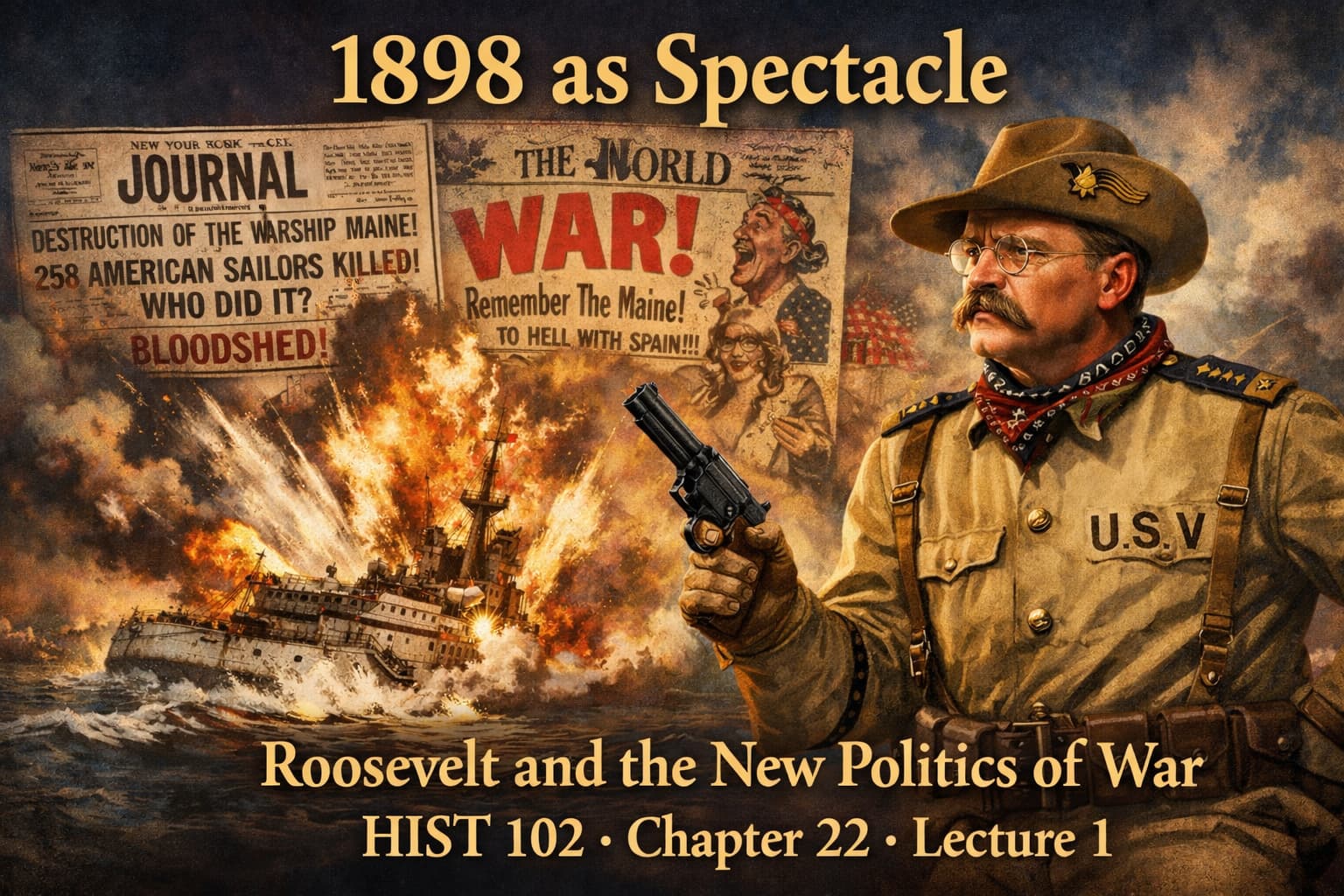
Today's Questions
- How did mass media transform American politics in the 1890s?
- What is the difference between an event and its meaning?
- Why did Theodore Roosevelt resign a position of power — and what did he understand that others didn't?
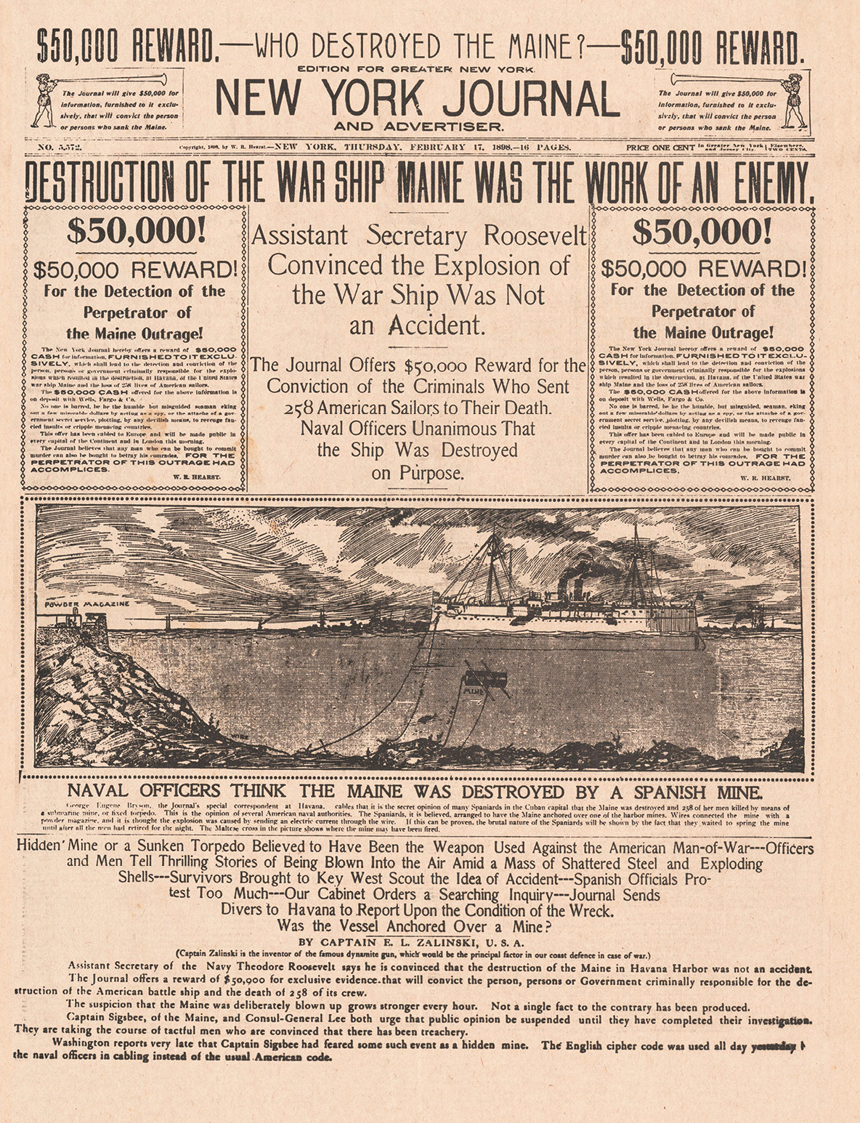
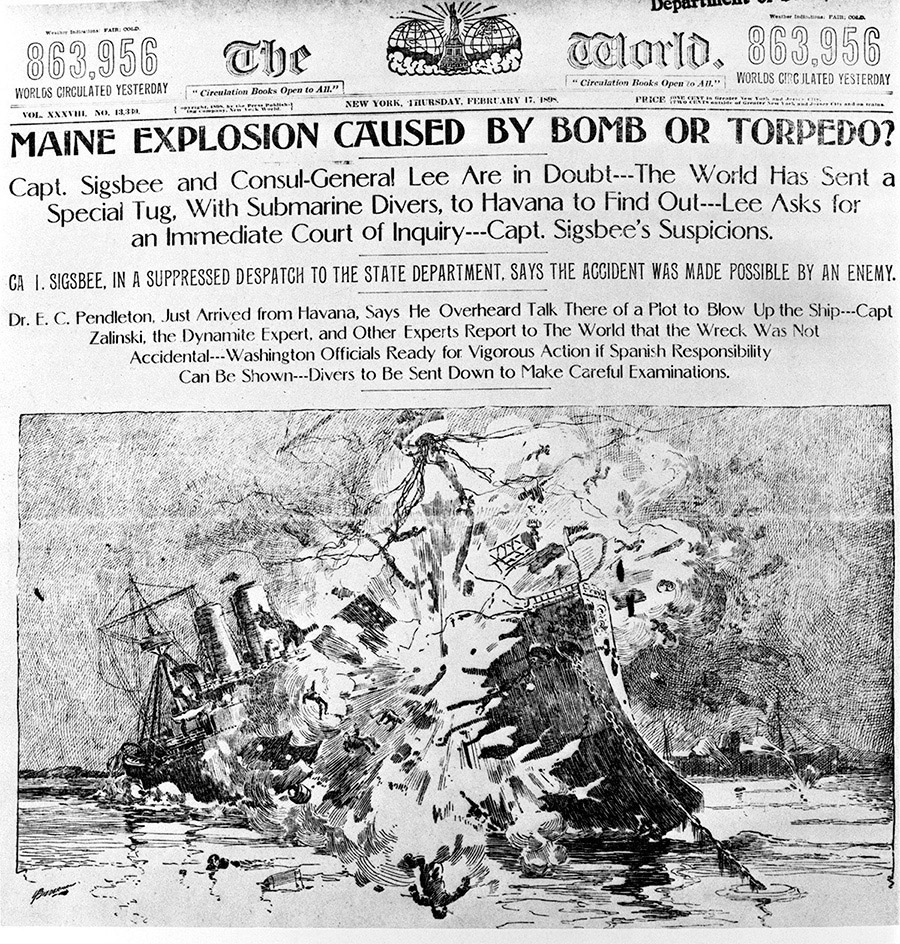
⏸ Opening Activity
Look at the two newspaper front pages on screen.
Don't read every word — just scan. What do the headlines want you to feel?
Section I
How did millions of Americans come to feel the same thing at the same time?
A New Scale of Persuasion
- By 1898, Pulitzer's New York World: 1 million daily readers
- 20 years earlier — physically impossible
- New technology made mass persuasion possible
- For the first time: millions consumed the same stories, same framing, same emotions — simultaneously
.jpg)
"The Yellow Press" · L.M. Glackens · c. 1910 · Public Domain
What Changed?
- High-speed rotary presses
- Half-tone photo printing
- Telegraph wire services & syndication
- Ad-driven revenue
- Competition for readers, not subscribers
- Sensationalism = profit
- Rising urban literacy
- Immigrant communities
- New working & middle class
Where "Yellow Journalism" Comes From
- Yellow journalism — sensational reporting that amplifies emotion over accuracy to sell papers
- The Yellow Kid — bald street urchin in a yellow nightshirt, New York World, 1895
- Pulitzer's circulation soared — Hearst poached the cartoonist
- Both papers ran competing versions simultaneously

The Yellow Kid · R.F. Outcault · New York Journal · 1896
Public domain — Library of Congress
Yellow Journalism: What It Actually Was
- Not primarily fabrication, but primarily selection and emphasis
- Moral clarity: Spain was cruel, Cuba was suffering, America must act
- Sensational language: "butchery," "massacre," "outrage"
- Made diplomacy feel slow and immoral, while action felt urgent
The Core Distinction
- Event — what actually happened
- Representation — how Americans encountered events through media
- Most Americans would never see Cuba directly — they experienced its representation
⏸ Pause & Reflect
Think of a foreign crisis you've seen covered in the media in your lifetime.
How was it framed? Who had agency? Who was passive? Who was cast as the rescuer?
Section II
What did Americans think Cuba was — and what did they miss?

"Spaniards Search Women on American Steamers"
Frederic Remington · New York Journal · February 12, 1897
The actual search was conducted by a female officer — Remington removed her
Cuba as Moral Theater
- Event: Spanish officials search an American steamer — female officer conducts the search
- Representation: nude American woman surrounded by menacing Spanish men
- The female officer was simply removed from the scene
- Not fabrication — selective distortion of a real event
Frederic Remington & the War That Wasn't
- Hearst sent America's most famous illustrator to Cuba — not a reporter
- Remington's job: construct the visual reality of the war
- Whether the telegram is real or invented, the steamer illustration proves the attitude was operational
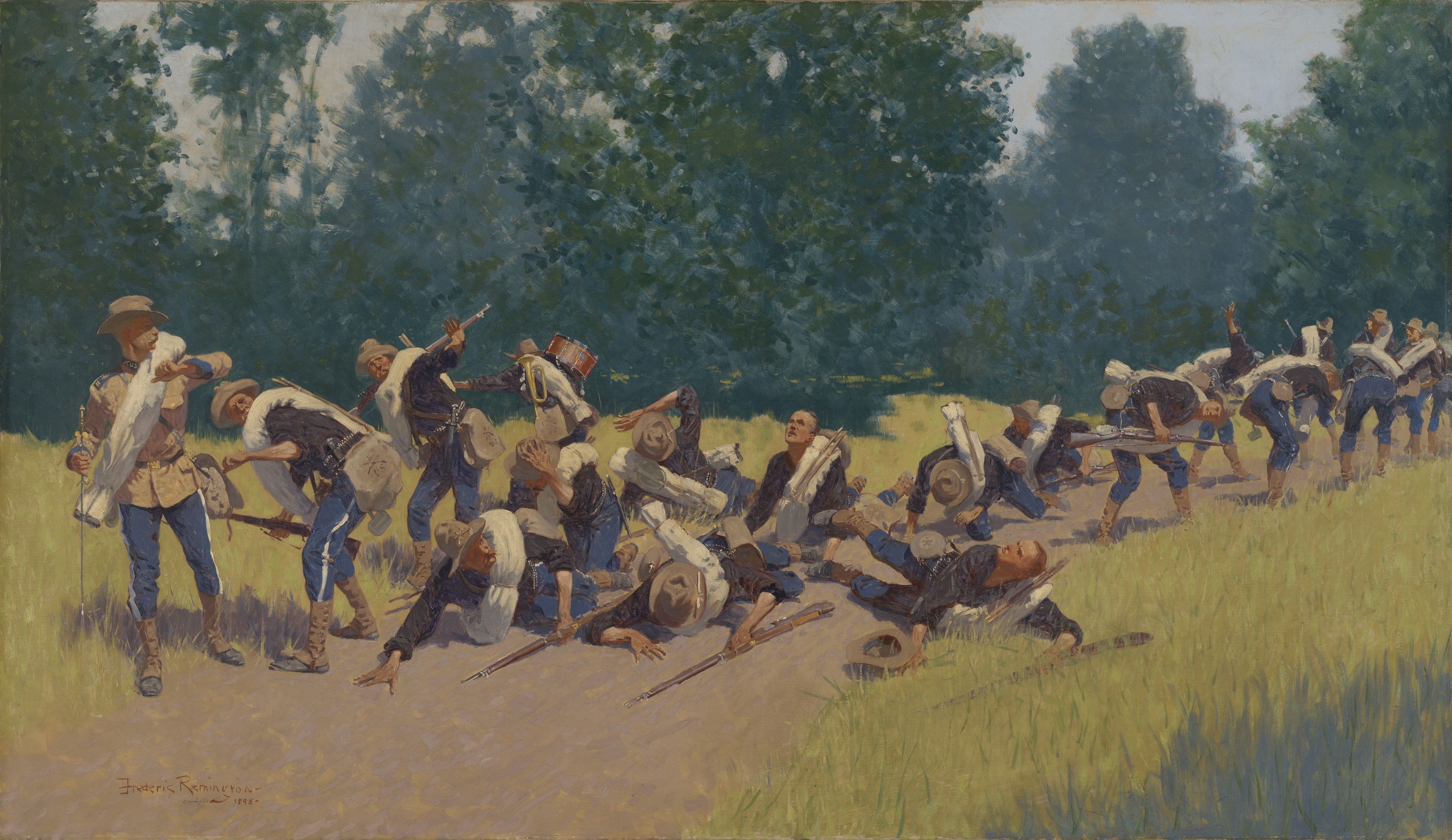
The Scream of Shrapnel at San Juan Hill
Frederic Remington · 1898 · Public Domain
Remington painted the war he helped manufacture

Evangelina Cosio y Cisneros · Photograph by Vander Weyde · November 1897
Taken in New York after her escape — Hearst's paper distributed it nationally
When Hearst Became the Story
- 19-year-old Cuban revolutionary imprisoned in Havana, 1897
- Hearst ran a months-long campaign — petitions, editorials, outrage
- When diplomacy failed, Hearst sent a reporter to break her out
- Called it "the greatest journalistic coup of this age"
What the Frame Required
- Helpless victims
- Cruel Spanish authority
- Moral urgency for U.S. intervention
- Real suffering in reconcentration camps
- Cuba's 30-year revolutionary history
- Cuban political leadership
- Alternative paths to independence
- Cuba as a nation with agency
Cuba's Real Story
- Cuba had been fighting for independence from Spain since 1868 — 30 years
- José Martí: poet, journalist, revolutionary — sophisticated nationalist movement
- Not a helpless island waiting for rescue — a nation in the middle of a war of independence
- American newspapers reported almost none of this
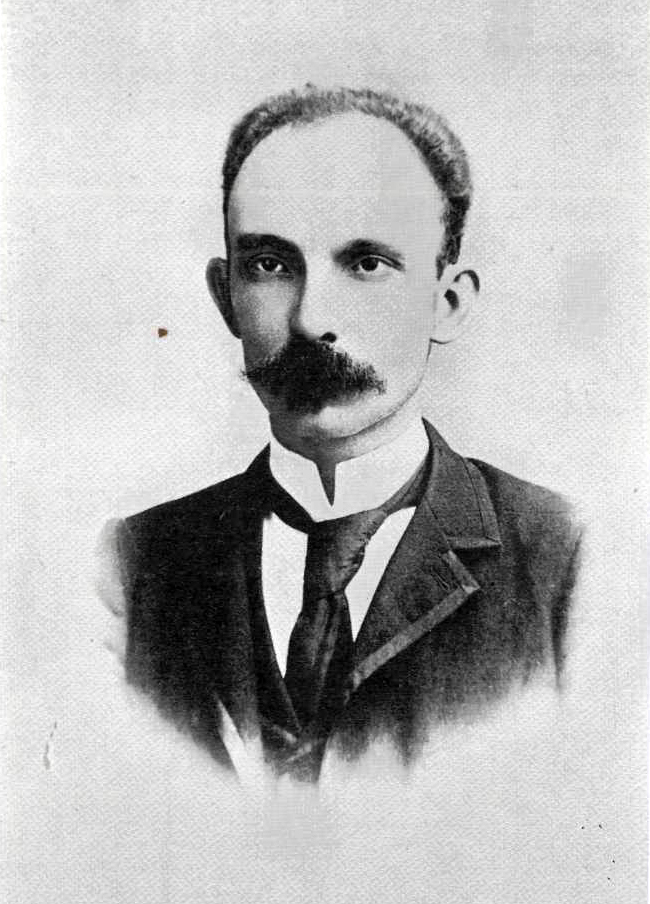
José Martí · Jamaica · 1892 · Public Domain
His most widely reproduced portrait — taken three years before his death in battle
Cuba's Faustian Bargain
- Cuban Revolutionary Party — operating out of New York City
- Sophisticated lobbying of press and politicians
- Deliberately fed the damsel narrative to Hearst and Pulitzer
- Calculated bet: accept the frame, get the intervention
- Formal independence — 1902
- Platt Amendment written into Cuban constitution
- U.S. right to intervene whenever it judged necessary
- Guantánamo Bay — permanent U.S. naval base
A set of conditions written into the Cuban constitution under American pressure as a condition of U.S. military withdrawal after the Spanish-American War. Key provisions included:
- The U.S. right to intervene in Cuban affairs to preserve Cuban independence or maintain order
- Cuba could not sign treaties or incur debt without U.S. approval
- The U.S. retained the right to lease naval bases — producing the permanent base at Guantánamo Bay
The Amendment was abrogated in 1934 under FDR's Good Neighbor Policy — except for the Guantánamo lease, which remains in effect. Cuba has demanded its return ever since.
⏸ Pause & Reflect
Can you report true facts and still construct a false picture?
What's the difference between lying and selecting?
Section III
How does ambiguity become obligation?
February 15, 1898
- The USS Maine explodes in Havana harbor — 266 sailors killed
- Cause: unknown in 1898
- 1898 naval investigation: external mine (Spanish sabotage)
- 1976 reinvestigation: probably internal explosion — accidental coal fire
- More recent analysis: leans internal

USS Maine entering Havana Harbor · January 1898 · U.S. Navy · Public Domain
After the Explosion
- Before any investigation: New York Journal headline — "The Warship Maine Was Split in Two by an Enemy's Secret Infernal Machine"
- Hearst offered $50,000 reward for information on perpetrators
- Slogan appeared within days:
.jpg)
"Blown Up By Spain" · The Evening Times · February 16, 1898 · Public Domain
Ambiguity → Obligation
(historical event)
(political meaning)
- Uncertain cause → certain obligation in headlines
- The slogan didn't describe what happened — it prescribed what should be done
- Democracies act on meaning, not always on certainty
- Whoever assigns meaning first — shapes the political response
⏸ Pause & Reflect
Why does waiting for evidence feel like betrayal in a democracy after a traumatic event?
What does this tell us about the relationship between grief and political action?
Section IV
What does it mean to understand the rules of modern political power before everyone else?
Why Did America Need This War?
- Economic interests — markets, raw materials
- Naval strategy — Mahan's sea power theory
- Rational actors, rational calculation
- Elite anxiety — American manhood was "going soft"
- Frontier closed in 1890 — no more proving ground
- Urban desk jobs replacing physical struggle
- War as performance of national virility
Kristin Hoganson is a historian at the University of Illinois whose 1998 book Fighting for American Manhood: How Gender Politics Provoked the Spanish-American and Philippine-American Wars argued that cultural anxieties about masculinity were a primary driver of American imperial expansion in the 1890s.
Her core argument: elite American men feared that modern urban life was producing a soft, feminized national character. War offered a remedy — a proving ground that would restore national vigor and demonstrate that American manhood was still capable of decisive action. The damsel-in-distress framing of Cuba was not incidental to this logic. It was central to it.
Hoganson's work is part of the broader turn toward cultural and gender history in the 1990s, which pushed historians to look beyond economic and strategic explanations for political decisions and ask: what cultural work were those decisions doing?
Roosevelt, 1897
- Age 38 — Assistant Secretary of the Navy
- Obsessed with preparedness, expansion, and himself
- Believed war tests national character

Theodore Roosevelt · 1898 · Public Domain · Wikimedia Commons
The Strategic Resignation
- February 1898: War becomes likely — Roosevelt resigns from the Navy Department
- Everyone tells him he's insane: giving up real power, family obligations, no combat experience
- But Roosevelt understands something others miss:
The Assistant Secretary writes policy. The cavalry officer charges up a hill. Which one ends up on the front page?
The Rough Riders: Symbol Over Substance
- Militarily: modest. The charge at Kettle Hill — confused action, horses walked (not charged)
- Symbolically: everything
- Cowboys from the West + Ivy League athletes from the East
- Embodied the myth of unified American character
- Journalists embedded, photographs taken — by design

Col. Roosevelt, Rough Riders · 1898 · NARA · Public Domain · Wikimedia Commons
Cuba → Career Trajectory
- 1897: Assistant Secretary of the Navy — mid-level administrator
- 1898: Cuba — celebrity soldier, national hero
- 1898: Elected Governor of New York
- 1900: Vice President of the United States
- 1901: President — youngest in American history (age 42)
The New Rules of Political Power
- Institutional position
- Party loyalty
- Back-room negotiation
- Bureaucratic influence
- Visibility is power
- The story IS the politics
- Heroism is a resource
- Leadership must be performed and seen
- Not reckless — adaptive
- Understood media logic before his rivals
- Harvested heroism methodically
- Performed for the cameras — by design
⏸ Pause & Reflect
Roosevelt resigned a position of real power to chase a story. Was this:
- Reckless and lucky
- A brilliant grasp of how modern politics works
- A dangerous precedent — celebrity over substance
- All of the above
Section V
Bringing the framework home
What 1898 Tells Us
- War could be sold, not just justified — public emotion as political resource
- Media shapes urgency and morality, not just information
- The Maine explosion didn't cause the war — the meaning assigned to it did
- Leaders who master spectacle gain power in mass media democracies
- Modern democratic leadership is performed as much as practiced
The Framework, Revisited
Looking Ahead: Lecture 2
If war could be sold — what happens when the bill comes due?
- Victory produces not applause, but a colonial empire
- The Philippines, Puerto Rico, Guam — what to do with them?
- Americans face the contradiction: a republic that builds an empire
- The skills of spectacle that won the war — can they govern what follows?
📰 Headline Dissection
Two headlines. Same incident. Different frames.
For each: What emotion words appear? Who is the villain, victim, hero? What action does the headline imply?
Which version makes war feel unavoidable — and why?