Chapter 20: Urbanization
Sons of the Yellow Emperor:
The Chinese Diaspora: Race, Exclusion, and the Architecture of Belonging
Decentering the United States
Huaqiao (Overseas Chinese) - Chinese migration was part of global labor circulation, not a U.S.-specific phenomenon.
- Chinese emigration surged during the "Century of Revolution" (c. 1850–1949)
- Migrants moved to: Southeast Asia, Hawaii, Latin America, Western United States
- Driven by political instability, warfare, disease, and starvation
- Overseas Chinese is estimated to be between 50 million and 60 million people across approximately 198 countries and regions.
Global Labor Circulation
In the late 1800s, capitalism and empire created massive flows of workers across continents. People moved:
- From rural areas to mines, plantations, railroads, and cities
- From colonized regions to imperial centers and frontier zones
- From areas of political upheaval to places with labor demand
This was a global system. Chinese workers went to Peru, Cuba, Southeast Asia, Australia, and North America. Indian workers went to East Africa, the Caribbean, and Fiji. This movement was structured by capitalism (need for cheap labor) and empire (ability to move subjects across borders).
China's Century of Revolution (1850-1949)
This period saw massive upheaval in China:
- Taiping Rebellion (1850-1864): Devastating civil war, ~20-30 million dead
- Opium Wars: British and European imperialism forced open Chinese ports
- Economic disruption: Traditional agriculture and trade collapsed in many regions
- Qing Dynasty decline: Weakening central government couldn't maintain order
- Republican Revolution (1911): Overthrow of imperial system
These crises pushed millions of Chinese to emigrate, seeking economic survival and safety.
Welcome—Then Rejection
Chinese workers were recruited for:
- Mining (California gold rush, Nevada silver)
- Railroad construction (Central Pacific, transcontinental lines)
- Agriculture (farms, orchards, land reclamation)
Burlingame Treaty (1868)
A diplomatic agreement between the United States and China that:
- Encouraged free migration: Recognized the right of Chinese to emigrate to the U.S.
- Protected mutual trade: Opened economic relations
- Promised equal treatment: Chinese in the U.S. would get "most favored nation" status
Context: The U.S. wanted Chinese labor for railroad construction and Western development. China wanted to protect its emigrants and maintain trade.
Irony: Just 14 years later, the U.S. passed the Chinese Exclusion Act (1882), directly violating the spirit of this treaty.
Sojourners, Not Settlers
Chinese migrants were often sojourners:
- Intended to work temporarily and return home.
- Maintained strong homeland ties (remittances, kinship).
- Viewed migration as a temporary economic strategy.
- Migration was overwhelmingly male (95%+).
- Structural lack of family units led to concentrated "bachelor communities."
- Common urban vices (gambling, violence) were amplified by social isolation.
White American Framing
Nativists used the "bachelor" structure to pathologize Chinese communities as:
Opium, gambling
Smallpox, TB
Vice districts
The "Coolie Labor" Framework
"Coolie labor" was framed as:
- Unfree — compared to slavery, contract labor
- Degrading — undermining white workers' dignity
- Racially distinct — biologically different, unassimilable
Hostility was not just economic—it was racial and cultural, rooted in ideas of civilization and whiteness.
"Coolie Labor" — A Racialized Category
The term "coolie" originally referred to low-wage Asian laborers, but it quickly became a racist slur implying:
- Unfreedom: Coolies were portrayed as semi-enslaved, bound by exploitative contracts
- Degradation: Working alongside "coolies" was seen as lowering white workers to an inferior status
- Racial otherness: Coolies weren't just poor workers—they were racially unfit for American society
Reality vs. Stereotype: While some Chinese workers did come under exploitative labor contracts, most were free migrants seeking economic opportunity, just like European immigrants. But the "coolie" label stuck, making ALL Chinese workers seem like a threat to "free labor."
Key Scholar: Moon-Ho Jung in Coolies and Cane shows how "coolie labor" was invented as a racial category to justify exclusion.
The Page Law (1875)
The Page Law (1875) effectively barred Chinese women by labeling them presumed prostitutes.
Consequences:
- Prevented family formation
- Reinforced the "permanent foreigner" stereotype
- Made assimilation structurally impossible
Page Law (1875)
The first federal immigration law to restrict entry based on race and gender.
Official Purpose: Ban the importation of "immoral" women (prostitutes)
Actual Effect: Created bureaucratic barriers that prevented virtually ALL Chinese women from immigrating
How It Worked:
- Required women to undergo invasive interrogations in China and San Francisco
- Assumed ALL Chinese women were prostitutes unless proven otherwise
- Placed burden of proof on women to demonstrate "moral character"
- Created long delays and denials
Impact:
Between 1875-1882, Chinese female immigration dropped by 70%. Even wives of legal residents were denied entry.
Historical Significance: This was the FIRST federal law restricting immigration—7 years BEFORE the more famous Chinese Exclusion Act. It targeted women specifically to prevent Chinese families from forming in the U.S.
The Legal Architecture of Exclusion
This is where race hardens into policy.
Page Law (1875)
See earlier slide for full details. This was the first federal immigration restriction, targeting Chinese women by presuming them to be prostitutes.
Chinese Exclusion Act (1882)
The first federal law to ban immigration based explicitly on race/nationality.
- Banned: Chinese laborers from entering the U.S. for 10 years
- Allowed: Only merchants, diplomats, students, and travelers (with strict documentation)
- Barred: Chinese from naturalization (becoming citizens)
- Extended: Renewed multiple times, made permanent in 1902, not repealed until 1943
Significance: This fundamentally changed American immigration policy from open to restrictive, from economic to racial. It established the principle that the U.S. could exclude people based on race.
Asiatic Barred Zone (1917)
Part of the Immigration Act of 1917, this law expanded exclusion from just Chinese to most of Asia.
The "Zone": Banned immigration from a geographic region including:
- India and South Asia
- Southeast Asia (Burma, Siam, Malay Peninsula)
- Parts of the Middle East (Arabia, Afghanistan)
- Pacific Islands
Japan and the Philippines were excluded from the zone (Japan due to diplomatic pressure, Philippines because it was a U.S. colony).
Impact: Effectively banned almost all Asian immigration except from Japan and the Philippines.
National Origins Act (1924)
Also called the Johnson-Reed Act, this created a comprehensive system of racial quotas.
- Quota system: Limited immigration from each country to 2% of that nationality present in the 1890 census
- Why 1890? To favor Northern/Western Europeans and restrict Southern/Eastern Europeans
- Asian exclusion: Banned ALL Asians (including Japanese) by creating category of "aliens ineligible for citizenship"
- No quotas for Americas: Latin American and Canadian immigration remained unrestricted (but still subject to bureaucratic barriers)
Effect: This remained the foundation of U.S. immigration law until 1965. It enshrined racial preferences: Northern Europeans favored, Southern/Eastern Europeans restricted, Asians banned, Africans nearly banned.
The Transformation of Immigration Policy
Immigration policy moves from economic regulation to racial engineering.
Yellow Peril
Law Does Not Operate Alone; Culture prepares the ground.
"Yellow Peril" is a Racist discourse prevalent in the late 19th/early 20th century.
"Barbarians hordes from the East (the yellow races) bent on world domination will rise up and destroy white civilization"
Assumes all Asians are:
- Inscrutable
- Unassimilable
- Dangerous
- Civilization-threatening
"Yellow Peril" Discourse
Definition: A body of ideas, images, and narratives that portrayed Asians (especially Chinese and later Japanese) as a racial threat to Western civilization.
Core Themes:
- Inscrutability: "You can never know what they're thinking" — portrayed as mysterious, devious, unreadable
- Unassimilability: "They will never become American" — culturally and racially incapable of adopting Western values
- Danger: Economic threat (job competition), moral threat (vice and disease), military threat (invasion)
- Mass: "The yellow horde" — overwhelming numbers that could swamp white civilization
Origins:
The term "Yellow Peril" (German: Gelbe Gefahr) gained prominence in the 1890s, popularized by Kaiser Wilhelm II of Germany who feared rising Asian (especially Japanese) power. It reflected anxieties about:
- Japan's military modernization (defeated China 1895, Russia 1905)
- China's population size
- Competition for empire and markets in Asia
- Racial theories about "civilization" and "barbarism"
Sources of Yellow Peril Discourse
Fueled By:
- Pseudoscience (racial biology)
- Imperial anxiety (competition for Asia)
- Global power shifts (Japan's rise)
- Labor conflict (white workers' fears)
Examples:
- Political cartoons
- Kaiser Wilhelm's Gelbe Gefahr
- Pulp fiction (Fu Manchu)
- Newspapers, postcards
The Global "gelbe Gefahr"
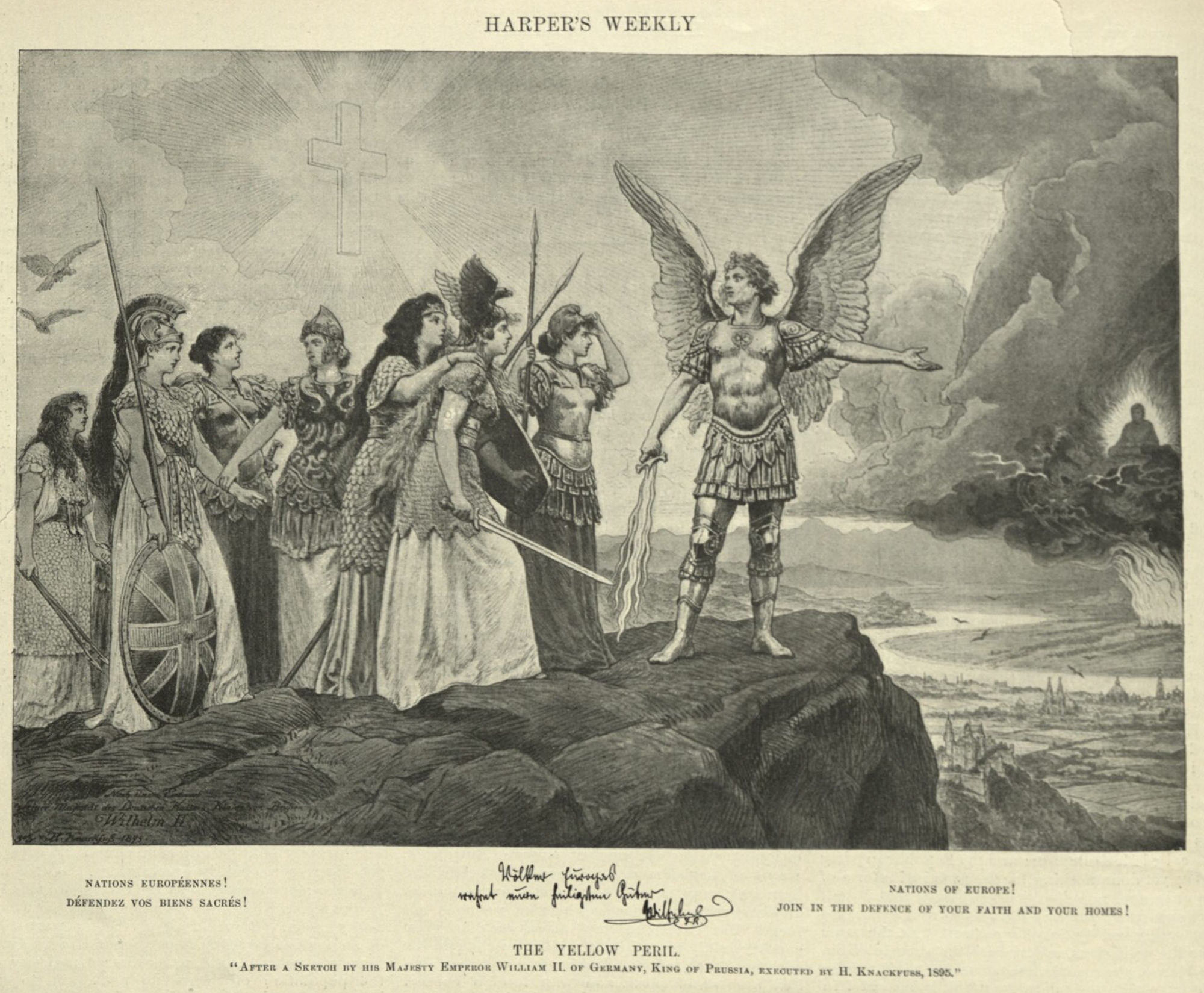
Völker Europas, wahrt eure heiligsten Güter (1895)
“Peoples of Europe, safeguard your most sacred possessions.”
Designed by Kaiser Wilhelm II; lithograph by Hermann Knackfuß.
- The Allegory: Archangel Michael rallying European nations against a "heathen" Buddha.
- The Medium: A mass-produced chromolithograph sent to world leaders (including the U.S. President).
Globalized Anxiety: Place aux jaunes
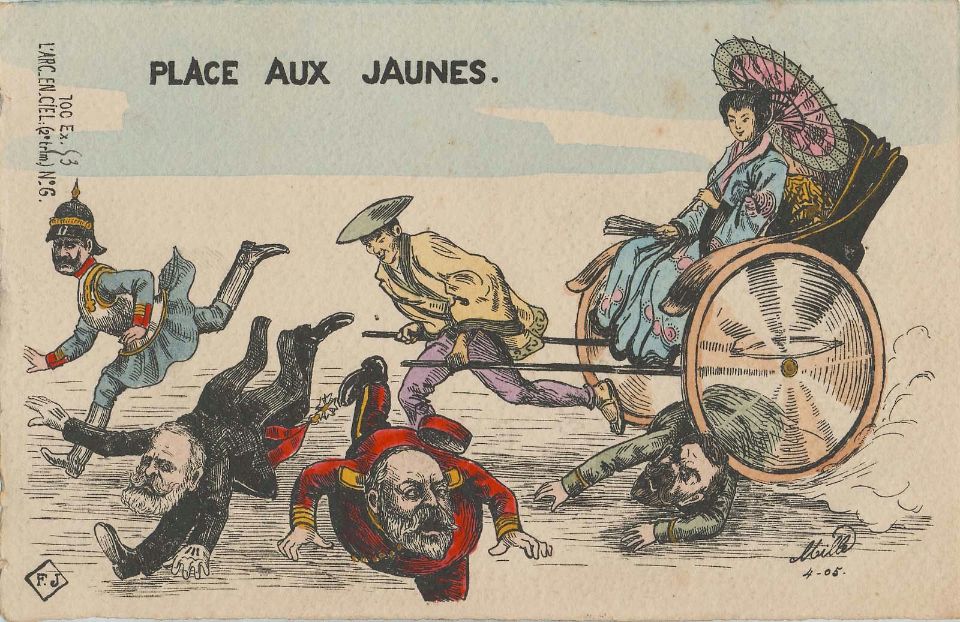
“Make way for the yellows.”
The "Invasion" Narrative
French satirical and political imagery often echoed the German 'Yellow Peril,' depicting an Asian 'flood' overwhelming European borders.
- Demonstrates that Nativism was a transnational phenomenon.
- Reinforces the Sojourner myth: Chinese presence was framed not as labor, but as a vanguard for invasion.
Pathologizing the Diaspora
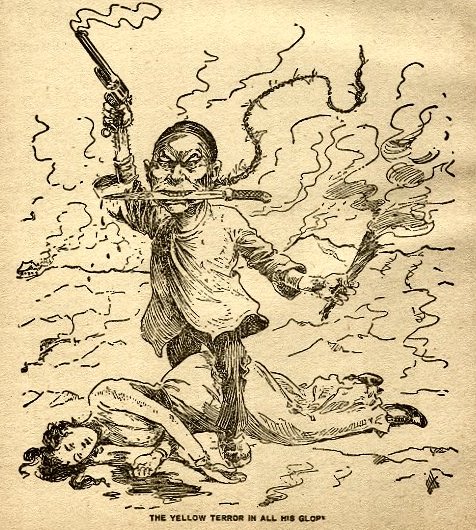
The "Yellow Terror"
Early 20th-century media synthesized economic fear with moral contagion.
- Focus on the "Bachelor Society" vices: Opium and Gambling.
- Framed the Huaqiao as an internal enemy.
Nativism in the Atomic Age
Ming the Merciless (Flash Gordon, 1940)
The transition of the 'Yellow Peril' into the Science Fiction genre.
- The "Oriental" villain is relocated to another planet (Mongo).
- Reflects the durability of the Racial Hierarchy: even in space, the threat remains 'Eastern' in aesthetic and philosophy.
_1.jpg)
The Literary Villain: Dr. Fu Manchu
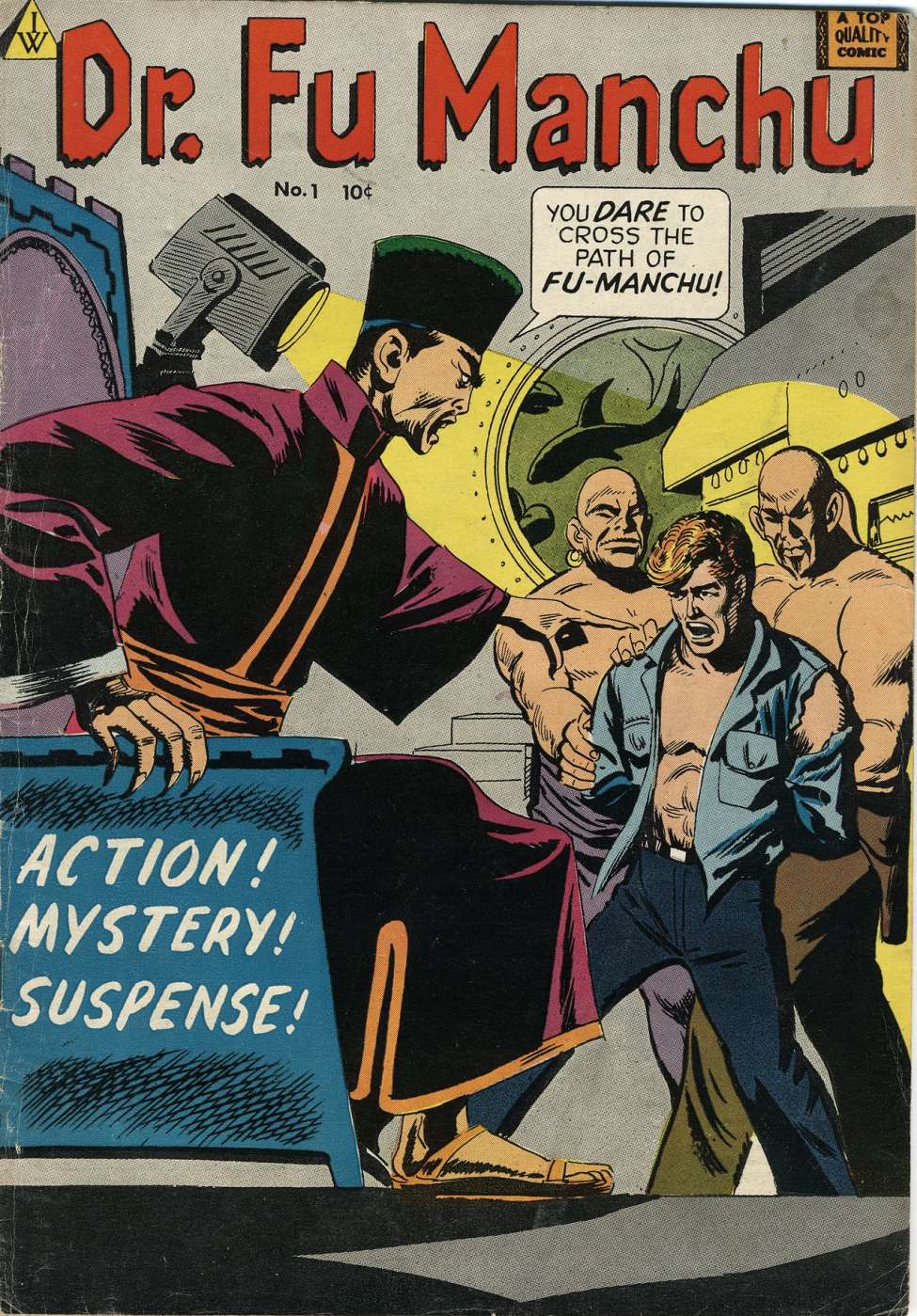
The "Genius" Threat
Unlike the 'coolie' (the labor threat), Fu Manchu represented the intellectual threat: a hidden, ancient, and technologically advanced adversary.
Created by Sax Rohmer in 1913, the character became the definitive pop-culture shorthand for the gelbe Gefahr.
Yellow Peril and the Mask of Fu Manchu
📽️ Cinematic Nativism
The 1932 film The Mask of Fu Manchu represents the cinematic zenith of the gelbe Gefahr. It synthesizes the "Sojourner" fear with the "Scientific" nativism of the 1920s.
- The Threat: Fu Manchu as the "Genius" who weaponizes Eastern mysticism and Western technology.
- The Logic: Reinforces the Racial Hierarchy by depicting the "heathen" East as a perpetual threat to Western artifacts.
- The Audience: Released during the height of the Great Depression, tapping into existing labor and cultural anxieties.
📝 Check Your Understanding
Synthesis Question
Review the clip from The Mask of Fu Manchu and the previous visual artifacts. How do these pop-culture depictions reconcile the "Sojourner" reality with the "Yellow Peril" myth?
Consider the following in your response:
- The role of "Bachelor Societies" in framing moral decay.
- How "Scientific Nativism" transformed a labor threat into a biological/civilizational one.
- The visual evolution from Kaiser Wilhelm's lithograph to Hollywood film.
Resistance and Resilience
Despite exclusion, Asian communities endured through:
- Ethnic enclaves (Chinatowns, fishing villages, labor camps)
- Self-employment (laundries, restaurants, small shops)
- Mutual-aid societies (tongs, family associations, benevolent organizations)
- Informal migration strategies (e.g., "paper sons")
Ethnic Enclaves
Concentrated communities where immigrants lived, worked, and built institutions.
Chinatowns emerged in San Francisco, New York, Los Angeles, and other cities as spaces where:
- Chinese could find housing (often denied elsewhere)
- Chinese businesses could operate
- Cultural practices could be maintained
- Mutual support networks functioned
Not by choice: Enclaves were often responses to segregation and exclusion, not voluntary isolation. Chinese wanted to live in Chinatowns because they were unwelcome elsewhere.
"Paper Sons"
A strategy Chinese immigrants used to circumvent exclusion laws.
How It Worked:
The 1906 San Francisco earthquake destroyed birth records. Chinese men in the U.S. (especially those with citizenship) could claim that children were born to them in China. They would sell these "slots" to young Chinese men who wanted to immigrate.
The young men would memorize detailed information about their "paper father's" village, family, and life story. When they arrived at Angel Island (the West Coast immigration station), they were interrogated extensively. If their stories matched their "father's," they were admitted as citizens' sons—even though they weren't actually related.
Significance:
- Showed Chinese determination to reunite families despite exclusion
- Demonstrated sophisticated resistance to unjust laws
- Created complex "paper families" that lasted generations
Analytical Insight
This is discourse, not description—a system of meaning that produces fear as "truth."
Yellow Peril wasn't a response to real threats. It was a cultural construction that made people BELIEVE Asians were threatening.
Important Reframing
Enclaves are not signs of isolation—they are responses to enforced exclusion.
When people couldn't live, work, or belong elsewhere, they built their own institutions and communities.
The Limits of American Pluralism
Asian exclusion reveals:
- Cities became diverse—but not equally inclusive
- Law, labor, and culture worked together to racialize belonging
- Urbanization intensified debates over:
- Citizenship
- Race
- Nationhood
Bridge to Next Lecture
The next lecture turns inward—to the urban environment itself.
We'll examine how density, disease, and infrastructure forced cities to confront the biological consequences of mass migration.
From the politics of exclusion to the politics of sanitation and public health.
Key Takeaway
Urban America was built through inclusion and exclusion.
Race determined not just who entered the city, but who could belong, reproduce, and claim the future.