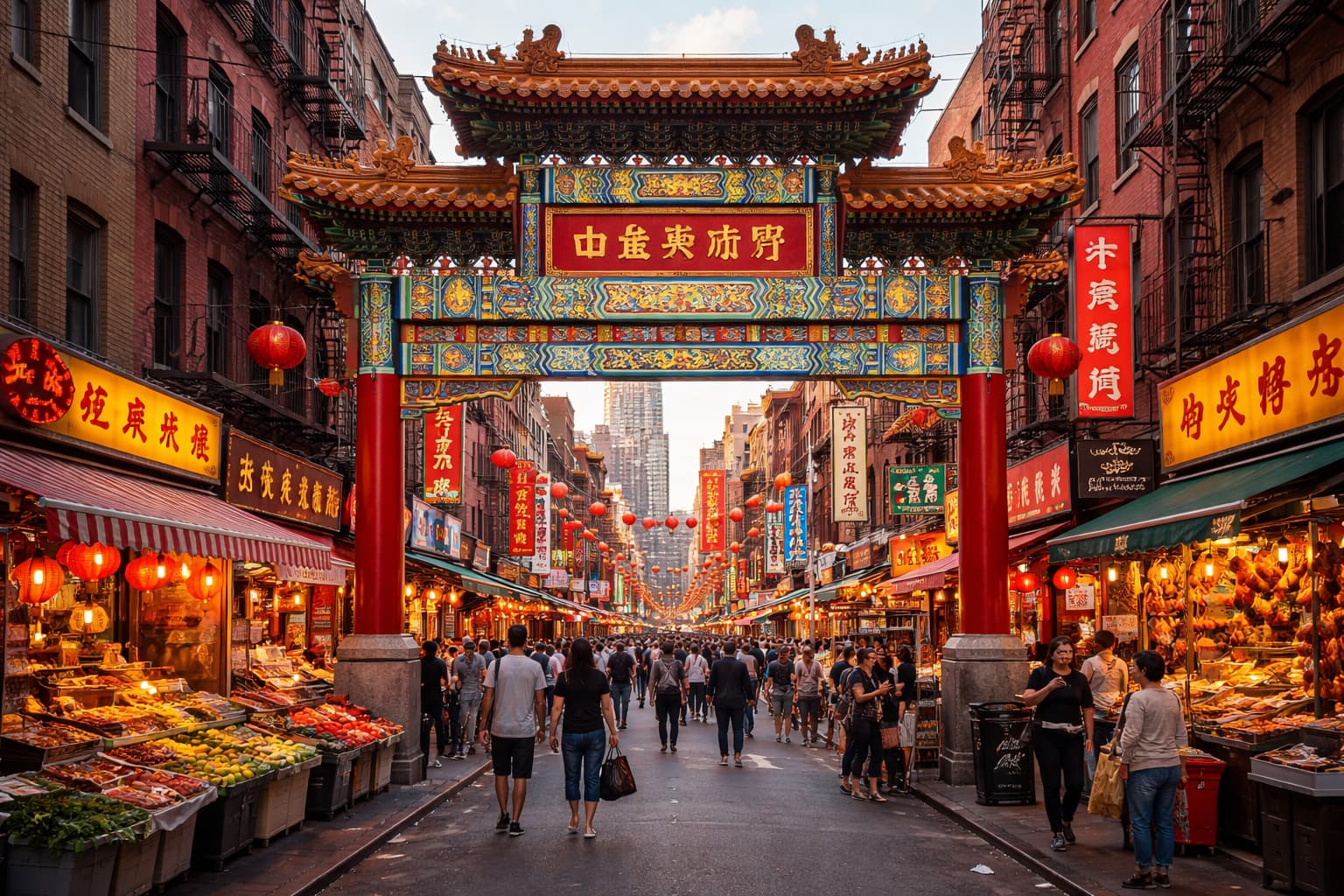
Urbanization is not just Americans moving into cities. It is the world in motion, driven by industrialization, imperial disruption, political violence, and transportation revolutions.
🔑 Key Insight: Constrained Choices
Urban growth reflects choices made under pressure, not free individual preference. Migrants were often fleeing violence or poverty rather than simply seeking "opportunity."
Late-19th-century American cities were nodes in global systems of labor, capital, and migration.
×
Cities as Global Nodes
Think of cities like New York, Chicago, and San Francisco as connection points in a worldwide network:
Labor flows: Workers from Italy, Poland, China, and Mexico converged on industrial centers.
Capital flows: European investment funded American railroads and factories.
Information flows: Telegraphs and letters connected communities across oceans.
American cities weren't isolated; they were embedded in a global economy.
The Drivers of Growth
Domestic Migration
~25-30%
Native-born Americans moving from farms to cities. Often motivated by agricultural mechanization.
Global Immigration
~70-75%
Immigrants and their children (Foreign Stock). The primary engine of Industrial Urbanization.
📌 Historiographical Note
By 1900, most urban residents were immigrants or their children. The city was not just an American creation; it was a global collection of American and Foreign Immgrants.
Part I
The Lure of the City
Why cities exploded after 1870
Industrialization and the Urban Explosion
🏭 Factories Required
Concentrated wage labor, thousands of workers in one place
🚂 Transportation Revolution
Railroads, steamships, and telegraph compressed time and distance, facilitating growth
Census Definition A City is defined as a population larger than 2,500
By 190040% of Americans lived in cities; 6 cities exceeded 500k
By 1920A Majority (50%+) lived in urban areas for the first time
×
The Compression of Time and Distance
Before 1850, crossing the Atlantic took 4-6 weeks. By 1900:
Steamships: 7-10 days
Telegraph: Messages in minutes
Railroads: Rapid overland transit
This made mass migration and urban concentration physically possible.
A Cultural Reversal
Antebellum View
Cities were seen as:
Corrupt and dangerous
Threats to republican virtue
Places of moral decay
"Those who labor in the earth are the chosen people of God." — Jefferson
Post-1870 View
Cities were celebrated as:
Modern and dynamic
Centers of progress
Inevitable and exciting
The city as the symbol of American power
Part II
"New Immigrants"
The scale and sources of migration after 1880
A Shift in Sources and Scale
"Old" Immigration
PRE-1880
Northern & Western Europe (Britain, Ireland, Germany)
Scandinavia
Often Protestant (except Irish)
"New" Immigration
POST-1880
Southern & Eastern Europe (Italy, Poland, Russia)
Austria-Hungary, Greece
Often Catholic, Jewish, or Orthodox
Higher birth rates among families accelerated urban growth.
×
Demographics and Urban Growth
Cities grew through both immigration and natural increase:
Immigrant families often had more children for economic security and labor.
High infant mortality often necessitated larger family sizes.
The Great Wave & Urban Pivot (1870–1920)
THE SCALE
26M ARRIVALS
1901–1910 Peak: 8.8 million in one decade.
Demographic Shift: 70%+ from Southern/Eastern Europe.
Entry Point: Ellis Island (Est. 1892).
THE PIVOT
25% TO 50%
Rise in U.S. population living in urban centers by the 1920 Census.
Labor for Vertical (Skyscrapers) and Horizontal (Streetcar suburbs) growth.
THE REACTION: Nativism
Part V
Nativism
The anxiety of belonging
Understanding Nativism
📌 Definition
Nativism: Preference for native-born Americans over immigrants, often expressed through hostility, discrimination, and restrictive policies.
Nativism isn't just prejudice; it's organized political opposition to immigration.
×
Nativism as Political Movement
Nativism took many forms:
Political parties: Know-Nothings (1850s), American Protective Association (1890s)
Legislative campaigns: Chinese Exclusion Act (1882), Immigration Acts (1921, 1924)
Cultural campaigns: "100% Americanism," English-only movements
Nativism Phase I: Pre-1880
The "Popery" Factor
Target: Irish/German Catholics
The Know-Nothing argument: Allegiance to a foreign Pope was fundamentally incompatible with Republicanism. This was an ethnocultural conflict, not a biological one.
Labor Anxiety
Fear of "Starvation Wages"
Immigrants were viewed as a threat to the "Free Labor" ideal. Native-born artisans feared low-wage competition would degrade the American standard of living.
⚠️ The Racial Exception
On the West Coast, the Workingmen's Party of California (1870s) was explicitly racialist toward the Chinese. This proved racialized exclusion existed in geographic pockets well before it became federal policy in 1882.
×
The "Alien" Threat
Pre-1880 nativists focused on the character and religion of the immigrant:
Naturalization: Proposed extending the wait for citizenship from 5 to 21 years.
Voting: Aimed to restrict office-holding to native-born citizens.
Assimilation: Believed Catholicism was a "monarchical" religion hostile to American liberty.
The Rise of Racialism
After 1880, nativists abandoned purely religious and labor arguments for biological justifications:
🧬 Social Darwinism
Applied "survival of the fittest" to nations; argued Anglo-Saxons were being "out-bred" by "inferior" stocks.
📊 Racial Hierarchies
Pseudo-scientific rankings (e.g., Nordic vs. Alpine/Mediterranean) used to justify exclusion.
🧪 Eugenics
The belief that "fitness" was hereditary and that "New Immigrants" threatened the national gene pool.
Racialist Nativism in Action
Immigration Restriction League (1894): Founded by Harvard grads to advocate for literacy tests to filter out "unfit" races.
Dillingham Commission (1907-1911): A 41-volume federal report that claimed "New Immigrants" were biologically unassimilable.
The Second KKK: Re-emerged in 1915 targeting not just Black Americans, but Catholics, Jews, and all "foreigners."
Immigration Act of 1924: The legislative climax of the racialist movement, codifying exclusion into federal law.
Chain migration: Movement that follows kinship and community ties—where you go depends on who you already know there.
Core insight: Cities grow through networks, not randomness.
The same Italian village might send ALL its emigrants to one specific neighborhood in Chicago. Polish families from one region might all settle in the same blocks of Pittsburgh.
📚 Want to Learn More?
Instructor's recommended readings:
John Bodnar, The Transplanted — foundational diaspora framework
John Higham, Strangers in the Land — definitive study of nativism
Jonathan Zimmerman, Whose America? — cultural conflict over national identity
Jacob Riis, How the Other Half Lives — primary source (read critically!)
Note: Riis is valuable as a cultural artifact showing how native-born Americans viewed immigrants—not as objective description.