⌨️ Keyboard Shortcuts
Keyboard Shortcuts
| → or Space | Next slide |
| ← | Previous slide |
| S | Speaker notes view |
| O or Esc | Slide overview |
| F | Fullscreen |
| B or . | Pause/black screen |
| Alt + Click | Zoom in |
| Esc | Close popups |
Click dotted underlined terms to open definition popups.
Guiding Question
Think back to our discussion of the Lost Cause.
How does a nation "reset" its identity after internal violence?
The Answer: National Myth
National Myth is the "Master Narrative" a country tells to justify its existence and expansion.
Just like the Lost Cause , it organizes the chaos of violence into a story of Providence.
The Core Binaries:
- Light over Darkness
- Civilization over Savagery
- Order over Chaos
- Future over the Past
The Purpose:
- Makes conquest look inevitable
- Makes violence look redemptive
- Erases "inconvenient" survivors
Historiographical Note
Historians analyze "National Myth" not to debunk it as a lie, but to see it as an ideological tool. By 1890, the US needed a myth that unified the North, South, and West.
The "Civilization vs. Savagery" binary was used to justify both Jim Crow (South) and Dispossession (West).
The Answer: Myth-Making
Myth is not the opposite of history.
Both the Mythic West and the Lost Cause are components of a larger National Myth used to organize meaning after violence.
What Myth IS:
- A narrative structure for identity
- A tool for national reconciliation
- A "usable past" for the present
What Myth DOES:
- Simplifies complex moral failures
- Turns victims/villains into archetypes
- Makes conquest feel inevitable
Scholarly Definition
Historians use "myth" to describe the ideological framework a culture uses to explain itself. It is not a "lie"—it is a selection of real events reorganized to serve a specific purpose.
Example: The Dunning School wasn't just "wrong history"; it was the academic myth required to sustain Jim Crow.
The "National Myth"
A National Myth is a "Master Narrative" that justifies a country's existence and character. In late-19th-century America, this myth relied on specific binaries:
- Civilization vs. Savagery
- Light vs. Darkness
- Progress vs. Stagnation
The Lost Cause reframed the South's "redemption" as a return to order, while the Mythic West reframed conquest as the inevitable march of civilization. Both served a unified national identity.
Why Myth Matters
In the 1890s, Americans were building two myths at once:
- In the South: Sanitizing the Civil War (The Lost Cause)
- In the West: Sanitizing the Conquest (The Mythic West)
The West was not distant history:
- Dispossession and violence were recent events.
- Americans needed narratives that made this past feel: heroic, orderly, and meaningful.
Myth vs. The Dunning School
Remember the Dunning School? It provided an "academic" myth to justify Jim Crow. Myth-making isn't just folk tales; it’s a narrative structure used by scholars, artists, and politicians to justify the present.
Myths are:
- Selective: Erasing Black agency (South) or Indigenous persistence (West).
- Purposeful: Creating a "usable past" for a white, reunified nation.
- Powerful: Shaping identity at the expense of historical accuracy.
Timing the Mythic West
Myth follows conquest; it does not precede it.
Myth emerges when explanation becomes necessary.
Part I
Buffalo Bill's Wild West
The Performance of the West
Buffalo Bill Cody
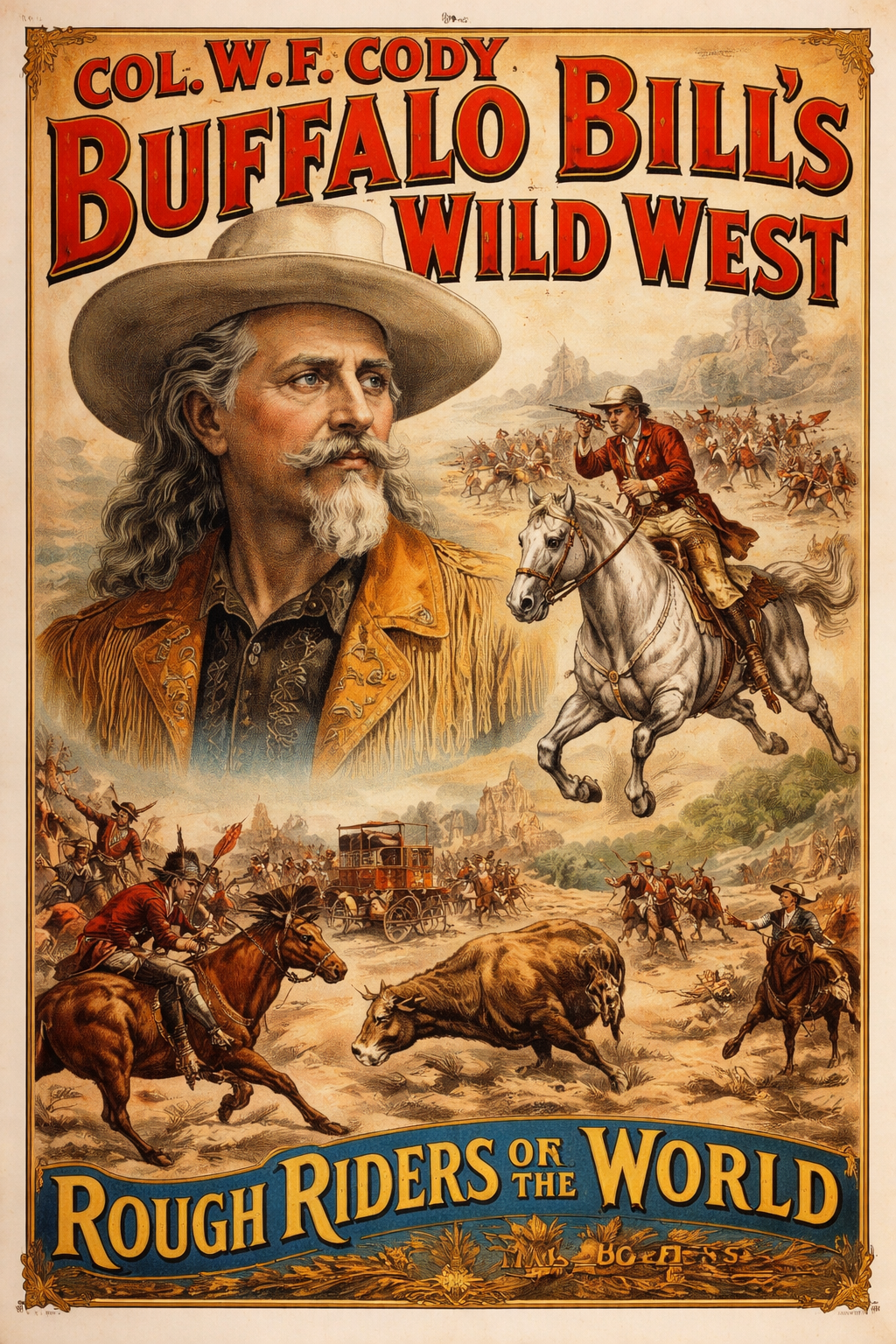
William Frederick Cody (1846–1917)
- Army scout, buffalo hunter, showman
- Created Buffalo Bill's Wild West in 1883
- Toured for 30 years across U.S. and Europe
- Performed for millions
Not fringe entertainment •
mass culture phenomenon
Buffalo Bill's Wild West
Not a "circus"—Cody insisted it was an educational exhibition depicting "actual scenes" from frontier life.
Featured acts included:
- Reenactments of "Indian attacks" on settlers
- Sharpshooting demonstrations (Annie Oakley)
- Stagecoach robberies
- Pony Express riders
- Cavalry charges
At its peak, the show employed 500+ performers and traveled by train with hundreds of horses.
The Critical Tension
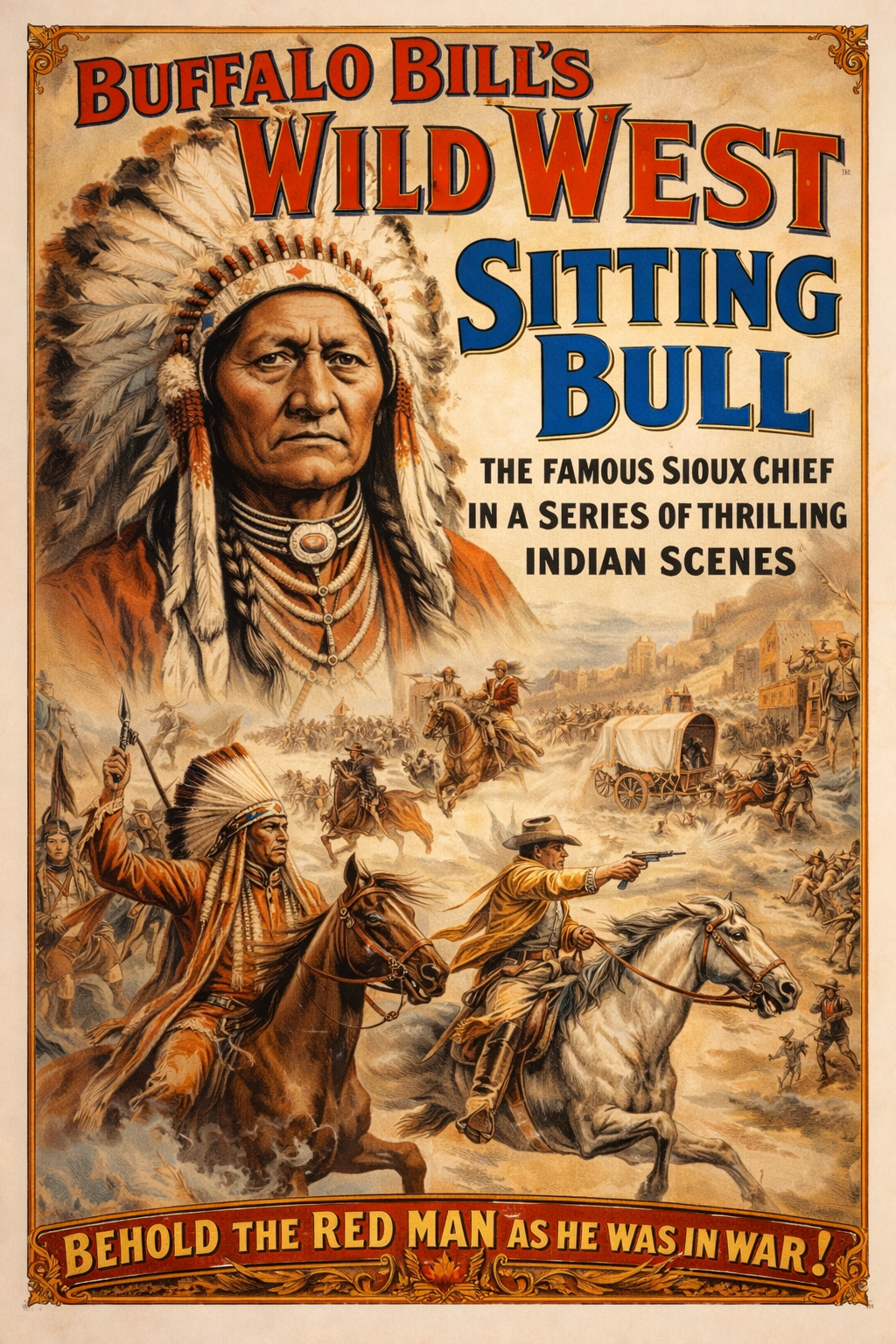
Native performers appeared on stage...
- But only within a script they did not control
- Including figures like Sitting Bull
- Playing "the Indian" for paying audiences
Presence without power.
Visibility without voice.
Sitting Bull (Tȟatȟáŋka Íyotake)
c. 1831–1890 — Hunkpapa Lakota leader who led resistance to U.S. expansion.
Military leader: At Little Bighorn (1876), Sitting Bull was the spiritual leader whose vision predicted victory over Custer.
Wild West performer: In 1885, Sitting Bull toured with Buffalo Bill for one season. He reportedly earned $50/week plus bonuses. He gave much of his earnings to homeless children he encountered in cities.
Death: Killed by Indian agency police in 1890, just weeks before Wounded Knee, during the Ghost Dance crisis.
His participation in the Wild West show represents the complex, constrained choices available to Native leaders after military defeat.
What the Shows Accomplished
Violence Became Adventure
Brutal conquest recast as thrilling drama
Conquest Became Drama
Policy and warfare become entertainment
Frontier Became Complete
Presented as resolved, finished, safe
This is not fabrication but rather selective narrative construction.
Real people and events reorganized into a usable national story.
Part II
Photography and the Authority of "Truth"
The Camera as Evidence
Photography's Power
If Buffalo Bill offers spectacle, photography offers evidence.
Why Photography Matters
- Claims objectivity
- Appears scientific
- Seems documentary
- Carries cultural authority
Dominant Forms
- Expeditionary photography
- Ethnographic documentation
- Studio "authenticity"
- Landscape surveys
The camera doesn't just record—it constructs.
Edward S. Curtis
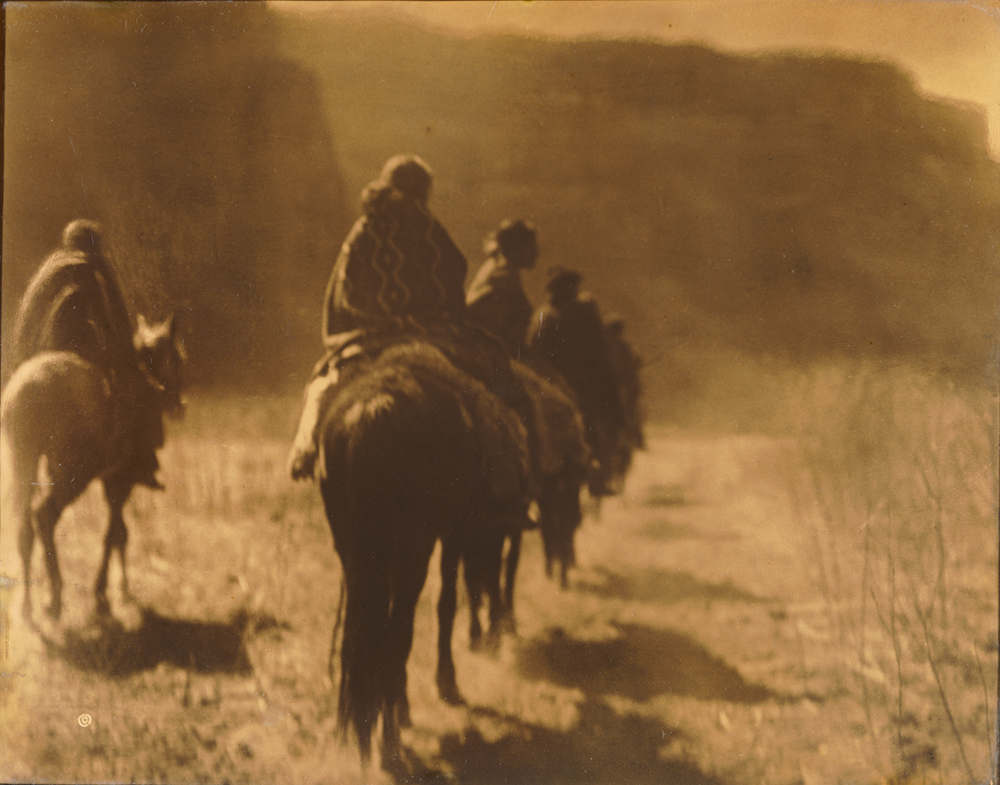
Edward Sheriff Curtis (1868–1952)
Massive project: The North American Indian (1907–1930)
- 20 volumes of photographs
- Over 40,000 images
- Documented 80+ tribes
Central thesis: The "Vanishing Indian"

The "Vanishing Indian" Thesis
Curtis explicitly stated his goal was to document Native peoples before they "vanished." His introduction claimed:
"The information that is to be gathered... respecting the mode of life of one of the great races of mankind, must be collected at once or the opportunity will be lost."
The assumption: Native cultures were dying and would soon be gone entirely. Curtis saw himself as a salvage operation, preserving what would otherwise disappear.
The problem: Native peoples weren't actually vanishing—they were adapting, surviving, and changing. Curtis's framing treated living people as already part of the past.
Curtis's Constructed "Authenticity"
- Staged scenes in controlled settings
- Removed modern clothing, tools, and environments
- Provided "traditional" costumes and props
- Presented Native life as timeless and already past
Curtis is not simply documenting disappearance.
He is aestheticizing it.
Photography does not merely record reality. It structures how reality is understood.
Launch “Picturing Manifest Destiny” Lecture
Part III
Shared Assumptions
The Logic of Preservation and Assimilation
Late-19th-Century Reform Logic
Reformers broadly believed:
- Native cultures were disappearing
- That disappearance was inevitable
The perceived moral task was therefore twofold:
Preserve the Past
Photography, museums, ethnographic records
Salvage ethnography
Reshape the Future
Boarding schools, allotment, assimilation
Assimilation policy
The Shared Assumption
Key distinction to maintain:
- Curtis is not advocating boarding schools
- Boarding schools are not using Curtis directly
This connection is ideological and temporal, not causal.
They share a worldview, not a conspiracy.
Part IV
Picturing Manifest Destiny
Landscape Photography and Empty Land
Landscape Photography
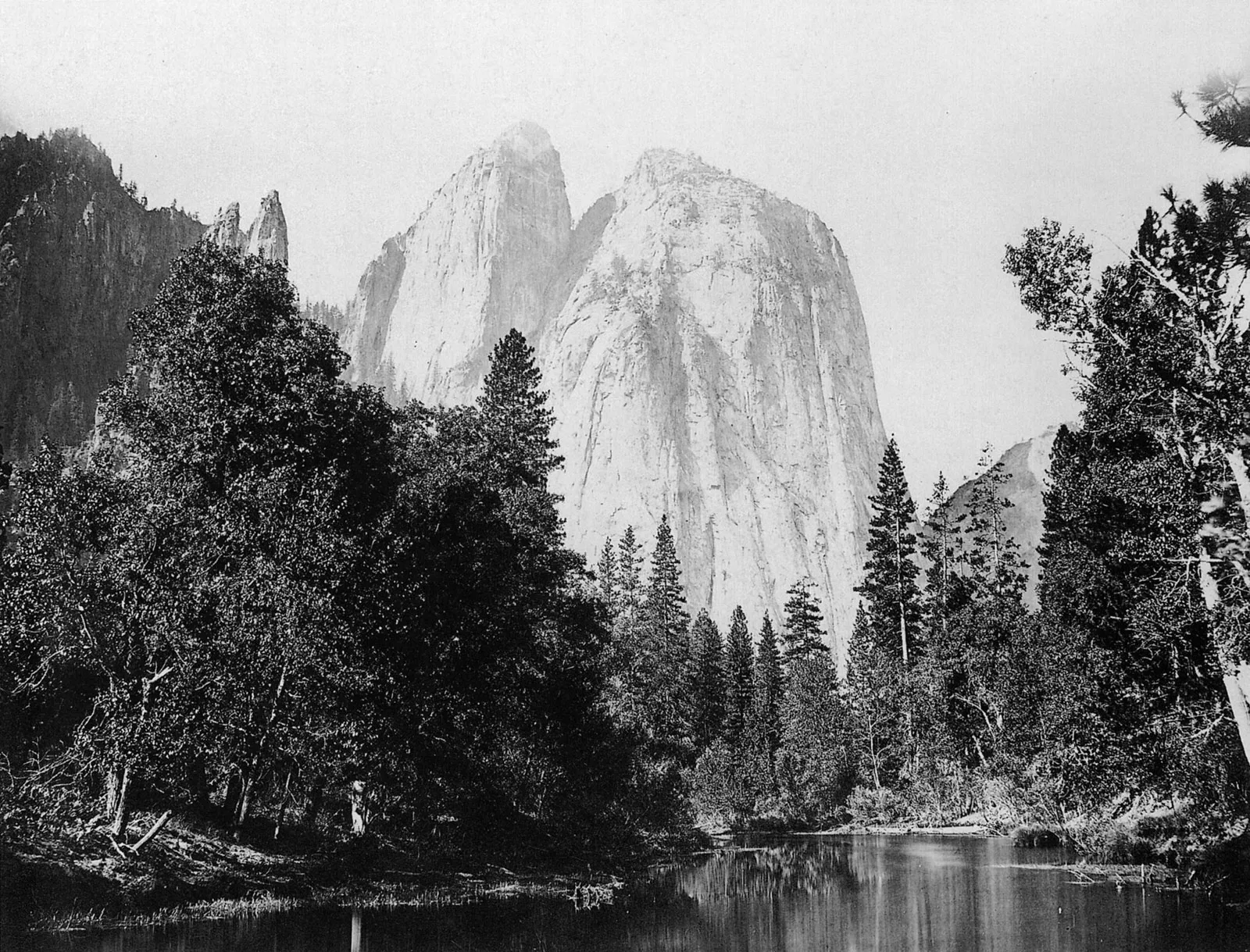
Emphasis on:
- Scale and grandeur
- Emptiness
- Land without visible history
- Absence as argument
The Camera's Implicit Messages
"The land is unused"
"Indigenous presence is past"
"Expansion is natural"
The camera makes conquest look peaceful.
Disappearance appears organic rather than coerced.
Part V
Spectacle and Photography Created National Memory
Synthesis
Two Tools, One Function
Buffalo Bill
Entertainment
Spectacle
Drama
Photography
Evidence
Documentation
"Truth"
Together they:
- Translate violence into culture
- Transform conquest into identity
- Replace moral uncertainty with narrative closure
Myth Is Structure
Myth is structure.
The Mythic West provided:
- A way to organize confusing, violent events
- Heroes and villains in clear roles
- A sense of resolution and completion
- A usable past for national identity
Conclusion: Memory, Not Explanation
By the 1890s, Americans possessed:
What they constructed was not analysis, but memory:
- Selective
- Comforting
- Durable
The West becomes not a site of conflict, but an origin story.
Looking Forward
Next: Frederick Jackson Turner and the Frontier Thesis
How an 1893 historian turned these cultural myths into academic theory and national ideology.