.webp)
Hey! Meet John Gast’s 1872 painting — the most famous image of **Manifest Destiny**. It’s not just art. It’s a visual manifesto of how Americans saw their expansion.
Why it matters: This wasn’t random. It shows **progress marching west** — with railroads, settlers, and light — while Native Americans and buffalo flee into darkness. It’s the 19th-century version of “Go West, young man!” — but with a dark side: who gets left behind?
Historians Weigh In:
“The painting is a stadial allegory — it maps human progress from savagery (left) to civilization (right), with white Americans as the final stage.”
— Martha A. Sandweiss, Print the Legend (2002)
Look closely: the woman in the center? She’s **Columbia**, symbol of America, stringing telegraph wire. Technology + destiny = unstoppable. But at what cost? Let’s find out.
Sea to Shining Sea
U.S. expansion 1783–1850 (just 67 years) — one of the fastest in world history
- 1783: ~890,000 sq mi (Treaty of Paris)
- 1850: ~3.0 million sq mi
- Growth: ~3.4×
- Added: ~2.1M sq mi → ~1.34B acres
- Pace: ~31,300 sq mi/yr
as fast, as far, and with as much lasting integration
as the U.S. from 1783 to 1850.

Central Thesis
Success in territorial expansion created fatal political division over slavery
Whoa — look at those numbers! In just 67 years, the U.S. grew 3.4× in size. That’s like adding a **new France** every decade.
Why it matters: This wasn’t slow settlement — it was a land rush. Plows, ballots, treaties, and guns all worked together to make it happen. But speed came with a price: who paid for every acre?
Historians Weigh In:
“No other nation in history has ever added so much territory, so quickly, and with such democratic legitimacy — and such devastating human cost.”
— Patricia Nelson Limerick, The Legacy of Conquest (1987)
Think of it like a startup: explosive growth, massive disruption. Next up: how did they pull it off?

Global Context: A Universal Pattern
Before examining American expansion, recognize a pattern repeating across continents and millennia:
A technologically or demographically stronger group claims a divine or civilizational mandate to "improve" land already in use by indigenous peoples.
Hold up — before we dive into the U.S., let’s zoom out. This pattern? It’s global. From Rome to the Mongols to European empires, the playbook is the same: stronger group + “higher purpose” = land grab.
Why it matters: Seeing Manifest Destiny as part of a worldwide pattern helps us ask better questions: Was it inevitable? Could it have been different? And — most importantly — are we still doing versions of this today?
Historians Weigh In:
“Expansion is not an American invention — it is a human constant, dressed in local costumes of religion, race, and progress.”
— Patricia Nelson Limerick, The Legacy of Conquest (1987)
So yes — America did it. But it wasn’t the first, and it wasn’t the last. Let’s see how the U.S. version played out.
Japanese Displace the Ainu
(~3rd century CE–1912)

Wait — this isn’t the U.S.! Japan did it too. For 1,600 years, the Yamato pushed north, claiming the Ainu were “uncivilized” and their land was terra nullius — empty and up for grabs.
Why it matters: This proves **expansion isn’t just a Western thing**. Same moves: civilizing mission → staged conquest → legal tricks → cultural erasure. The Ainu lost their language, land, and autonomy — just like Native nations in America.
Historians Weigh In:
“The Meiji-era colonization of Hokkaido was not modernization — it was internal imperialism, using the same tools Europe used overseas.”
— Brett L. Walker, The Conquest of Ainu Lands (2001)
So when Americans said “God wants us to expand,” they weren’t original — just loud. Next: How did the U.S. make it legal?
Viet Push Champa and Khmer South
("Southward Advance," 10th–19th centuries)

Meet Nam Tiến — Vietnam’s 900-year push south. Starting in the 10th century, the Đại Việt kingdom marched into the Hindu **Champa** and Buddhist **Khmer** lands, claiming the **Mandate of Heaven** gave them the right to “civilize” the south.
More history: By 1471, Champa’s capital fell. By 1698, the Mekong Delta was taken. By 1802, the entire region was **Vietnamized** — temples destroyed, populations displaced, culture absorbed. The last Champa king was executed in 1832. Sound familiar?
Why it matters: This wasn’t Christian or Western — it was **Confucian imperialism**. Same pattern: divine mandate + demographic pressure + state migration = total conquest. The south became Vietnam’s rice bowl — but at the cost of two ancient civilizations.
Historians Weigh In:
“Nam Tiến was not mere migration — it was a state-orchestrated civilizing mission, using Confucian ideology the way Americans used Protestant destiny.”
— Li Tana, Nguyễn Cochinchina: Southern Vietnam in the Seventeenth and Eighteenth Centuries (1998)
So whether it’s Japan, Vietnam, or the U.S. — the playbook is universal. Next: How did America make expansion legal?
Bantu Migrations Displaced Khoisan
(Southern Africa, ~300–1800 CE)
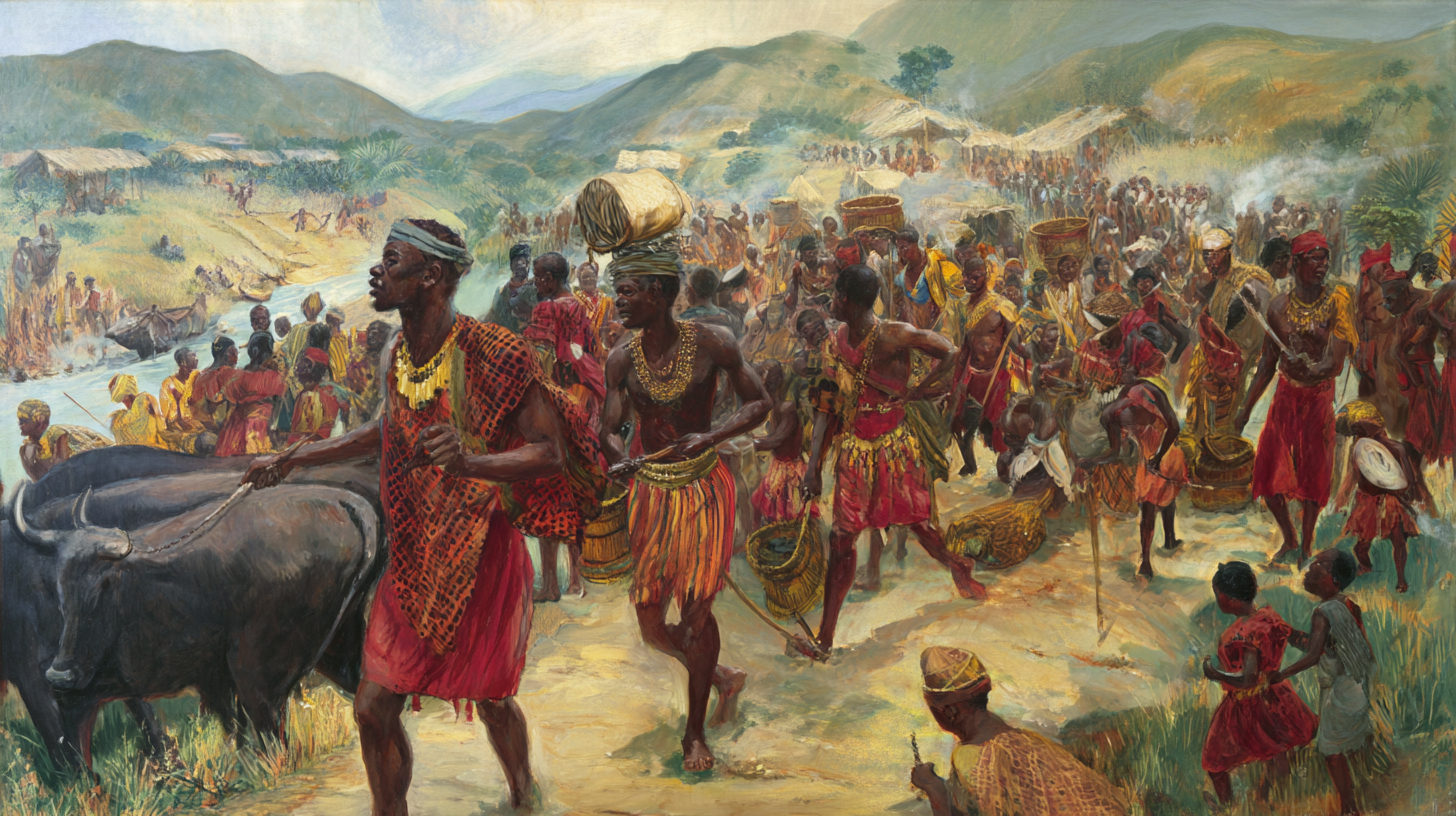
Think expansion is just a European thing? Nope. For 1,500 years, **Bantu-speaking farmers** swept south from West/Central Africa, pushing **Khoisan hunter-gatherers** into deserts and mountains — using iron tools, farming, and population growth as their weapons.
More history: By 300 CE, they were in East Africa. By 1000 CE, they reached the Limpopo. By 1800, they dominated southern Africa. The **Khoisan** (world’s oldest human lineage) lost 90% of their land. The **Zulu kingdom** (a Bantu state) later used divine kingship and military genius to conquer neighbors — sound familiar?
Why it matters: This wasn’t “primitive.” It was **agriculture vs. hunting**, **iron vs. stone**, **settlement vs. mobility** — the same logic U.S. Senator Benton used: *“The hunter must give way to the farmer.”* It’s a human pattern, not a racial one.
Historians Weigh In:
“The Bantu expansion was one of the greatest demographic revolutions in human history — and one of the most overlooked.”
— Christopher Ehret, An African Classical Age (1998)
So when Americans said “civilization must advance,” they weren’t inventing the wheel — just copying a 2,000-year-old playbook. Next: How did the U.S. turn this into law?
Common Threads Across All Examples
- Divine right, racial superiority, or "civilizing mission"
- Demographic swamping via mass migration
- Legal fictions: treaties, purchases, declarations of emptiness
- Violence + disease as force multipliers
- Long-term assimilation/erasure of indigenous cultures
Pivot Statement: The United States is not the origin of this process: speed, democratic-republic, media-amplification, industrial scale, and legal sophistication are the only difference.
The "Civilizing Mission"
A justification for colonization claiming that the colonizing power has a duty to bring "civilization," education, religion, or superior institutions to "backward" peoples.
Examples across cultures:
- Japanese: Bringing Yamato culture to Ainu "barbarians"
- Vietnamese: Spreading Confucian learning to Hindu Champa
- French: "Mission civilisatrice" in Africa and Asia
- British: "White Man's Burden" in India and Africa
- American: Spreading republican institutions and Christianity
Critical note: This rhetoric was used to justify dispossession, cultural destruction, and violence while framing it as beneficial to the colonized.
Look — it’s the **same five moves** in Japan, Vietnam, Africa, and America: 1) “We’re better” → 2) Flood the land → 3) Fake paperwork → 4) War + germs → 5) Erase the culture. Rinse. Repeat.
More history: This isn’t coincidence. From **Bantu iron spears** to **American railroads**, from **Mandate of Heaven** to **Manifest Destiny**, every empire used the same script. The U.S. just ran it in **fast-forward** — with **voters, newspapers, and factories** turbocharging the machine.
Why it matters: This isn’t about blaming one nation. It’s about **power** — how humans justify taking what isn’t theirs. The U.S. didn’t invent the game. It just perfected it.
Historians Weigh In:
“Every empire claims a moral mission. The difference is not the claim — it’s the scale and speed of execution.”
— Paul A. Kramer, The Blood of Government (2006)
So yeah — America was exceptional… in how efficiently it played the oldest game in human history. Next: How did they make it legal?
Thinking Historically: Context vs. Presentism
Critical Framework:
Contextualization is disciplined empathy; presentism is undisciplined certainty.
Understanding historical actors, events, and ideas within their own time period, considering the beliefs, knowledge, values, and constraints they operated under.
"The past is a foreign country; they do things differently there."
Contextualization
Definition: Understanding historical actors, events, and ideas within their own time period, considering the beliefs, knowledge, values, and constraints they operated under.
Why it matters:
- Prevents judging past people by present-day moral standards they couldn't have known
- Helps us understand why historical actors made choices that seem incomprehensible today
- Allows us to see change over time—how ideas that were once "common sense" became unacceptable
- Doesn't mean approving of past actions—just understanding them on their own terms first
Example: Understanding that 1840s Americans widely accepted stadial theory and racial hierarchies helps us see how they justified expansion. We can then analyze and critique those justifications—but only after we understand them.
Presentism
Definition: The anachronistic introduction of present-day ideas, perspectives, and moral standards into depictions of the past.
Why it's problematic:
- Prevents understanding historical change—if the past is judged only by present standards, we can't see how ideas evolved
- Creates "heroes and villains" rather than understanding complex human beings
- Flattens history into simple morality tales rather than analyzing causes and consequences
- Makes us miss important patterns by focusing only on moral judgment
Note: Avoiding presentism doesn't mean we can't make moral judgments about the past—but those judgments should come AFTER understanding, not instead of it.
History isn’t about judging the past with today’s rules — it’s about understanding how people *back then* saw the world. That’s contextualization. Without it, we miss the whole story.
More history: In 1848, most Americans believed **God wanted them to expand**, **science proved white superiority**, and **laws said land was empty if not farmed**. These weren’t fringe ideas — they were **textbooks, sermons, and Supreme Court rulings**.
Why it matters: You can’t fight an idea until you understand it. Judging 1840s people by 2025 morals is like yelling at someone in 1900 for not having a smartphone. But once we *get* their worldview, we can ask: Was it self-serving? Was it cruel? Did it change?
Historians Weigh In:
“The first duty of the historian is to enter the mind of the past — not to condemn it, but to comprehend it.”
— Richard Hofstadter, The American Political Tradition (1948)
So yes — we’ll call out the harm. But first, we’ll walk in their shoes. Ready to meet the 1840s mind?
Reframing the National Mission
In the decade following 1845, the United States underwent a transformation that redefined the scope of the American Republic.
Three Interlocking Realities:
- Demographic pressure: Population doubling every 25 years
- Institutional superiority: Confidence in republican government
- Providential duty: Divine mandate for expansion
By 1845, Americans weren’t just expanding — they were on a mission. After 60 years of winning wars, building a stable republic, and doubling in size, they thought: “We’re not just lucky — we’re chosen.”
More history: Texas annexed in 1845. Oregon settled in 1846. Mexican-American War ends 1848 — **half of Mexico’s land** becomes U.S. territory in just 3 years. This wasn’t random. It was a national project driven by population, pride, and providence.
Why it matters: These three beliefs — we’re too many, we’re the best, God said so — turned expansion from a policy into a moral duty. And once you believe that, anything goes: treaties, wars, removals.
Historians Weigh In:
“By 1848, expansion was no longer a debate — it was a national sacrament.”
— Reginald Horsman, Race and Manifest Destiny (1981)
So yeah — America didn’t just take land. It believed it was saving the world. Next: How did they make that belief legal?
Justifications for Westernward Expansion
How Americans in the 1840s understood their mission
1840s Americans didn’t just *want* to expand — they believed **God told them to**. This wasn’t fringe preaching. It was **newspapers, sermons, and campaign speeches**.
Let’s dive deeper: The idea came from the Puritans’ “City upon a Hill” — America as **chosen by God**. By the 1840s, it evolved into: “The whole continent is ours — because God said so.” John L. O’Sullivan (who coined *Manifest Destiny*) wrote in 1845: “Providence has given us this land.” Full stop.
Why it matters: When you believe **God is on your side**, treaties, wars, and removals aren’t just politics — they’re **divine duty**. Opposing expansion? That’s not just wrong — it’s blasphemy.
Historians Weigh In:
“For many Americans, Manifest Destiny was not metaphor — it was literal theology.”
— Robert W. Johannsen, The Meaning of Manifest Destiny (1997)
So yeah — they weren’t just greedy. They were **on a mission from God**. Next: How did they prove they were “better”?
Whig Opposition: Moral Restraint in an Age of Conquest
Who Were the Whigs?
- Founded 1834 — anti-Jackson coalition
- Leaders: Henry Clay, Daniel Webster, young Abraham Lincoln
- Core belief: Strong federal government for national improvement
- “American System”: bank, tariffs, internal improvements
- Social vision: moral progress through institutions, not conquest
Opposition to Aggressive Expansion
- Indian Removal Act (1830): Clay voted against — called it “cruel and unjust”
- Mexican-American War (1846–48): Lincoln’s “Spot Resolutions” demanded proof of U.S. soil
- Feared war would spread slavery, inflate debt, weaken federal legitimacy
- Believed in elevation over expulsion: Natives & Mexicans could be “civilized”
“Not all who believed in progress believed in plunder.”
— A Whig conscience in a Jacksonian age
Not everyone was cheering for war. The **Whigs** — led by **Henry Clay** and a young **Abraham Lincoln** — said: “We can grow the nation without destroying others.”
Let’s unpack this: Whigs wanted **railroads, schools, and banks** — not **bayonets**. They voted against Indian Removal and **questioned the Mexican War**. Lincoln demanded Polk prove the war started on U.S. soil (it didn’t). Their fear? Expansion would **spread slavery** and **tear the Union apart**.
Why it matters: The Whigs lost the 1840s — but their ideas **won the future**. Their moral stand became the **Republican Party** (1854) and shaped **Reconstruction**. They proved you could believe in American greatness without believing in conquest.
Historians Weigh In:
“The Whigs were the conscience of the republic — defeated in their time, but prophetic in their warnings.”
— Daniel Walker Howe, What Hath God Wrought (2007)
So while Democrats shouted “54°40' or Fight!”, the Whigs whispered: “Not like this.” Next: How did slavery become the **real** battleground?
1. Providential Allotment (Divine Destiny)
North American continent providentially allotted to the U.S. for free development of its multiplying millions under Anglo-Saxon republican government.
God's plan specifically designated this land for Anglo-Saxons.
×
Anglo-Saxon Racial Theory (1840s)
In the 1840s, "Anglo-Saxon" referred to people of English descent and their institutions—particularly common law, Protestant Christianity, and representative government.
Key beliefs:
- Anglo-Saxons possessed unique capacity for self-government and liberty
- Anglo-Saxon institutions were superior to other systems
- Anglo-Saxon "race" had a duty to spread these institutions globally
- This was understood as both racial and cultural superiority
Modern understanding: These beliefs are now recognized as racist ideology that rationalized conquest and dispossession.
1840s Americans didn’t just *think* the continent was theirs — they believed **God signed the deed**. This wasn’t a metaphor. It was literal theology in newspapers and pulpits.
Let’s break it down: The idea came from Puritan roots — America as a “City upon a Hill.” By 1845, John L. O’Sullivan wrote: “Our manifest destiny is to overspread the continent allotted by Providence.” Translation: “God gave us everything from sea to sea — and told us to take it.”
Why it matters: When you believe **God is your realtor**, Native nations and Mexico aren’t neighbors — they’re obstacles to divine will. This made war, removal, and annexation feel like **holy work**.
Historians Weigh In:
“Manifest Destiny fused Protestant millennialism with racial nationalism — a theology of conquest.”
— Amy Greenberg, Manifest Manhood and the Antebellum American Empire (2005)
So yes — they weren’t just land-hungry. They were heaven-sent. Next: How did they claim to be “better” than everyone else?
Manifest Destiny
“…our manifest destiny to overspread the continent allotted by Providence for the free development of our yearly multiplying millions.”
— John L. O’Sullivan, 1845
Key Innovation: Destiny > Law — Moral imperative trumps legal claims.
1. American Exceptionalism
- Puritan “City upon a Hill” (1630)
- Stable gov’t, growth, mobility
- Religious freedom, literacy
- Polk: “most free & happy”
2. Republican Mission
- Spread self-rule & law
- Replace chaos with republics
- Not conquest — rescue
- Mexico: 30 coups → U.S. order
3. Divine Guidance
- Continent = God’s theater
- Geography proves design
- Opposition = defying Providence
- Success = proof
This wasn’t a policy. It was a faith. O’Sullivan didn’t *ask* for the continent — he said **God already gave it**.
Let’s connect the dots: America’s success (stable gov’t, growth, freedom) → proves we’re special → so we must spread our system → and since God designed the continent for us → resistance is literally sin.
Why it matters: This loop made expansion **unstoppable**. Legal claims? Treaties? Borders? Irrelevant. Destiny > Law. Mexico’s 30 coups? Proof they *needed* us. Native nations? Just in the way of God’s plan.
Historians Weigh In:
“Manifest Destiny was a self-fulfilling prophecy — the more we won, the more we believed we were right.”
— Frederick Merk, Manifest Destiny and Mission in American History (1963)
So yeah — they didn’t just take the land. They believed they were saving the world. Next: How did this explode over slavery?
Whig Response to “Manifest Destiny”
Whigs did not oppose expansion —
they opposed Democratic, uncontrolled, divinely reckless expansion.
1. Moral Hubris
- Blasphemous to claim God ordains conquest
- Clay: “No divine right to trample nations”
2. Reckless & Costly
- War debt, military overreach
- Mexican War = “Mr. Polk’s War”
3. Sectional Poison
- Slave-power plot to add slave states
- Adams: Texas = “slaveocracy conspiracy”
Whig Vision: Controlled Expansion to fund the American System —
law, commerce, and federal guidance, not divine land grabs.
Whigs didn’t hate expansion — they hated reckless, God-drunk expansion. They wanted **roads, banks, and schools**, not **wars, debt, and slavery**.
Let’s zoom in: Henry Clay called divine-right conquest **blasphemy**. Abraham Lincoln mocked Polk’s war as **unconstitutional**. John Quincy Adams saw Texas annexation as a **slave-power conspiracy**. Their fear? Unchecked Manifest Destiny would **tear the republic apart** — and they were right.
Why it matters: The Whigs offered a **sane alternative**: grow the nation through **law and investment**, not **faith and force**. They lost the 1840s — but their warnings became the **Republican Party** and the **Union’s conscience**.
Historians Weigh In:
“The Whigs saw Manifest Destiny not as destiny — but as dangerous delusion.”
— Daniel Walker Howe, What Hath God Wrought (2007)
So while Democrats shouted “God wills it!”, the Whigs whispered: “Not like this.” Next: How did slavery turn destiny into disaster?
xs
2. Demographic Imperative (Population Pressure)
1820
9.6 million
1840
17.1 million (78% increase)
1850
23.2 million (36% increase)
1860
31.4 million (35% increase)
The Problem: Human tide pressing against boundaries
The Solution: Land need for demographic safety valve preventing overcrowding, class conflict, and stagnation
America wasn’t just growing — it was exploding. From 1820 to 1860, the population tripled. That’s **21.8 million new people** in 40 years — more than the entire population of France.
Let’s feel the pressure: Farms were filling up. Cities were swelling. Politicians feared: “No land = no freedom = no republic.” Jefferson’s dream of independent farmers was dying — unless they opened the West. The continent wasn’t a want. It was a survival need.
Why it matters: This wasn’t greed — it was panic. If you believed a republic dies without land for all, then **blocking expansion = killing democracy**. Native nations? Mexico? Just in the way of the **safety valve**.
Historians Weigh In:
“The West was not a luxury — it was the oxygen of American democracy.”
— Frederick Jackson Turner, The Significance of the Frontier in American History (1893)
So yeah — they didn’t just want the land. They needed it to breathe. Next: How did they claim to be “better” than the people already there?
3. Anglo-Saxon Racial Mission
Consensus belief: Anglo-Saxon race and their institutions uniquely suited to liberty, law, and progress.
Cultural and racial beliefs in the 19th justified displacing "inferior systems"
Okay — let’s be real. This justification is hard to hear. But it was the **mainstream belief** of white 1840s Americans. They didn’t just *think* they were better — they believed it was scientific fact.
Let’s unpack it carefully:
“Anglo-Saxon” meant: English/Germanic blood + Protestant work ethic + common law + representative government. They said: “Look at our cities, railroads, schools — proof we’re the pinnacle of civilization.”
Then they looked at Native nations and Mexico and said: “Tribal chaos. Catholic superstition. 30 coups in 25 years. They’re stuck in the past.”
Why it matters: This wasn’t just prejudice — it was policy. It made **displacement feel like progress**. If you’re “saving” the land from “savages,” you’re not stealing — you’re improving. That’s how good people justified terrible things.
Historians Weigh In:
“Anglo-Saxonism was the intellectual scaffolding of Manifest Destiny — a racist myth dressed as science and destiny.”
— Reginald Horsman, Race and Manifest Destiny (1981)
Important: These ideas are wrong and racist. We study them not to excuse — but to understand how power works. And to ask: What myths do we believe today?
Next: How did they turn “We’re better” into actual land?
4. Ethical Exceptionalism (Moral Superiority)
“The people of these States are the most free, the most enlightened, and the most happy people on the face of the whole globe.”
— James K. Polk, Inaugural Address, March 4, 1845
- Press, pulpit, and schools proclaimed superiority
- Expansion viewed as ethical act benefiting humanity
- Spreading superior institutions was seen as a moral duty to mankind
- Self-reinforcing: Success proved righteousness
This one’s the trickiest — because it feels so good. Americans didn’t just think they were better. They believed **expanding was a moral act** — like charity, but with guns.
Let’s unpack the logic:
“We have no king, no poverty, no illiteracy, no coups — we’re the happiest, freest people ever. So if we take California from unstable Mexico, we’re helping them. If we remove Native tribes, we’re elevating them from savagery.”
→ **Self-interest = global good**.
Why it matters: This is the most dangerous justification. When you believe you’re **saving the world**, you don’t see the harm. You don’t hear the screams. You just see progress. That’s how empires sleep at night.
Historians Weigh In:
“Moral exceptionalism turned conquest into crusade — the ultimate self-deception.”
— Amy S. Greenberg, A Wicked War (2012)
Important: This wasn’t hypocrisy. They meant it. That’s what makes it so powerful — and so scary. Next: How did they make “saving the world” legal?
5. Manifest Destiny, Divided Aims
Democrats championed expansion to dilute federal centralism; Whigs backed it to shore up the American System.
Democrats
- Distant states dilute Eastern elite control & prevent “consolidation”
- More land → more yeoman farmers → stronger state sovereignty
- Expansion as constitutional safeguard against federal overreach
- Manifest Destiny (O’Sullivan, 1845) = spread smallholder democracy
Key Actions: Jackson’s Indian removal; Polk’s “54°40' or Fight!”, Texas annexation, Mexican War.
“To enlarge [the] area of freedom… is worthy of the patronage of a free people.” —Polk, 1845
Whigs
- Expansion must fund & protect the American System (bank, tariffs, infrastructure)
- New states = new markets & revenue for national economic unity
- Cautious pace to avoid debt, sectionalism, & slave-power imbalance
- Strong federal institutions needed to bind empire together
Key Fears: Overextension weakens national bank; Southern gains upset Missouri Compromise balance.
“Annexation of Texas would kindle a fire which all the waters of the ocean could not extinguish.” —Henry Clay
Both parties wanted the continent — but for totally different reasons.
Let’s break it down:
**Democrats** (Jackson, Polk): “More land = more farmers = less federal control.” They feared a strong national government would crush local freedom. Expansion was their **anti-federal weapon**.
**Whigs** (Clay, Webster): “More land = more markets = stronger national bank and roads.” They wanted **federal power** to build a unified economy. Expansion was their **nation-building tool**.
Why it matters: This wasn’t just politics — it was **vision vs. vision**. Democrats saw empire as freedom from Washington. Whigs saw it as freedom through Washington. And the **real fight**? Slavery — because every new state tipped the balance of power.
Historians Weigh In:
“Manifest Destiny was not one idea — it was a civil war of ideologies within the same nation.”
— Daniel Walker Howe, What Hath God Wrought (2007)
So yeah — both wanted the West. But one wanted **decentralized freedom**, the other **centralized progress**. Guess which one won? Next: The **human cost**.
6. Economic Rationalism (Land as Wealth Engine)
Core Argument: Land equals opportunity and wealth
- Land needed for yeoman farmers, entrepreneurs, speculators
- Mexican Cession = "richest territory on earth" (gold, farmland, ports)
- $15M for 525,000 square miles
Strip away the God talk and race talk — here’s the **real math**: America bought half of Mexico for **$15 million** — and got **gold, ports, and farmland** worth billions.
Let’s run the numbers:
• **Cost**: $15M + $100M war = ~$115M total
• **Gain**: 525,000 sq mi = $220 per square mile
• **California Gold Rush (1848–53)**: **$2 billion** in 5 years
→ **ROI**: Paid for itself in gold dust alone.
Why it matters: This wasn’t charity — it was **capitalism on steroids**. Farmers got land. Speculators got rich. Ports connected the world. And the **human cost**? Not on the balance sheet. Native nations and Mexican citizens were just externalities.
Historians Weigh In:
“The Mexican Cession was the greatest real estate deal in human history — and the greatest uncounted tragedy.”
— David M. Potter, The Impending Crisis (1976)
So yeah — they didn’t just take the land. They invested in it — and cashed out big. Next: What did it **cost the people already there**?
Legal Framework: Doctrine of Discovery
Definition: An international legal principle originating in 15th-century papal bulls and European traditions that automatically provided Europeans with property rights and governmental, political, and commercial rights over indigenous inhabitants without their consent.
Basis: Religious and ethnocentric ideas of European and Christian superiority
American Continuity: Manifest Destiny was the natural outgrowth of this doctrine
Current Status: Still cited in U.S. federal law today
Here’s the **legal cheat code** Europe used for 500 years — and America still uses: “If you’re Christian and European, you own the land. If not, you don’t.” No vote. No treaty. Just **automatic title**.
Let’s trace the timeline:
• **1452**: Pope says Portugal can claim non-Christian lands
• **1493**: Pope splits the world between Spain and Portugal
• **1823**: U.S. Supreme Court (Johnson v. M’Intosh) says: “Discovery = ownership”
• **2005**: U.S. courts still cite it in Native land cases
Why it matters: Manifest Destiny wasn’t new — it was **Doctrine of Discovery 2.0**. The U.S. didn’t invent conquest. It just modernized it with railroads, constitutions, and gold. And the **original rule**? Still in the law books. Today.
Historians Weigh In:
“The Doctrine of Discovery is not ancient history — it is the living foundation of American property law.”
— Robert A. Williams Jr., Like a Loaded Weapon (2005)
So yeah — every “For Sale” sign in the West? It started with a **papal bull**. Next: How did they turn this into **actual removal**?
10 Elements of the Doctrine of Discovery
1. First Discovery
First European to “see” land gains claim.
2. Actual Occupancy
Must settle or fortify within reasonable time.
3. Preemption
Government monopoly on Native land sales.
4. Indian Title
Natives keep use, but not full ownership.
5. Limited Sovereignty
Tribes = “domestic dependent nations.”
6. Contiguity
River mouth = claim to entire watershed.
7. Christianity
Non-Christians = lesser land rights.
8. Terra Nullius
“Empty” if not farmed European-style.
9. Civilization
Duty to “civilize” = justify control.
10. Conquest
Military victory = full legal title.
×First Discovery
First European nation to “discover” land gains inchoate title — even if indigenous people lived there for millennia. Example: Cabot (1497) → England claims Atlantic coast.
×Actual Occupancy
Discovery must be followed by physical presence — forts, settlements, patrols — within “reasonable time.” Lewis & Clark (1804–06) = U.S. occupancy in Oregon.
×Preemption
Only the discovering government can buy from Natives. No private sales. U.S. law (1790s): Individuals buying from tribes = illegal.
×Indian Title
Natives have right of occupancy, but ultimate title belongs to U.S. Marshall (1823): “They are occupants… we hold dominion.”
×Limited Sovereignty
Tribes = “domestic dependent nations” — can govern internally, but not sell land or ally with foreign powers. Cherokee Nation v. Georgia (1831).
×Contiguity
Discovering a river mouth = claim to entire watershed. France (1682): Mississippi mouth → all interior. U.S. (1792): Columbia River → Oregon.
×Terra Nullius
“Empty land” if not used via European agriculture. Hunting, migration, spiritual use = invisible. Great Plains = “waste” despite buffalo economy.
×Christianity
Non-Christians have inferior rights. Rooted in 15th-century papal bulls. Missionaries = legal agents of conquest.
×Civilization
God commands “civilized” to educate and control “savages.” Paternalism = moral duty. “For their own good.”
×Conquest
Military victory = full legal title. No treaty needed. Mexican Cession (1848), Indian Wars.
Click any term for full definition & historical example.
This isn’t history — it’s a **legal playbook** used for 500 years to take land from people who were already there. Click any term to see how it worked.
Let’s see the system:
1. **First Discovery** → “We saw it first.”
2. **Occupancy** → “We planted a flag.”
3. **Preemption** → “Only we can buy it.”
…and so on — until **Conquest** = “We won, so it’s ours.”
Why it matters: This wasn’t chaos. It was **law**. Every treaty, every removal, every war — backed by **10 rules** written 400 years before Manifest Destiny. And the **craziest part**? It’s still cited in U.S. courts today.
Historians Weigh In:
“The Doctrine of Discovery is the original sin of American property law — a 15th-century rule still shaping 21st-century justice.”
— Robert A. Williams Jr., Like a Loaded Weapon (2005)
So yeah — every “For Sale” sign in the West? It started with a **papal bull**. Next: How did they turn this into **mass removal**?
Early U.S. Application: The Oregon Strategy
Thomas Jefferson's Strategic Use of the Doctrine:
- Dispatched Lewis & Clark Expedition (1803–1806) as legal maneuver
- Built on Robert Gray's 1792 Columbia River discovery
- Post-War of 1812 rituals at Astoria reinforced occupancy
Jefferson understood that physical possession converted incomplete discovery into complete title under the Doctrine's principles.
Jefferson didn’t just *send* Lewis & Clark — he sent them to **win a legal war** before it started.
Let’s replay the move:
• **1792**: Robert Gray sails up the Columbia → “First Discovery” check.
• **1803**: Louisiana Purchase → U.S. owns land to the Rockies.
• **1804–06**: Lewis & Clark build Fort Clatsop, map rivers, meet tribes → “Actual Occupancy” check.
• **1811**: Astoria founded → commercial stake.
• **1818**: Flag-raising, soil-turning rituals → symbolic possession check.
→ **1846**: Oregon Treaty at 49th parallel → **checkmate**.
Why it matters: This wasn’t exploration. It was **legal theater**. Jefferson used the **Doctrine of Discovery** like a chess grandmaster — every move building a claim that Britain couldn’t beat. The West wasn’t won by war — it was won by **paper, flags, and footprints**.
Historians Weigh In:
“Jefferson played the Doctrine of Discovery with genius — turning exploration into empire.”
— Bernard DeVoto, The Course of Empire (1952)
So yeah — the Oregon Trail didn’t just carry settlers. It carried **legal title**. Next: How did they use this to **remove entire nations**?
Stadial Theory: The “Science” of Progress
4 Stages of Society
- 1. Savagery: Hunting and gathering (nomadic existence, no fixed property)
- 2. Barbarism: Pastoralism (tribes, herding societies)
- 3. Agriculture: Settled farming (fixed land tenure, villages)
- 4. Civilization: Commerce (trade and manufacturing, written law, republican institutions)
Americans believed:
By 1848, Americans looked at their track record and saw overwhelming evidence of Stage 4 achievement.
- Higher stages naturally replace lower ones
- Not conquest — progress
- Like water flows downhill
This idea was in every textbook, newspaper, and sermon. It wasn’t fringe — it was common sense.
📚 What Is Stadial Theory?
Stadial theory (also called "stage theory" or "four stages theory") was the most influential social science framework of the 18th-19th centuries. It argued that all human societies naturally progress through four stages of development, each defined by how people produce food and organize property.
🎯 Origins in Scottish Enlightenment
Key thinkers:
- Adam Smith: Wealth of Nations (1776) described progression from hunting to commerce
- John Millar: Origin of the Distinction of Ranks (1771) linked property systems to political institutions
- Lord Kames: Sketches of the History of Man (1774) traced cultural evolution through stages
- Adam Ferguson: Essay on the History of Civil Society (1767) analyzed transition from "rude" to "polished" nations
Why it was persuasive: This theory was based on empirical observation of societies worldwide. Enlightenment thinkers believed they'd discovered a universal law of human development—like Newton's laws but for society.
💭 American Adoption
American founders were deeply influenced by Scottish Enlightenment. Jefferson, Madison, Hamilton, Adams—all read and cited these thinkers. By the 1840s, stadial thinking was so embedded in American culture that most people didn't even recognize it as theory—it was just "common sense."
🎓 Why This Matters for Manifest Destiny
Stadial theory provided intellectual justification for displacement that seemed scientific rather than racist: Stage 1 societies naturally give way to Stage 3-4 societies. This isn't conquest—it's historical progress. Higher stages have right/duty to replace lower stages. Resistance is futile—like fighting gravity.
📚 The Four Stages Explained
🎯 Stage 1: Savagery (Hunting & Gathering)
Subsistence: Hunting animals, gathering plants—living off what nature provides. Property: No fixed property because nomadic; temporary claims to hunting territories. Social organization: Small bands, kinship-based, no formal government.
Examples cited: Plains Indians (Lakota, Cheyenne), Great Basin tribes (Shoshone, Paiute), some California tribes.
Scottish Enlightenment view: Most "primitive" stage; necessary foundation but least developed.
💭 Stage 2: Barbarism (Pastoralism)
Subsistence: Herding livestock (cattle, sheep, horses)—domestication without settled agriculture. Property: Movable wealth (herds); some territorial claims for grazing. Social organization: Tribal with chiefs, warrior culture, more complex than Stage 1.
Examples cited: Mongols, Arabian Bedouins, some Plains tribes after horse adoption, Scottish Highland clans (pre-1745).
Key feature: More organized than hunters but still mobile, making them formidable but "backward."
🎓 Stage 3: Agriculture
Subsistence: Settled farming—planting crops, maintaining fixed fields. Property: Fixed land tenure with defined boundaries and inheritance. Social organization: Villages, towns, customary or written law, political hierarchies.
Examples cited: Eastern Woodlands tribes (Cherokee, Creek after "civilization" efforts), Mexican haciendas, feudal Europe, ancient civilizations.
Key advancement: Permanent settlement enables accumulation, specialization, government.
⚡ Stage 4: Civilization/Commerce
Subsistence: Trade and manufacturing—economy based on exchange, not just production. Property: Complex legal systems for property, contracts, corporations. Social organization: Written constitutions, representative government, division of powers, courts.
Examples cited: Britain, United States, Netherlands, republican Rome.
The pinnacle: Scottish Enlightenment viewed this as highest achievement of human society.
🎯 Critical Understanding
This framework was considered SCIENTIFIC in the 1840s—not racist ideology but empirical observation of human development. It was taught in universities, cited by intellectuals, and accepted across the political spectrum. Questioning it was like questioning evolution today—possible, but you'd be dismissed as ignorant.
📚 How Americans Viewed Themselves
By 1848, Americans looked at their track record and saw overwhelming evidence of Stage 4 achievement.
🎯 Political Institutions (Stage 4 Evidence)
- Constitutional government: Written Constitution (1787) operating successfully for 60+ years
- Representative democracy: Regular elections, peaceful transfers of power
- Federal system: Balance between national and state governments
- Independent judiciary: Courts enforcing law against government overreach
- Bill of Rights: Protected individual liberties
💭 Economic Institutions (Stage 4 Evidence)
- Commercial economy: Trade networks spanning continent
- Banking system: Capital accumulation and investment
- Contract law: Enforceable agreements enabling complex transactions
- Property registration: Deeds, titles, surveyed boundaries
- Early industrialization: Factories, mills, railroads beginning
🎓 The Western Territories' "Deficiency"
Plains Tribes (Stage 1): Buffalo hunting = nomadic, no fixed settlements. Tribal councils = no written law or permanent institutions. Warfare between tribes = instability and "savagery." No agricultural development = "wasted" land.
Mexican California/Southwest (Stage 3): Hacienda system = agriculture but feudal, not commercial. Political instability = 30 coups in 25 years showed weak institutions. Sparse settlement = underdeveloped land. Mission system = religious not republican government. Californios numbered ~10,000 in territory that could support millions.
⚠️ The Critical Distinction
Not racial judgment (in their view): This was institutional capacity assessment. Americans believed: Native peoples COULD advance to Stage 4 (hence "civilization" programs). Mexicans WERE at Stage 3 but couldn't maintain Stage 4 institutions. Anglo-Saxons HAD PROVEN Stage 4 capacity through track record.
From this perspective, displacement wasn't about race per se—it was about replacing lower-stage societies with higher-stage ones. The plow was instrument of progress; the treaty was legal expression of stadial advancement.
Modern understanding: We now recognize this as rationalization for conquest. Stage classifications reflected power differences, not inherent developmental stages. But understanding how contemporaries thought is essential to historical analysis.
Stadial Theory in Action: Replacement vs. Elevation
Democrats: Progress through Replacement
- Stage 4 must replace Stage 1
- Hunters represent "waste"
- War and removal constitute natural law
“The hunter state can never coexist with the agricultural… one must give way.”
— Sen. Thomas Hart Benton, May 28, 1846
Whigs: Progress through Elevation
- Stage 1 can advance to Stage 4
- Hunters possess "potential"
- Education and treaties fulfill moral duty
“The hunter and warrior of the forest must yield to the more dense and compact form of civilized life.”
— Abraham Lincoln, January 27, 1838
Both accepted stadial theory — disagreed on how to apply it.
Key Takeaway
Both parties used stadial theory — but drew opposite conclusions:
- Democrats (Benton): Displacement is inevitable and immediate — “one must give way”
- Whigs (Lincoln): Displacement is inevitable but humane — “must yield” through law and education
Whigs didn’t deny progress — they demanded moral process.
Historical Context
- Benton (1846): Defending Oregon expansion; justified Mexican War
- Lincoln (1838): Warning against mob violence; later opposed Mexican War (1847)
Why It Matters
Reveals **ideological nuance** within Manifest Destiny: same “science,” different ethics. Whig critique lost politically but shaped moral discourse.
Sources:
• Benton: Congressional Globe, 29th Cong., 1st Sess., p. 918 (HathiTrust)
• Lincoln: Lyceum Address, Collected Works, Vol. 1, p. 112 (UMich)
Key Takeaway
Both parties used stadial theory — but drew opposite conclusions:
- Democrats (Benton, Polk): “The hunter must give way” → rapid expansion, war, removal
- Whigs (Clay, Lincoln): “The hunter can be civilized” → gradual progress, education, treaties
Whigs didn’t reject the “science” — they rejected the rush.
Whig Evidence
- Henry Clay: Voted against Indian Removal Act (1830); supported “civilization” funds
- Lincoln (1838): “The savage must learn to yield… but not by violence”
- Greeley (Whig editor): Called Trail of Tears “a national crime”
Why It Matters
Shows **ideology wasn’t uniform** — even within “Manifest Destiny,” there was moral debate. Whigs lost politically, but their critique foreshadows modern ethics.
Sources:
• Benton: Congressional Globe, 29th Cong., 1st Sess., p. 918 (HathiTrust)
• Clay: Senate speeches, 1830; Lincoln: Lyceum Address, 1838
📚 Senator Thomas Hart Benton
Thomas Hart Benton (Democratic Senator from Missouri, 1821–1851) was one of the most articulate spokesmen for Manifest Destiny and stadial theory. His May 28, 1846, Senate speech on the Oregon Question perfectly captures how Americans used stadial logic to justify displacement.
🎯 Benton's Full Argument
The core claim: "The hunter state can never coexist with the agricultural… one must give way." This wasn't presented as opinion but as natural law—like saying water and fire cannot occupy the same space.
The reasoning: Hunters need vast territories for game (100+ square miles per person). Farmers need small plots intensively cultivated (40–160 acres per family). Same land cannot support both—different land use patterns are incompatible. Therefore, when they meet, one must "give way."
Which one gives way? Benton argued it was historically determined: agricultural societies always displace hunting societies because agriculture supports larger populations with better organization and technology.
💭 The "Divine Law" Language
When asked about the fate of “the red man of the forest,” Benton stated:
"I cannot murmur at what seems to be the effect of divine law… The moral and intellectual superiority of the white race will do the rest."
Breaking this down: "Divine law" = not human choice but God's decree—stadial progression is providential. "Cannot murmur" = accepting the inevitable rather than celebrating it (claimed stance). "Moral and intellectual superiority" = Stage 4 culture produces superior institutions. "Will do the rest" = peaceful displacement through superiority, not violent conquest.
🎓 Race as Proxy Variable
Here's the critical nuance: In stadial theory, race functioned as a proxy variable for civilizational stage:
- Anglo-Saxons: Praised for common law, representative government, Protestant work ethic (Stage 4 institutions)
- Mexicans: Criticized for political instability—30+ coups in 25 years showed inability to maintain Stage 4
- Native nations: Targeted not for "redness" but for inability/refusal to adopt Stage 4 practices
The theory allowed for advancement: Native peoples weren't condemned eternally—they could (in theory) adopt agriculture, Christianity, written law, and become "civilized." The Cherokee attempted exactly this strategy.
⚠️ Why This Matters
Policy prescription: Not extermination but elevation—through removal, reservation, or assimilation. This made Americans see themselves as benefactors rather than conquerors.
Self-justification: "We're not murdering people for their land—we're fulfilling divine law and historical progress. Resistance proves their inability to advance."
Modern critique: This was self-serving rationalization that conveniently justified dispossession. The "proxy variable" allowed Americans to claim they weren't racist while pursuing racially targeted policies. Understanding this intellectual framework helps us see how people convince themselves that terrible actions are justified.
Source (Benton): Congressional Globe, 29th Congress, 1st Session, pp. 917–918 (HathiTrust)
📚 How Stadial Theory Enabled Terra Nullius
The Doctrine of Discovery provided the legal framework (terra nullius = "empty land"), but stadial theory provided the intellectual justification for determining what counted as "empty."
🎯 The Logic Chain
- Premise 1: Human societies progress through four stages based on subsistence mode
- Premise 2: Only Stages 3–4 (agriculture/commerce) create legitimate property rights
- Premise 3: Stage 1 hunting/gathering doesn't "improve" or "cultivate" land
- Conclusion: Lands used for hunting are legally "vacant" (terra nullius) and available for appropriation by agricultural/commercial societies
📚 Full Lincoln Quote & Context (1838 Lyceum Address)
Full Passage (excerpted for clarity):
“The hunter and warrior of the forest must yield to the more dense and compact form of civilized life. The idle and the vicious man must yield to the industrious and virtuous. The lawless must yield to the laws of the country… Let every American, every lover of liberty, every well-wisher to his posterity, swear by the blood of the Revolution, never to violate in the least particular, the laws of the country; and never to tolerate their violation by others.”
— Abraham Lincoln, “Address Before the Young Men’s Lyceum of Springfield,” January 27, 1838
🎯 Explanation & Whig Interpretation
- “Hunter and warrior of the forest” = Stage 1 societies (Plains tribes, pre-contact Native Americans)
- “More dense and compact form of civilized life” = Stage 4 (settled agriculture, commerce, republican institutions)
- “Must yield” = Accepts **stadial inevitability** — same premise as Benton
- But: Lincoln **rejects violence** — the transition must be **lawful, orderly, and moral**
- Context: Delivered amid rising mob violence (e.g., burning of Elijah Lovejoy, 1837). Lincoln warns that **lawlessness** (even in the name of progress) threatens the republic.
- Whig Policy Implication: Natives should be **elevated through education, treaties, and legal process** — not forcibly removed or exterminated.
💭 Why This Quote Is Powerful for Your Lecture
- Direct parallel to Benton: Both accept “hunter must yield” — but **Democrats say “push,” Whigs say “guide”**
- Foreshadows Lincoln’s later stance: Opposed Mexican War (1847) as “unnecessary and unconstitutional”
- Shows Whig moral consistency: Same theory, humane application
🎓 Source & Access
• Collected Works of Abraham Lincoln, Vol. 1, pp. 108–115
• Full Text (University of Michigan)
💭 American Application
Great Plains example: Lakota, Cheyenne, Arapaho used plains for buffalo hunting (Stage 1). Americans declared this "waste"—land could support farms but was "merely" hunting ground. Therefore, settling and farming the plains = legitimate improvement, not theft. The fact that buffalo hunting sustained Native economies was irrelevant—it wasn't Stage 3+ use.
California example: Mexican land grants (ranchos) were Stage 3 agriculture. But Americans judged them "inefficient"—large estates with sparse cultivation. Anglo-American intensive farming could support 10x the population on same land. Therefore, transfer to Anglo-Americans = better land use, not conquest.
🎓 George Washington's 1783 Prediction
Washington wrote to Congress:
“The gradual extension of our settlements will as certainly cause the savage, as the wolf, to retire; both being beasts of prey, tho’ they differ in shape.”
He urged Congress to manage this process via treaties and "civilization" programs — not stop it. This positioned U.S. policy as humane management of an inevitable natural law.
⚠️ The Self-Serving Nature
Notice how perfectly stadial theory served American interests: It made American claims seem scientifically objective rather than self-serving. It justified taking land Americans wanted while claiming to improve it. It made resistance seem futile (fighting natural law/progress). It framed dispossession as elevation rather than conquest.
When theory perfectly aligns with self-interest, skepticism is warranted. Stadial theory rationalized what Americans already wanted to do.
Sources (Washington & Legal):
• Washington to James Duane, Sept 7, 1783 (Library of Congress)
• Johnson v. M’Intosh (1823); Congressional Globe (1846)
Presidential Leadership: James K. Polk
Polk’s Four Goals — All Achieved
- Texas Annexation (1845)
- Oregon Settlement (1846)
- California & Southwest (1848)
- Lower Tariff (Walker Tariff, 1846)
Added 1.2 million sq mi — second only to Jefferson
Whig Critique:
“Polk provoked an unnecessary war on foreign soil to steal land for slavery.”
— Abraham Lincoln, “Spot Resolutions,” 1848
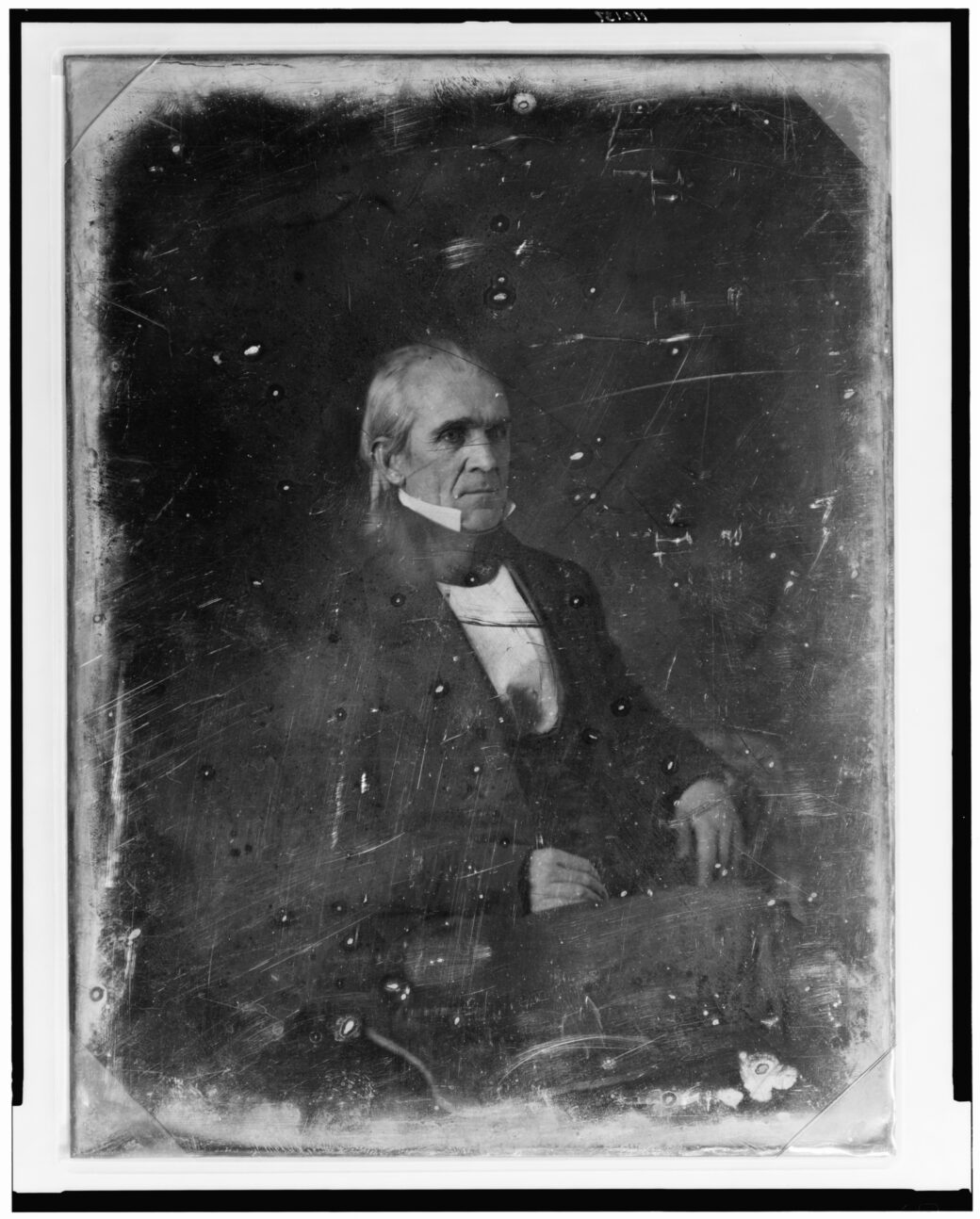
Agent of Destiny — or Architect of War?
Hey there! Let’s break down James K. Polk
Okay, so Polk was born in 1795 in North Carolina, grew up in Tennessee, and was basically Andrew Jackson’s political mini-me — they even called him “Young Hickory.” He was Speaker of the House, then governor, and in 1844 became the first “dark horse” president. One term only (1845–1849), then he left office and… passed away just three months later at age 53. Wild, right?
Polk’s Big Four — He Nailed Every One
- Texas: Annexed in 1845 — done!
- Oregon: Settled the border with Britain in 1846 — check!
- California + Southwest: Grabbed via the Mexican-American War and Treaty of Guadalupe Hidalgo in 1848 — boom!
- Lower tariffs: Walker Tariff in 1846 — nailed it!
That’s 1.2 million square miles added — only Jefferson with the Louisiana Purchase did more. Polk literally reshaped the map of America in four years.
But Wait — The Whigs Were *Not* Happy
Whigs like Abraham Lincoln thought Polk started the Mexican-American War on purpose, and on foreign soil, just to grab land for slavery. Lincoln even demanded Polk show proof the fighting began in the U.S. — that’s the famous “Spot Resolutions.”
Historians Weigh In
- Walter Borneman: “Polk was the most effective president of the 19th century… he got exactly what he wanted.”
- Daniel Walker Howe: “Polk’s success came at the price of moral compromise — war for territory.”
- Paul Johnson: “A president of iron will… but the cost was a divided nation.”
Sources:
• Polk’s Diary (1845–49)
• Lincoln: Congressional Globe, 1848
• Howe, What Hath God Wrought
📚 The 1844 Campaign Platform
Polk ran on an aggressive expansionist platform against Whig Henry Clay. The campaign slogan "54-40 or Fight!" (demanding all of Oregon to 54°40' latitude) symbolized Polk's uncompromising expansionism. He defeated Clay partly because Clay equivocated on Texas annexation.
The mandate: Polk interpreted his victory as public endorsement for aggressive territorial expansion. He used this to justify controversial actions like provoking war with Mexico.
🎯 Goal 1: Oregon Dispute Settlement
The problem: U.S. and Britain both claimed Oregon Country (present-day Oregon, Washington, Idaho, parts of Montana/Wyoming/BC).
Competing claims: U.S. (Discovery via Robert Gray 1792, Lewis & Clark exploration, continuous settlement) vs. Britain (Hudson's Bay Company trading posts, Vancouver exploration, prior Spanish claims).
Campaign promise: "54-40 or Fight!"—all of Oregon to Alaska boundary.
Reality: Polk negotiated compromise at 49th parallel (1846 Oregon Treaty), avoiding war with Britain.
Why compromise? Polk needed Britain neutral while fighting Mexico. War on two fronts was strategically unwise. The 49th parallel gave U.S. the valuable territory (Willamette Valley, Puget Sound) while avoiding conflict.
💭 Goal 2: Texas Annexation
Background: Texas won independence from Mexico (1836) but annexation was controversial—Would it be slave state? Would Mexico attack?
Constitutional obstacle: Treaty requires 2/3 Senate approval—couldn't get votes.
Polk's solution: Joint resolution of Congress (simple majority in both houses)—passed March 1845.
Significance: Demonstrated willingness to use constitutional workarounds to achieve expansion. Also provoked Mexico, contributing to war.
🎓 Goal 3: California and Southwest
The prize: California ports (San Francisco, San Diego) for Pacific trade + Southwest territories.
The problem: Mexico wouldn't sell—still claimed Texas, resented U.S. interference.
Polk's approach: (1) Sent diplomat John Slidell to offer $30 million for California/New Mexico (rejected). (2) Ordered General Taylor to disputed Texas-Mexico border (provocative). (3) When skirmish occurred, declared Mexico "invaded our territory" (May 1846). (4) Congress declared war; U.S. invaded Mexico. (5) Victory forced Treaty of Guadalupe Hidalgo (1848): Mexican Cession acquired.
Controversy: Many believed Polk deliberately provoked war. Congressman Abraham Lincoln demanded to know the exact "spot" where American blood was shed—implying Polk lied.
⚠️ Goal 4: Economic Consolidation
Jacksonian financial policy: Reduced tariff (Walker Tariff 1846)—lower import taxes. Reestablished Independent Treasury (1846)—federal funds separate from private banks. Opposed Whig "American System" of national bank and protective tariffs.
Purpose: Limited federal economic intervention, preserved state sovereignty, supported agrarian interests.
Success: Both policies enacted, shaping U.S. economy until Civil War.
🎯 Overall Assessment
Polk accomplished ALL FOUR goals in ONE TERM—extraordinary presidential effectiveness. Whether you approve of the goals or not, his success rate is remarkable. He's the only president to achieve his entire agenda and voluntarily step down.
Mexican-American War: Polk’s War of Choice
Context: Polk’s Provocation
- Texas border dispute (Nueces vs. Rio Grande)
- Polk sent troops to disputed zone
- April 1846: “American blood on American soil”
- Congress declared war in 48 hours
Democrat Justification
“Mexico has invaded our territory and shed American blood upon American soil.”
— James K. Polk, May 11, 1846
“The mountain plains of the Aztecs… shall yet become the abode of a free and enlightened people, under the banners of the stars and stripes.”
— Caleb Cushing, 1847
“The war with Mexico is a war of necessity… to extend the area of freedom and republican institutions.”
— Lewis Cass, February 1847
“American blood on American soil” — but whose soil?
📚 The Mexican-American War Overview
Duration: April 1846 – February 1848 (nearly 2 years).
Causes: Texas annexation (Mexico never recognized independence), border dispute (Texas claimed Rio Grande; Mexico claimed Nueces River), U.S. desire for California/Southwest, Mexican refusal to sell territory, Polk's provocation (ordering Taylor to disputed border).
Hey! Let’s unpack the Democratic spin & Polk’s war message
You’re watching the battles in the documentary — so here’s the why, the how it started, and the words they used.
Context: Polk’s Setup
Polk wanted California. Texas claimed the Rio Grande as its border — Mexico said no, it’s the Nueces. Polk sent General Taylor into the disputed zone. When fighting broke out, Polk rushed to Congress: “American blood on American soil!” Congress declared war in 48 hours. Democrats cheered. Whigs called it a lie/setup.
Democrat Justification (Click to Cycle)
- Polk (War Message, May 11, 1846): Mexico “invaded our territory,” “shed American blood upon American soil” — war was “forced upon us.” Defensive war!
- Cushing (Recruiting Speech, 1847): We’re liberating Mexicans from “barbarism” — moral crusade!
- Cass (Congressional Globe, Feb 1847): Spreading freedom and democracy — it’s our duty!
But the fighting happened between the Nueces and Rio Grande — land both sides claimed. Whigs like Lincoln demanded proof it was U.S. soil — hence the “Spot Resolutions.”
Hey! Let’s connect the dots — Significance: What It Cost & Gave Us
- Land (Mexican Cession): 525,000 sq mi — California, Nevada, Utah, most of Arizona/New Mexico, parts of Colorado/Wyoming; settled Texas boundary at Rio Grande.
- Military: Lee, Grant, Scott, Taylor — all got battlefield experience.
- Human Cost: ~13,000 dead — 1,721 in battle, 11,000+ from disease (yellow fever, dysentery, typhoid).
- Slavery Crisis: Wilmot Proviso (1846) tried to ban slavery in new lands — failed, but lit the fuse for Civil War.
🎯 "Dress Rehearsal" Thesis
This war prepared the U.S. Army for the Civil War (1861-1865).
Officers who fought in Mexico: Union: Ulysses S. Grant, George McClellan, George Meade, William T. Sherman. Confederate: Robert E. Lee, Stonewall Jackson, Jefferson Davis, James Longstreet. Both sides: Winfield Scott (too old for Civil War), Zachary Taylor (president 1849-50, died in office).
What they learned: Large-scale troop movements and logistics, combined infantry/cavalry/artillery operations, siege warfare (Veracruz), mountain and urban combat, political-military coordination.
Irony: Many officers who fought together as allies in Mexico faced each other as enemies in the Civil War. Grant and Lee both served with distinction under Scott; 15 years later, they'd face each other at Appomattox.
💭 The Numbers
U.S. Forces: ~100,000 total over course of war. Mix of regular army and volunteers. Peak deployment: ~50,000 simultaneously in field.
Mexican Forces: Larger numbers but poorly equipped/trained. Political instability hampered command. Led by General Antonio López de Santa Anna.
🎓 Cost Analysis
Financial cost: War expenses: $97.7M. Treaty payment to Mexico: $15M. Mexican debts assumed: $3.25M. Total: ~$116M.
⚠️ Interpretation
Some historians characterize the war as: Limited, professional, successful. Limited: Clear objectives (territory acquisition), not regime change. Professional: Well-executed campaigns, minimal atrocities. Successful: Achieved objectives at acceptable cost. War enabled legal transfer via treaty, not permanent occupation.
Critical perspective: This view minimizes violence and coercion. Mexico signed the treaty under duress with U.S. Army occupying its capital. "Legal transfer" involved substantial force.
Historians Weigh In
- Daniel Walker Howe: “Polk manufactured a war to seize territory.” / “The war was a moral catastrophe — fought for territory, not defense.”
- Amy Greenberg: “The rhetoric masked raw imperialism.” / “The war message was a masterclass in political deception.” / “Polk’s war of choice made America an empire — and tore it apart.”
Sources:
• Polk’s War Message, May 11, 1846
• Cushing: Recruiting Speech, 1847
• Cass: Congressional Globe, Feb 1847
• Lincoln’s Spot Resolutions, 1848
• Trist Diary; Howe, What Hath God Wrought
Whig Opposition to the War
Core Whig Charge: The Mexican War was unnecessary, unconstitutional, and ruinously expensive—a Democratic land-grab to extend slavery.
⚖️ Constitutional Objection
- War declared without Congressional vote (Polk’s “spot” pretext)
- Lincoln’s Spot Resolutions (1847): “Show us the spot!”
💰 Fiscal Objection
- War cost ~$100M—3× annual federal budget
- Whigs: “Money for canals, not conquest!”
🪦 Moral Objection
- “A war to plant slavery on free soil” — Henry Clay, 1847
- Northern Whigs: “Blood money for slave pens”
The Whigs didn’t oppose war — they opposed **Polk’s war**. They called it **unconstitutional**, **bank-breaking**, and **morally bankrupt**.
Let’s hear the fire:
• **Lincoln**: “Show me the spot where Mexico attacked us!” (There wasn’t one.)
• **Clay**: “$100 million for desert? We could’ve built 1,000 miles of railroad!”
• **Greeley**: “This war is a **slave-power conspiracy** — paid in blood.”
Why it matters: The Whigs lost the vote — but **won the argument**. Their warnings about slavery’s spread became the **Republican Party** and the **Civil War**. They proved you could love America without loving **empire**.
Historians Weigh In:
“The Whigs were the moral brake on Manifest Destiny — and history proved them right.”
— Daniel Walker Howe, What Hath God Wrought (2007)
So yeah — Polk got his map. But the Whigs got **conscience**. Next: Who **paid** for it?
Whig Warning: “This War Will Tear Us Apart”
“Allow the President to extend slavery into these territories, and you plant the seeds of civil war.”
— John Quincy Adams, 1846
- Wilmot Proviso (1846): Whig/Democrat alliance to ban slavery in new lands
- 1848 Election: Whigs run on “No More Territory for Slavery”
- Result: Party splits → Rise of Free Soil → Republicans
The war cost more than money—it cost the Union.
Polk wanted land. The Whigs wanted **peace**. But slavery turned a border war into a **national fracture**.
Let’s follow the dominoes:
• **1846**: Wilmot Proviso — “No slavery in new land!” (House says yes, Senate says no)
• **1848**: Whigs run on **anti-slavery expansion** — lose, but split the Democrats
• **1854**: Free Soil + anti-slavery Whigs = **Republican Party**
→ **1860**: Lincoln wins. South secedes. **Civil War**.
Why it matters: The Mexican War didn’t just add California — it **added slavery’s future**. Every new state was a vote for or against human bondage. The Whigs saw it coming. They were **right**.
Historians Weigh In:
“The Mexican War was the prologue to civil war — the moment the Union cracked.”
— David M. Potter, The Impending Crisis (1976)
So yeah — Polk got his map. But the Whigs got **prophecy**. Next: Who **paid** for it?
Mexican Land Acquistions:
Treaty of Guadalupe Hidalgo (1848)
Territorial Gains
- 525,000 square miles ceded by Mexico
- Combined with Texas and Gadsden Purchase = >1 million total
Protections for Mexicans
- Property rights protected
- U.S. citizenship offered
- Religious freedom guaranteed
America **bought** half of Mexico for **$15 million** — and called it a **treaty**. But Mexico signed with a **gun to its head**.
Let’s read between the lines:
• **Gains**: 525,000 sq mi — bigger than France + Germany
• **Cost**: $15M + $100M war = **$115M total**
• **Promises**: Citizenship, land rights, religion — on paper
→ **Reality**: Many Californios lost land in U.S. courts. Citizenship? Second-class.
Why it matters: This wasn’t a fair deal. It was **conquest with a receipt**. The treaty tried to look noble — but it the law of conquest. And the **human cost**? Not in the fine print.
Historians Weigh In:
“The Treaty of Guadalupe Hidalgo was victor’s justice — a surrender disguised as diplomacy.”
— David J. Weber, The Mexican Frontier (1982)
So yeah — America got the West. But **Mexico got the bill**. Next: Who **really** paid?
Native American Land Acquisitions
Scale (1830–1850): Over 100 million acres ceded via treaties
Legal Framework
-
Based on Doctrine of Discovery’s preemption right
-
Treaty Record (1789–1871):Over 370 treaties signed
Why It Was Legal
-
Recognized tribal sovereignty
(treaties = agreements between sovereign entities)
-
Provided compensation
annuities, reservations, relocation assistance
-
Treaties enforceable as federal law
under Supremacy Clause
But Was it Theft? 
📚 The Indian Treaty System
Between 1789-1871, the U.S. signed over 370 treaties with Native nations. This treaty system was the legal mechanism for transferring land from Native peoples to the United States.
🎯 How the Treaty System Worked
Legal foundation: Constitution (Article II, Section 2) gives President power to make treaties with Senate advice/consent (2/3 vote). Treaties with Indian nations treated as international agreements (tribe = sovereign nation). Once ratified, treaties become "supreme Law of the Land" (Article VI). This meant Indian treaties had same legal status as treaties with Britain or France.
What treaties typically included: Land cession (Tribe agreed to sell specific territory to U.S.), cash payment (One-time payment for land sold), annuities (Annual payments in cash or goods for period of years), reservation (Land set aside for tribe's exclusive use), services (Schools, agricultural instruction, medical care), protection (U.S. promised to protect tribe from other tribes/settlers).
💭 Example: Treaty of New Echota (1835)
Background: Cherokee Nation in Georgia/Tennessee/North Carolina. Controversy: Negotiated with minority faction; most Cherokee opposed it (Principal Chief John Ross rejected it).
Terms: Cherokee ceded all lands east of Mississippi (millions of acres). Received $5 million compensation. Granted 13 million acres in Indian Territory (Oklahoma). Promised assistance with relocation. Given 2 years to voluntarily move.
Outcome: Forced removal (1838-1839) became Trail of Tears—~4,000 Cherokee died during forced march. Despite treaty promises, relocation was brutal and poorly provisioned.
🎓 Scale of Land Transfers (1830-1850)
Over 100 million acres ceded via treaties in these two decades alone.
Major treaty periods: 1830s: Indian Removal Act (1830) led to treaties with Five Civilized Tribes (Cherokee, Choctaw, Chickasaw, Creek, Seminole). 1840s: Treaties with Plains tribes as westward migration increased. 1850s-1860s: Treaties with Pacific Northwest and California tribes.
⚠️ Johnson's Interpretation vs. Critical View
Johnson's framework: Treaties = state-to-state agreements between sovereign entities. Compensation provided (not just seizure). Legal framework governed by same principles as European diplomacy. Violations = breaches of contract, not inherent theft. U.S. recognized treaty violations were wrong (hence Indian Claims Commission 1946).
Critical perspective: Treaties signed under extreme duress—alternatives were starvation or military conquest. Many treaties negotiated with unrepresentative factions. U.S. repeatedly violated treaty terms (boundaries, annuities, protections). Tribes had no enforcement mechanism when U.S. broke treaties. Compensation was grossly inadequate (pennies per acre). U.S. stopped making treaties in 1871, shifting to executive orders—less protection.
🎯 The Key Question
Are these "legitimate transfers" or "coerced surrenders"?
Johnson's view: Legitimate because: Followed recognized legal process, provided compensation, recognized tribal sovereignty, later violations don't invalidate original agreements.
Critical view: Coerced because: Tribes faced military conquest if they refused, no alternative buyers (preemption meant only U.S. could purchase), power asymmetry made "negotiation" largely one-sided, persistent treaty violations showed bad faith.
Teaching point: Present both perspectives. Understanding the legal framework helps students see how Americans justified expansion. Analyzing power dynamics helps students think critically about whether legal forms guarantee justice.
Explicit Contemporary Statements
"Advised Congress that American expansion would cause the 'Savage as the Wolf to retire.'"
— George Washington, 1783
In his 1846 Senate speech on Oregon annexation, Thomas Hart Benton addressed the fate of tribes resisting expansion: "The Red race has disappeared from the Atlantic coast: the tribes that resisted civilization met extinction. This is a cause of lamentation with many. For my part, I cannot murmur at what seems to be the effect of divine law... Moral and intellectual superiority will do the rest: the White race will take the ascendant."
— Senator Thomas Hart Benton, Congressional Globe, 29:1 (May 28, 1846), 917–918
Critical Reality: The expansion was specifically anticipated and intended to be a disaster for the legal, cultural, economic, and political rights of Indian nations and native peoples.
📚 Why These Quotes Matter
These aren't isolated extremist views—they're statements from founding father (Washington) and leading senator (Benton) that reveal how mainstream American leaders understood expansion's human cost. They KNEW it would be catastrophic for Native peoples and proceeded anyway.
🎯 George Washington's 1783 Prediction
Context: Just after Revolutionary War, Washington was advising Congress on western policy.
The quote in context: Washington predicted that American settlement would inevitably push Native peoples westward and ultimately cause their disappearance ("retire" = euphemism for displacement/extinction).
Key point: This was 1783—62 years before "Manifest Destiny" was coined. The logic of displacement was built into American expansion from the beginning, not invented in the 1840s.
Washington's view: He saw this as inevitable (stadial logic—hunters must give way to farmers) rather than something to prevent. His policy recommendation: manage it through treaties rather than let it happen chaotically.
💭 Senator Benton's "Divine Law" Justification
Context: 1846 Senate debate over westward expansion and Mexican-American War.
Breaking down the quote: "resisted civilization" = Tribes that refused to adopt agriculture, Christianity, Euro-American property systems. "extinction" = Benton openly acknowledged expansion might lead to tribal disappearance. "I cannot murmur" = Can't complain/object—presents it as beyond human control. "divine law" = God's decree, not human choice—removes moral agency. "moral and intellectual superiority of the White race" = Explicit racial hierarchy. "will do the rest" = Inevitable process—resistance is futile.
The logic chain: (1) God ordained White/Anglo-Saxon superiority. (2) This superiority naturally leads to dominance. (3) Native peoples can either "civilize" (assimilate) or disappear. (4) If they disappear, it's divine will—not our fault. (5) Therefore, we bear no moral responsibility.
This reasoning absolves Americans of guilt by attributing outcomes to divine plan rather than human choices. It's theological determinism used to evade moral responsibility.
🎓 Racial Ideology Extended Beyond Native Peoples
The lecture outline notes: "It was claimed Mexicans must assimilate into the 'superior vigor of the Anglo-Saxon race, or they must utterly perish.'"
What this reveals: Same logic applied to Mexicans as Native peoples. Binary choice: assimilate or disappear. "Superior vigor" = racial/cultural dominance language. No option for Mexicans to maintain distinct identity. Framed as natural process rather than deliberate policy.
Historical outcome: Many Californios and Tejanos did lose land despite treaty protections, and were marginalized in societies they'd once dominated. The prediction was self-fulfilling because Americans designed systems to ensure it happened.
⚠️ Why We Study These Statements
The concluding statement is critical: "These statements reveal the racial ideology that undergirded legal frameworks. We study them not to excuse them but to understand how contemporaries reconciled republicanism with displacement."
Teaching purpose: NOT to make students feel guilty for being American. NOT to condemn individuals as uniquely evil. BUT to understand how intelligent, otherwise moral people convinced themselves that terrible actions were justified.
The critical question: How do people reconcile stated values (liberty, justice, equality) with actions that contradict those values (displacement, cultural destruction)?
The answer: Through intellectual frameworks (stadial theory, Doctrine of Discovery, racial hierarchies) that make contradictions seem coherent. Understanding these frameworks helps us identify similar rationalizations today.
💭 Discussion Prompts
- "If Benton truly believed this was 'divine law,' does that make him less morally culpable? Or does invoking divine will to justify harm make it worse?"
- "Washington and Benton were considered moral, intelligent leaders. What does it mean that good people can justify terrible things?"
- "What modern beliefs might future generations judge as harshly as we judge 19th-century racial theories?"
The Human Cost of Manifest Destiny
Americans
- ~13,000 U.S. troops dead (mostly disease)
- Financial cost: $100M+ war debt
- Political fracture → Civil War
- 620,000+ dead in 1861–65
Mexicans
- ~25,000 dead (military + civilians)
- Lost 55% of territory (2.1M km²)
- ~100,000 displaced in ceded lands
- Cultural & political erasure
Indigenous Nations
- 100M+ acres seized (1830–50)
- 60,000+ forcibly removed
- 15,000+ died in removals (e.g., Trail of Tears)
- Ethnic Cleansing, cultural annihilation
Ultimate Consequence: Civil War — the price of a continent built on displacement and division.
Americans: Paid in blood (Mexican War) and treasure — but the real cost was political: expansion shattered national unity.
Mexicans: Defeated militarily, dispossessed territorially, marginalized within the new U.S. Southwest.
Indigenous: Suffered the intended catastrophe — land, sovereignty, and survival systematically destroyed.
Final Irony: The “success” of Manifest Destiny created the conditions for its greatest failure — disunion and civil war.
Conclusion: Transformation Complete
1783
Atlantic republic
- Vulnerable
- Coastal
- 13 states
1853
Continental federation
- Secure
- Coast-to-coast
- 31 states
Tools of Transformation:
Treaties • Plows • Ballots • and Guns!
📚 The 70-Year Transformation
1783: The Starting Point - Treaty of Paris ended Revolutionary War. U.S. recognized as independent nation. Territory: Atlantic coast to Mississippi River. 13 original states. Population: ~3 million. Vulnerable to European powers (Britain, Spain, France). No certainty the republic would survive.
1853: The Culmination - Gadsden Purchase completed continental expansion. Territory: Atlantic to Pacific, Canada to Mexico. 31 states (California 1850 most recent). Population: ~25 million. Continental security—no immediate European threats. Economically thriving, technologically advanced. BUT sectionally divided and heading toward civil war.
🎯 The Three Tools
Treaties (Legal Framework): 370+ treaties with Native nations. International treaties (Louisiana, Oregon, Mexican Cession, Gadsden). Legal mechanisms provided appearance of legitimacy. Doctrine of Discovery provided intellectual foundation.
Plows (Economic/Technological): Agricultural settlement transformed Stage 1 lands to Stage 3. Railroads, telegraphs connected continent. Industrial tools enabled rapid development. Technology made expansion physically possible.
Ballots (Democratic Process): Voters supported expansionist candidates (Polk 1844). Congress approved territorial acquisitions. States voted to admit new territories. Democratic legitimacy distinguished U.S. from European empires.
💭 What Made It Possible
Demographic growth (population doubling every 25 years), technological advantage (industrial revolution), political stability (constitutional government), ideological confidence (Manifest Destiny, stadial theory), military capacity (professional army, militia system), weak neighbors (Mexico unstable, Native nations divided).
North American continent providentially allotted to the U.S. for free development of its multiplying millions under Anglo-Saxon republican government.
God's plan specifically designated this land for Anglo-Saxons.
Anglo-Saxon Racial Theory (1840s)
In the 1840s, "Anglo-Saxon" referred to people of English descent and their institutions—particularly common law, Protestant Christianity, and representative government.
Key beliefs:
- Anglo-Saxons possessed unique capacity for self-government and liberty
- Anglo-Saxon institutions were superior to other systems
- Anglo-Saxon "race" had a duty to spread these institutions globally
- This was understood as both racial and cultural superiority
Modern understanding: These beliefs are now recognized as racist ideology that rationalized conquest and dispossession.
1840s Americans didn’t just *think* the continent was theirs — they believed **God signed the deed**. This wasn’t a metaphor. It was literal theology in newspapers and pulpits.
Let’s break it down: The idea came from Puritan roots — America as a “City upon a Hill.” By 1845, John L. O’Sullivan wrote: “Our manifest destiny is to overspread the continent allotted by Providence.” Translation: “God gave us everything from sea to sea — and told us to take it.”
Why it matters: When you believe **God is your realtor**, Native nations and Mexico aren’t neighbors — they’re obstacles to divine will. This made war, removal, and annexation feel like **holy work**.
Historians Weigh In:
“Manifest Destiny fused Protestant millennialism with racial nationalism — a theology of conquest.”
— Amy Greenberg, Manifest Manhood and the Antebellum American Empire (2005)
So yes — they weren’t just land-hungry. They were heaven-sent. Next: How did they claim to be “better” than everyone else?
Manifest Destiny
“…our manifest destiny to overspread the continent allotted by Providence for the free development of our yearly multiplying millions.”
Key Innovation: Destiny > Law — Moral imperative trumps legal claims.
1. American Exceptionalism
- Puritan “City upon a Hill” (1630)
- Stable gov’t, growth, mobility
- Religious freedom, literacy
- Polk: “most free & happy”
2. Republican Mission
- Spread self-rule & law
- Replace chaos with republics
- Not conquest — rescue
- Mexico: 30 coups → U.S. order
3. Divine Guidance
- Continent = God’s theater
- Geography proves design
- Opposition = defying Providence
- Success = proof
This wasn’t a policy. It was a faith. O’Sullivan didn’t *ask* for the continent — he said **God already gave it**.
Let’s connect the dots: America’s success (stable gov’t, growth, freedom) → proves we’re special → so we must spread our system → and since God designed the continent for us → resistance is literally sin.
Why it matters: This loop made expansion **unstoppable**. Legal claims? Treaties? Borders? Irrelevant. Destiny > Law. Mexico’s 30 coups? Proof they *needed* us. Native nations? Just in the way of God’s plan.
Historians Weigh In:
“Manifest Destiny was a self-fulfilling prophecy — the more we won, the more we believed we were right.”
— Frederick Merk, Manifest Destiny and Mission in American History (1963)
So yeah — they didn’t just take the land. They believed they were saving the world. Next: How did this explode over slavery?
Whig Response to “Manifest Destiny”
Whigs did not oppose expansion —
they opposed Democratic, uncontrolled, divinely reckless expansion.
1. Moral Hubris
- Blasphemous to claim God ordains conquest
- Clay: “No divine right to trample nations”
2. Reckless & Costly
- War debt, military overreach
- Mexican War = “Mr. Polk’s War”
3. Sectional Poison
- Slave-power plot to add slave states
- Adams: Texas = “slaveocracy conspiracy”
Whig Vision: Controlled Expansion to fund the American System —
law, commerce, and federal guidance, not divine land grabs.
Whigs didn’t hate expansion — they hated reckless, God-drunk expansion. They wanted **roads, banks, and schools**, not **wars, debt, and slavery**.
Let’s zoom in: Henry Clay called divine-right conquest **blasphemy**. Abraham Lincoln mocked Polk’s war as **unconstitutional**. John Quincy Adams saw Texas annexation as a **slave-power conspiracy**. Their fear? Unchecked Manifest Destiny would **tear the republic apart** — and they were right.
Why it matters: The Whigs offered a **sane alternative**: grow the nation through **law and investment**, not **faith and force**. They lost the 1840s — but their warnings became the **Republican Party** and the **Union’s conscience**.
Historians Weigh In:
“The Whigs saw Manifest Destiny not as destiny — but as dangerous delusion.”
— Daniel Walker Howe, What Hath God Wrought (2007)
So while Democrats shouted “God wills it!”, the Whigs whispered: “Not like this.” Next: How did slavery turn destiny into disaster?
2. Demographic Imperative (Population Pressure)
The Problem: Human tide pressing against boundaries
The Solution: Land need for demographic safety valve preventing overcrowding, class conflict, and stagnation
America wasn’t just growing — it was exploding. From 1820 to 1860, the population tripled. That’s **21.8 million new people** in 40 years — more than the entire population of France.
Let’s feel the pressure: Farms were filling up. Cities were swelling. Politicians feared: “No land = no freedom = no republic.” Jefferson’s dream of independent farmers was dying — unless they opened the West. The continent wasn’t a want. It was a survival need.
Why it matters: This wasn’t greed — it was panic. If you believed a republic dies without land for all, then **blocking expansion = killing democracy**. Native nations? Mexico? Just in the way of the **safety valve**.
Historians Weigh In:
“The West was not a luxury — it was the oxygen of American democracy.”
— Frederick Jackson Turner, The Significance of the Frontier in American History (1893)
So yeah — they didn’t just want the land. They needed it to breathe. Next: How did they claim to be “better” than the people already there?
3. Anglo-Saxon Racial Mission
Consensus belief: Anglo-Saxon race and their institutions uniquely suited to liberty, law, and progress.
Cultural and racial beliefs in the 19th justified displacing "inferior systems"
Okay — let’s be real. This justification is hard to hear. But it was the **mainstream belief** of white 1840s Americans. They didn’t just *think* they were better — they believed it was scientific fact.
Let’s unpack it carefully:
“Anglo-Saxon” meant: English/Germanic blood + Protestant work ethic + common law + representative government. They said: “Look at our cities, railroads, schools — proof we’re the pinnacle of civilization.”
Then they looked at Native nations and Mexico and said: “Tribal chaos. Catholic superstition. 30 coups in 25 years. They’re stuck in the past.”
Why it matters: This wasn’t just prejudice — it was policy. It made **displacement feel like progress**. If you’re “saving” the land from “savages,” you’re not stealing — you’re improving. That’s how good people justified terrible things.
Historians Weigh In:
“Anglo-Saxonism was the intellectual scaffolding of Manifest Destiny — a racist myth dressed as science and destiny.”
— Reginald Horsman, Race and Manifest Destiny (1981)
Important: These ideas are wrong and racist. We study them not to excuse — but to understand how power works. And to ask: What myths do we believe today?
Next: How did they turn “We’re better” into actual land?
4. Ethical Exceptionalism (Moral Superiority)
“The people of these States are the most free, the most enlightened, and the most happy people on the face of the whole globe.”
- Press, pulpit, and schools proclaimed superiority
- Expansion viewed as ethical act benefiting humanity
- Spreading superior institutions was seen as a moral duty to mankind
- Self-reinforcing: Success proved righteousness
This one’s the trickiest — because it feels so good. Americans didn’t just think they were better. They believed **expanding was a moral act** — like charity, but with guns.
Let’s unpack the logic:
“We have no king, no poverty, no illiteracy, no coups — we’re the happiest, freest people ever. So if we take California from unstable Mexico, we’re helping them. If we remove Native tribes, we’re elevating them from savagery.”
→ **Self-interest = global good**.
Why it matters: This is the most dangerous justification. When you believe you’re **saving the world**, you don’t see the harm. You don’t hear the screams. You just see progress. That’s how empires sleep at night.
Historians Weigh In:
“Moral exceptionalism turned conquest into crusade — the ultimate self-deception.”
— Amy S. Greenberg, A Wicked War (2012)
Important: This wasn’t hypocrisy. They meant it. That’s what makes it so powerful — and so scary. Next: How did they make “saving the world” legal?
5. Manifest Destiny, Divided Aims
Democrats championed expansion to dilute federal centralism; Whigs backed it to shore up the American System.
Democrats
- Distant states dilute Eastern elite control & prevent “consolidation”
- More land → more yeoman farmers → stronger state sovereignty
- Expansion as constitutional safeguard against federal overreach
- Manifest Destiny (O’Sullivan, 1845) = spread smallholder democracy
Key Actions: Jackson’s Indian removal; Polk’s “54°40' or Fight!”, Texas annexation, Mexican War.
“To enlarge [the] area of freedom… is worthy of the patronage of a free people.” —Polk, 1845
Whigs
- Expansion must fund & protect the American System (bank, tariffs, infrastructure)
- New states = new markets & revenue for national economic unity
- Cautious pace to avoid debt, sectionalism, & slave-power imbalance
- Strong federal institutions needed to bind empire together
Key Fears: Overextension weakens national bank; Southern gains upset Missouri Compromise balance.
“Annexation of Texas would kindle a fire which all the waters of the ocean could not extinguish.” —Henry Clay
Both parties wanted the continent — but for totally different reasons.
Let’s break it down:
**Democrats** (Jackson, Polk): “More land = more farmers = less federal control.” They feared a strong national government would crush local freedom. Expansion was their **anti-federal weapon**.
**Whigs** (Clay, Webster): “More land = more markets = stronger national bank and roads.” They wanted **federal power** to build a unified economy. Expansion was their **nation-building tool**.
Why it matters: This wasn’t just politics — it was **vision vs. vision**. Democrats saw empire as freedom from Washington. Whigs saw it as freedom through Washington. And the **real fight**? Slavery — because every new state tipped the balance of power.
Historians Weigh In:
“Manifest Destiny was not one idea — it was a civil war of ideologies within the same nation.”
— Daniel Walker Howe, What Hath God Wrought (2007)
So yeah — both wanted the West. But one wanted **decentralized freedom**, the other **centralized progress**. Guess which one won? Next: The **human cost**.
6. Economic Rationalism (Land as Wealth Engine)
Core Argument: Land equals opportunity and wealth
- Land needed for yeoman farmers, entrepreneurs, speculators
- Mexican Cession = "richest territory on earth" (gold, farmland, ports)
- $15M for 525,000 square miles
Strip away the God talk and race talk — here’s the **real math**: America bought half of Mexico for **$15 million** — and got **gold, ports, and farmland** worth billions.
Let’s run the numbers:
• **Cost**: $15M + $100M war = ~$115M total
• **Gain**: 525,000 sq mi = $220 per square mile
• **California Gold Rush (1848–53)**: **$2 billion** in 5 years
→ **ROI**: Paid for itself in gold dust alone.
Why it matters: This wasn’t charity — it was **capitalism on steroids**. Farmers got land. Speculators got rich. Ports connected the world. And the **human cost**? Not on the balance sheet. Native nations and Mexican citizens were just externalities.
Historians Weigh In:
“The Mexican Cession was the greatest real estate deal in human history — and the greatest uncounted tragedy.”
— David M. Potter, The Impending Crisis (1976)
So yeah — they didn’t just take the land. They invested in it — and cashed out big. Next: What did it **cost the people already there**?
Legal Framework: Doctrine of Discovery
Definition: An international legal principle originating in 15th-century papal bulls and European traditions that automatically provided Europeans with property rights and governmental, political, and commercial rights over indigenous inhabitants without their consent.
Basis: Religious and ethnocentric ideas of European and Christian superiority
American Continuity: Manifest Destiny was the natural outgrowth of this doctrine
Current Status: Still cited in U.S. federal law today
Here’s the **legal cheat code** Europe used for 500 years — and America still uses: “If you’re Christian and European, you own the land. If not, you don’t.” No vote. No treaty. Just **automatic title**.
Let’s trace the timeline:
• **1452**: Pope says Portugal can claim non-Christian lands
• **1493**: Pope splits the world between Spain and Portugal
• **1823**: U.S. Supreme Court (Johnson v. M’Intosh) says: “Discovery = ownership”
• **2005**: U.S. courts still cite it in Native land cases
Why it matters: Manifest Destiny wasn’t new — it was **Doctrine of Discovery 2.0**. The U.S. didn’t invent conquest. It just modernized it with railroads, constitutions, and gold. And the **original rule**? Still in the law books. Today.
Historians Weigh In:
“The Doctrine of Discovery is not ancient history — it is the living foundation of American property law.”
— Robert A. Williams Jr., Like a Loaded Weapon (2005)
So yeah — every “For Sale” sign in the West? It started with a **papal bull**. Next: How did they turn this into **actual removal**?
10 Elements of the Doctrine of Discovery
1. First Discovery
First European to “see” land gains claim.
2. Actual Occupancy
Must settle or fortify within reasonable time.
3. Preemption
Government monopoly on Native land sales.
4. Indian Title
Natives keep use, but not full ownership.
5. Limited Sovereignty
Tribes = “domestic dependent nations.”
6. Contiguity
River mouth = claim to entire watershed.
7. Christianity
Non-Christians = lesser land rights.
8. Terra Nullius
“Empty” if not farmed European-style.
9. Civilization
Duty to “civilize” = justify control.
10. Conquest
Military victory = full legal title.
First Discovery
First European nation to “discover” land gains inchoate title — even if indigenous people lived there for millennia. Example: Cabot (1497) → England claims Atlantic coast.
Actual Occupancy
Discovery must be followed by physical presence — forts, settlements, patrols — within “reasonable time.” Lewis & Clark (1804–06) = U.S. occupancy in Oregon.
Preemption
Only the discovering government can buy from Natives. No private sales. U.S. law (1790s): Individuals buying from tribes = illegal.
Indian Title
Natives have right of occupancy, but ultimate title belongs to U.S. Marshall (1823): “They are occupants… we hold dominion.”
Limited Sovereignty
Tribes = “domestic dependent nations” — can govern internally, but not sell land or ally with foreign powers. Cherokee Nation v. Georgia (1831).
Contiguity
Discovering a river mouth = claim to entire watershed. France (1682): Mississippi mouth → all interior. U.S. (1792): Columbia River → Oregon.
Terra Nullius
“Empty land” if not used via European agriculture. Hunting, migration, spiritual use = invisible. Great Plains = “waste” despite buffalo economy.
Christianity
Non-Christians have inferior rights. Rooted in 15th-century papal bulls. Missionaries = legal agents of conquest.
Civilization
God commands “civilized” to educate and control “savages.” Paternalism = moral duty. “For their own good.”
Conquest
Military victory = full legal title. No treaty needed. Mexican Cession (1848), Indian Wars.
Click any term for full definition & historical example.
This isn’t history — it’s a **legal playbook** used for 500 years to take land from people who were already there. Click any term to see how it worked.
Let’s see the system:
1. **First Discovery** → “We saw it first.”
2. **Occupancy** → “We planted a flag.”
3. **Preemption** → “Only we can buy it.”
…and so on — until **Conquest** = “We won, so it’s ours.”
Why it matters: This wasn’t chaos. It was **law**. Every treaty, every removal, every war — backed by **10 rules** written 400 years before Manifest Destiny. And the **craziest part**? It’s still cited in U.S. courts today.
Historians Weigh In:
“The Doctrine of Discovery is the original sin of American property law — a 15th-century rule still shaping 21st-century justice.”
— Robert A. Williams Jr., Like a Loaded Weapon (2005)
So yeah — every “For Sale” sign in the West? It started with a **papal bull**. Next: How did they turn this into **mass removal**?
Early U.S. Application: The Oregon Strategy
Thomas Jefferson's Strategic Use of the Doctrine:
- Dispatched Lewis & Clark Expedition (1803–1806) as legal maneuver
- Built on Robert Gray's 1792 Columbia River discovery
- Post-War of 1812 rituals at Astoria reinforced occupancy
Jefferson understood that physical possession converted incomplete discovery into complete title under the Doctrine's principles.
Jefferson didn’t just *send* Lewis & Clark — he sent them to **win a legal war** before it started.
Let’s replay the move:
• **1792**: Robert Gray sails up the Columbia → “First Discovery” check.
• **1803**: Louisiana Purchase → U.S. owns land to the Rockies.
• **1804–06**: Lewis & Clark build Fort Clatsop, map rivers, meet tribes → “Actual Occupancy” check.
• **1811**: Astoria founded → commercial stake.
• **1818**: Flag-raising, soil-turning rituals → symbolic possession check.
→ **1846**: Oregon Treaty at 49th parallel → **checkmate**.
Why it matters: This wasn’t exploration. It was **legal theater**. Jefferson used the **Doctrine of Discovery** like a chess grandmaster — every move building a claim that Britain couldn’t beat. The West wasn’t won by war — it was won by **paper, flags, and footprints**.
Historians Weigh In:
“Jefferson played the Doctrine of Discovery with genius — turning exploration into empire.”
— Bernard DeVoto, The Course of Empire (1952)
So yeah — the Oregon Trail didn’t just carry settlers. It carried **legal title**. Next: How did they use this to **remove entire nations**?
Stadial Theory: The “Science” of Progress
4 Stages of Society
- 1. Savagery: Hunting and gathering (nomadic existence, no fixed property)
- 2. Barbarism: Pastoralism (tribes, herding societies)
- 3. Agriculture: Settled farming (fixed land tenure, villages)
- 4. Civilization: Commerce (trade and manufacturing, written law, republican institutions)
Americans believed:
By 1848, Americans looked at their track record and saw overwhelming evidence of Stage 4 achievement.
- Higher stages naturally replace lower ones
- Not conquest — progress
- Like water flows downhill
This idea was in every textbook, newspaper, and sermon. It wasn’t fringe — it was common sense.
📚 What Is Stadial Theory?
Stadial theory (also called "stage theory" or "four stages theory") was the most influential social science framework of the 18th-19th centuries. It argued that all human societies naturally progress through four stages of development, each defined by how people produce food and organize property.
🎯 Origins in Scottish Enlightenment
Key thinkers:
- Adam Smith: Wealth of Nations (1776) described progression from hunting to commerce
- John Millar: Origin of the Distinction of Ranks (1771) linked property systems to political institutions
- Lord Kames: Sketches of the History of Man (1774) traced cultural evolution through stages
- Adam Ferguson: Essay on the History of Civil Society (1767) analyzed transition from "rude" to "polished" nations
Why it was persuasive: This theory was based on empirical observation of societies worldwide. Enlightenment thinkers believed they'd discovered a universal law of human development—like Newton's laws but for society.
💭 American Adoption
American founders were deeply influenced by Scottish Enlightenment. Jefferson, Madison, Hamilton, Adams—all read and cited these thinkers. By the 1840s, stadial thinking was so embedded in American culture that most people didn't even recognize it as theory—it was just "common sense."
🎓 Why This Matters for Manifest Destiny
Stadial theory provided intellectual justification for displacement that seemed scientific rather than racist: Stage 1 societies naturally give way to Stage 3-4 societies. This isn't conquest—it's historical progress. Higher stages have right/duty to replace lower stages. Resistance is futile—like fighting gravity.
📚 The Four Stages Explained
🎯 Stage 1: Savagery (Hunting & Gathering)
Subsistence: Hunting animals, gathering plants—living off what nature provides. Property: No fixed property because nomadic; temporary claims to hunting territories. Social organization: Small bands, kinship-based, no formal government.
Examples cited: Plains Indians (Lakota, Cheyenne), Great Basin tribes (Shoshone, Paiute), some California tribes.
Scottish Enlightenment view: Most "primitive" stage; necessary foundation but least developed.
💭 Stage 2: Barbarism (Pastoralism)
Subsistence: Herding livestock (cattle, sheep, horses)—domestication without settled agriculture. Property: Movable wealth (herds); some territorial claims for grazing. Social organization: Tribal with chiefs, warrior culture, more complex than Stage 1.
Examples cited: Mongols, Arabian Bedouins, some Plains tribes after horse adoption, Scottish Highland clans (pre-1745).
Key feature: More organized than hunters but still mobile, making them formidable but "backward."
🎓 Stage 3: Agriculture
Subsistence: Settled farming—planting crops, maintaining fixed fields. Property: Fixed land tenure with defined boundaries and inheritance. Social organization: Villages, towns, customary or written law, political hierarchies.
Examples cited: Eastern Woodlands tribes (Cherokee, Creek after "civilization" efforts), Mexican haciendas, feudal Europe, ancient civilizations.
Key advancement: Permanent settlement enables accumulation, specialization, government.
⚡ Stage 4: Civilization/Commerce
Subsistence: Trade and manufacturing—economy based on exchange, not just production. Property: Complex legal systems for property, contracts, corporations. Social organization: Written constitutions, representative government, division of powers, courts.
Examples cited: Britain, United States, Netherlands, republican Rome.
The pinnacle: Scottish Enlightenment viewed this as highest achievement of human society.
🎯 Critical Understanding
This framework was considered SCIENTIFIC in the 1840s—not racist ideology but empirical observation of human development. It was taught in universities, cited by intellectuals, and accepted across the political spectrum. Questioning it was like questioning evolution today—possible, but you'd be dismissed as ignorant.
📚 How Americans Viewed Themselves
By 1848, Americans looked at their track record and saw overwhelming evidence of Stage 4 achievement.
🎯 Political Institutions (Stage 4 Evidence)
- Constitutional government: Written Constitution (1787) operating successfully for 60+ years
- Representative democracy: Regular elections, peaceful transfers of power
- Federal system: Balance between national and state governments
- Independent judiciary: Courts enforcing law against government overreach
- Bill of Rights: Protected individual liberties
💭 Economic Institutions (Stage 4 Evidence)
- Commercial economy: Trade networks spanning continent
- Banking system: Capital accumulation and investment
- Contract law: Enforceable agreements enabling complex transactions
- Property registration: Deeds, titles, surveyed boundaries
- Early industrialization: Factories, mills, railroads beginning
🎓 The Western Territories' "Deficiency"
Plains Tribes (Stage 1): Buffalo hunting = nomadic, no fixed settlements. Tribal councils = no written law or permanent institutions. Warfare between tribes = instability and "savagery." No agricultural development = "wasted" land.
Mexican California/Southwest (Stage 3): Hacienda system = agriculture but feudal, not commercial. Political instability = 30 coups in 25 years showed weak institutions. Sparse settlement = underdeveloped land. Mission system = religious not republican government. Californios numbered ~10,000 in territory that could support millions.
⚠️ The Critical Distinction
Not racial judgment (in their view): This was institutional capacity assessment. Americans believed: Native peoples COULD advance to Stage 4 (hence "civilization" programs). Mexicans WERE at Stage 3 but couldn't maintain Stage 4 institutions. Anglo-Saxons HAD PROVEN Stage 4 capacity through track record.
From this perspective, displacement wasn't about race per se—it was about replacing lower-stage societies with higher-stage ones. The plow was instrument of progress; the treaty was legal expression of stadial advancement.
Modern understanding: We now recognize this as rationalization for conquest. Stage classifications reflected power differences, not inherent developmental stages. But understanding how contemporaries thought is essential to historical analysis.
Stadial Theory in Action: Replacement vs. Elevation
Democrats: Progress through Replacement
- Stage 4 must replace Stage 1
- Hunters represent "waste"
- War and removal constitute natural law
“The hunter state can never coexist with the agricultural… one must give way.”
— Sen. Thomas Hart Benton, May 28, 1846
Whigs: Progress through Elevation
- Stage 1 can advance to Stage 4
- Hunters possess "potential"
- Education and treaties fulfill moral duty
“The hunter and warrior of the forest must yield to the more dense and compact form of civilized life.”
— Abraham Lincoln, January 27, 1838
Both accepted stadial theory — disagreed on how to apply it.
Key Takeaway
Both parties used stadial theory — but drew opposite conclusions:
- Democrats (Benton): Displacement is inevitable and immediate — “one must give way”
- Whigs (Lincoln): Displacement is inevitable but humane — “must yield” through law and education
Whigs didn’t deny progress — they demanded moral process.
Historical Context
- Benton (1846): Defending Oregon expansion; justified Mexican War
- Lincoln (1838): Warning against mob violence; later opposed Mexican War (1847)
Why It Matters
Reveals **ideological nuance** within Manifest Destiny: same “science,” different ethics. Whig critique lost politically but shaped moral discourse.
Sources:
• Benton: Congressional Globe, 29th Cong., 1st Sess., p. 918 (HathiTrust)
• Lincoln: Lyceum Address, Collected Works, Vol. 1, p. 112 (UMich)
Key Takeaway
Both parties used stadial theory — but drew opposite conclusions:
- Democrats (Benton, Polk): “The hunter must give way” → rapid expansion, war, removal
- Whigs (Clay, Lincoln): “The hunter can be civilized” → gradual progress, education, treaties
Whigs didn’t reject the “science” — they rejected the rush.
Whig Evidence
- Henry Clay: Voted against Indian Removal Act (1830); supported “civilization” funds
- Lincoln (1838): “The savage must learn to yield… but not by violence”
- Greeley (Whig editor): Called Trail of Tears “a national crime”
Why It Matters
Shows **ideology wasn’t uniform** — even within “Manifest Destiny,” there was moral debate. Whigs lost politically, but their critique foreshadows modern ethics.
Sources:
• Benton: Congressional Globe, 29th Cong., 1st Sess., p. 918 (HathiTrust)
• Clay: Senate speeches, 1830; Lincoln: Lyceum Address, 1838
📚 Senator Thomas Hart Benton
Thomas Hart Benton (Democratic Senator from Missouri, 1821–1851) was one of the most articulate spokesmen for Manifest Destiny and stadial theory. His May 28, 1846, Senate speech on the Oregon Question perfectly captures how Americans used stadial logic to justify displacement.
🎯 Benton's Full Argument
The core claim: "The hunter state can never coexist with the agricultural… one must give way." This wasn't presented as opinion but as natural law—like saying water and fire cannot occupy the same space.
The reasoning: Hunters need vast territories for game (100+ square miles per person). Farmers need small plots intensively cultivated (40–160 acres per family). Same land cannot support both—different land use patterns are incompatible. Therefore, when they meet, one must "give way."
Which one gives way? Benton argued it was historically determined: agricultural societies always displace hunting societies because agriculture supports larger populations with better organization and technology.
💭 The "Divine Law" Language
When asked about the fate of “the red man of the forest,” Benton stated:
"I cannot murmur at what seems to be the effect of divine law… The moral and intellectual superiority of the white race will do the rest."
Breaking this down: "Divine law" = not human choice but God's decree—stadial progression is providential. "Cannot murmur" = accepting the inevitable rather than celebrating it (claimed stance). "Moral and intellectual superiority" = Stage 4 culture produces superior institutions. "Will do the rest" = peaceful displacement through superiority, not violent conquest.
🎓 Race as Proxy Variable
Here's the critical nuance: In stadial theory, race functioned as a proxy variable for civilizational stage:
- Anglo-Saxons: Praised for common law, representative government, Protestant work ethic (Stage 4 institutions)
- Mexicans: Criticized for political instability—30+ coups in 25 years showed inability to maintain Stage 4
- Native nations: Targeted not for "redness" but for inability/refusal to adopt Stage 4 practices
The theory allowed for advancement: Native peoples weren't condemned eternally—they could (in theory) adopt agriculture, Christianity, written law, and become "civilized." The Cherokee attempted exactly this strategy.
⚠️ Why This Matters
Policy prescription: Not extermination but elevation—through removal, reservation, or assimilation. This made Americans see themselves as benefactors rather than conquerors.
Self-justification: "We're not murdering people for their land—we're fulfilling divine law and historical progress. Resistance proves their inability to advance."
Modern critique: This was self-serving rationalization that conveniently justified dispossession. The "proxy variable" allowed Americans to claim they weren't racist while pursuing racially targeted policies. Understanding this intellectual framework helps us see how people convince themselves that terrible actions are justified.
Source (Benton): Congressional Globe, 29th Congress, 1st Session, pp. 917–918 (HathiTrust)
📚 How Stadial Theory Enabled Terra Nullius
The Doctrine of Discovery provided the legal framework (terra nullius = "empty land"), but stadial theory provided the intellectual justification for determining what counted as "empty."
🎯 The Logic Chain
- Premise 1: Human societies progress through four stages based on subsistence mode
- Premise 2: Only Stages 3–4 (agriculture/commerce) create legitimate property rights
- Premise 3: Stage 1 hunting/gathering doesn't "improve" or "cultivate" land
- Conclusion: Lands used for hunting are legally "vacant" (terra nullius) and available for appropriation by agricultural/commercial societies
📚 Full Lincoln Quote & Context (1838 Lyceum Address)
Full Passage (excerpted for clarity):
“The hunter and warrior of the forest must yield to the more dense and compact form of civilized life. The idle and the vicious man must yield to the industrious and virtuous. The lawless must yield to the laws of the country… Let every American, every lover of liberty, every well-wisher to his posterity, swear by the blood of the Revolution, never to violate in the least particular, the laws of the country; and never to tolerate their violation by others.”
— Abraham Lincoln, “Address Before the Young Men’s Lyceum of Springfield,” January 27, 1838
🎯 Explanation & Whig Interpretation
- “Hunter and warrior of the forest” = Stage 1 societies (Plains tribes, pre-contact Native Americans)
- “More dense and compact form of civilized life” = Stage 4 (settled agriculture, commerce, republican institutions)
- “Must yield” = Accepts **stadial inevitability** — same premise as Benton
- But: Lincoln **rejects violence** — the transition must be **lawful, orderly, and moral**
- Context: Delivered amid rising mob violence (e.g., burning of Elijah Lovejoy, 1837). Lincoln warns that **lawlessness** (even in the name of progress) threatens the republic.
- Whig Policy Implication: Natives should be **elevated through education, treaties, and legal process** — not forcibly removed or exterminated.
💭 Why This Quote Is Powerful for Your Lecture
- Direct parallel to Benton: Both accept “hunter must yield” — but **Democrats say “push,” Whigs say “guide”**
- Foreshadows Lincoln’s later stance: Opposed Mexican War (1847) as “unnecessary and unconstitutional”
- Shows Whig moral consistency: Same theory, humane application
🎓 Source & Access
• Collected Works of Abraham Lincoln, Vol. 1, pp. 108–115
• Full Text (University of Michigan)
💭 American Application
Great Plains example: Lakota, Cheyenne, Arapaho used plains for buffalo hunting (Stage 1). Americans declared this "waste"—land could support farms but was "merely" hunting ground. Therefore, settling and farming the plains = legitimate improvement, not theft. The fact that buffalo hunting sustained Native economies was irrelevant—it wasn't Stage 3+ use.
California example: Mexican land grants (ranchos) were Stage 3 agriculture. But Americans judged them "inefficient"—large estates with sparse cultivation. Anglo-American intensive farming could support 10x the population on same land. Therefore, transfer to Anglo-Americans = better land use, not conquest.
🎓 George Washington's 1783 Prediction
Washington wrote to Congress:
“The gradual extension of our settlements will as certainly cause the savage, as the wolf, to retire; both being beasts of prey, tho’ they differ in shape.”
He urged Congress to manage this process via treaties and "civilization" programs — not stop it. This positioned U.S. policy as humane management of an inevitable natural law.
⚠️ The Self-Serving Nature
Notice how perfectly stadial theory served American interests: It made American claims seem scientifically objective rather than self-serving. It justified taking land Americans wanted while claiming to improve it. It made resistance seem futile (fighting natural law/progress). It framed dispossession as elevation rather than conquest.
When theory perfectly aligns with self-interest, skepticism is warranted. Stadial theory rationalized what Americans already wanted to do.
Sources (Washington & Legal):
• Washington to James Duane, Sept 7, 1783 (Library of Congress)
• Johnson v. M’Intosh (1823); Congressional Globe (1846)
Presidential Leadership: James K. Polk
Polk’s Four Goals — All Achieved
- Texas Annexation (1845)
- Oregon Settlement (1846)
- California & Southwest (1848)
- Lower Tariff (Walker Tariff, 1846)
Added 1.2 million sq mi — second only to Jefferson
Whig Critique:
“Polk provoked an unnecessary war on foreign soil to steal land for slavery.”
— Abraham Lincoln, “Spot Resolutions,” 1848
Agent of Destiny — or Architect of War?
Hey there! Let’s break down James K. Polk
Okay, so Polk was born in 1795 in North Carolina, grew up in Tennessee, and was basically Andrew Jackson’s political mini-me — they even called him “Young Hickory.” He was Speaker of the House, then governor, and in 1844 became the first “dark horse” president. One term only (1845–1849), then he left office and… passed away just three months later at age 53. Wild, right?
Polk’s Big Four — He Nailed Every One
- Texas: Annexed in 1845 — done!
- Oregon: Settled the border with Britain in 1846 — check!
- California + Southwest: Grabbed via the Mexican-American War and Treaty of Guadalupe Hidalgo in 1848 — boom!
- Lower tariffs: Walker Tariff in 1846 — nailed it!
That’s 1.2 million square miles added — only Jefferson with the Louisiana Purchase did more. Polk literally reshaped the map of America in four years.
But Wait — The Whigs Were *Not* Happy
Whigs like Abraham Lincoln thought Polk started the Mexican-American War on purpose, and on foreign soil, just to grab land for slavery. Lincoln even demanded Polk show proof the fighting began in the U.S. — that’s the famous “Spot Resolutions.”
Historians Weigh In
- Walter Borneman: “Polk was the most effective president of the 19th century… he got exactly what he wanted.”
- Daniel Walker Howe: “Polk’s success came at the price of moral compromise — war for territory.”
- Paul Johnson: “A president of iron will… but the cost was a divided nation.”
Sources:
• Polk’s Diary (1845–49)
• Lincoln: Congressional Globe, 1848
• Howe, What Hath God Wrought
📚 The 1844 Campaign Platform
Polk ran on an aggressive expansionist platform against Whig Henry Clay. The campaign slogan "54-40 or Fight!" (demanding all of Oregon to 54°40' latitude) symbolized Polk's uncompromising expansionism. He defeated Clay partly because Clay equivocated on Texas annexation.
The mandate: Polk interpreted his victory as public endorsement for aggressive territorial expansion. He used this to justify controversial actions like provoking war with Mexico.
🎯 Goal 1: Oregon Dispute Settlement
The problem: U.S. and Britain both claimed Oregon Country (present-day Oregon, Washington, Idaho, parts of Montana/Wyoming/BC).
Competing claims: U.S. (Discovery via Robert Gray 1792, Lewis & Clark exploration, continuous settlement) vs. Britain (Hudson's Bay Company trading posts, Vancouver exploration, prior Spanish claims).
Campaign promise: "54-40 or Fight!"—all of Oregon to Alaska boundary.
Reality: Polk negotiated compromise at 49th parallel (1846 Oregon Treaty), avoiding war with Britain.
Why compromise? Polk needed Britain neutral while fighting Mexico. War on two fronts was strategically unwise. The 49th parallel gave U.S. the valuable territory (Willamette Valley, Puget Sound) while avoiding conflict.
💭 Goal 2: Texas Annexation
Background: Texas won independence from Mexico (1836) but annexation was controversial—Would it be slave state? Would Mexico attack?
Constitutional obstacle: Treaty requires 2/3 Senate approval—couldn't get votes.
Polk's solution: Joint resolution of Congress (simple majority in both houses)—passed March 1845.
Significance: Demonstrated willingness to use constitutional workarounds to achieve expansion. Also provoked Mexico, contributing to war.
🎓 Goal 3: California and Southwest
The prize: California ports (San Francisco, San Diego) for Pacific trade + Southwest territories.
The problem: Mexico wouldn't sell—still claimed Texas, resented U.S. interference.
Polk's approach: (1) Sent diplomat John Slidell to offer $30 million for California/New Mexico (rejected). (2) Ordered General Taylor to disputed Texas-Mexico border (provocative). (3) When skirmish occurred, declared Mexico "invaded our territory" (May 1846). (4) Congress declared war; U.S. invaded Mexico. (5) Victory forced Treaty of Guadalupe Hidalgo (1848): Mexican Cession acquired.
Controversy: Many believed Polk deliberately provoked war. Congressman Abraham Lincoln demanded to know the exact "spot" where American blood was shed—implying Polk lied.
⚠️ Goal 4: Economic Consolidation
Jacksonian financial policy: Reduced tariff (Walker Tariff 1846)—lower import taxes. Reestablished Independent Treasury (1846)—federal funds separate from private banks. Opposed Whig "American System" of national bank and protective tariffs.
Purpose: Limited federal economic intervention, preserved state sovereignty, supported agrarian interests.
Success: Both policies enacted, shaping U.S. economy until Civil War.
🎯 Overall Assessment
Polk accomplished ALL FOUR goals in ONE TERM—extraordinary presidential effectiveness. Whether you approve of the goals or not, his success rate is remarkable. He's the only president to achieve his entire agenda and voluntarily step down.
Mexican-American War: Polk’s War of Choice
Context: Polk’s Provocation
- Texas border dispute (Nueces vs. Rio Grande)
- Polk sent troops to disputed zone
- April 1846: “American blood on American soil”
- Congress declared war in 48 hours
Democrat Justification
“Mexico has invaded our territory and shed American blood upon American soil.”
— James K. Polk, May 11, 1846
“The mountain plains of the Aztecs… shall yet become the abode of a free and enlightened people, under the banners of the stars and stripes.”
— Caleb Cushing, 1847
“The war with Mexico is a war of necessity… to extend the area of freedom and republican institutions.”
— Lewis Cass, February 1847
“American blood on American soil” — but whose soil?
📚 The Mexican-American War Overview
Duration: April 1846 – February 1848 (nearly 2 years).
Causes: Texas annexation (Mexico never recognized independence), border dispute (Texas claimed Rio Grande; Mexico claimed Nueces River), U.S. desire for California/Southwest, Mexican refusal to sell territory, Polk's provocation (ordering Taylor to disputed border).
Hey! Let’s unpack the Democratic spin & Polk’s war message
You’re watching the battles in the documentary — so here’s the why, the how it started, and the words they used.
Context: Polk’s Setup
Polk wanted California. Texas claimed the Rio Grande as its border — Mexico said no, it’s the Nueces. Polk sent General Taylor into the disputed zone. When fighting broke out, Polk rushed to Congress: “American blood on American soil!” Congress declared war in 48 hours. Democrats cheered. Whigs called it a lie/setup.
Democrat Justification (Click to Cycle)
- Polk (War Message, May 11, 1846): Mexico “invaded our territory,” “shed American blood upon American soil” — war was “forced upon us.” Defensive war!
- Cushing (Recruiting Speech, 1847): We’re liberating Mexicans from “barbarism” — moral crusade!
- Cass (Congressional Globe, Feb 1847): Spreading freedom and democracy — it’s our duty!
But the fighting happened between the Nueces and Rio Grande — land both sides claimed. Whigs like Lincoln demanded proof it was U.S. soil — hence the “Spot Resolutions.”
Hey! Let’s connect the dots — Significance: What It Cost & Gave Us
- Land (Mexican Cession): 525,000 sq mi — California, Nevada, Utah, most of Arizona/New Mexico, parts of Colorado/Wyoming; settled Texas boundary at Rio Grande.
- Military: Lee, Grant, Scott, Taylor — all got battlefield experience.
- Human Cost: ~13,000 dead — 1,721 in battle, 11,000+ from disease (yellow fever, dysentery, typhoid).
- Slavery Crisis: Wilmot Proviso (1846) tried to ban slavery in new lands — failed, but lit the fuse for Civil War.
🎯 "Dress Rehearsal" Thesis
This war prepared the U.S. Army for the Civil War (1861-1865).
Officers who fought in Mexico: Union: Ulysses S. Grant, George McClellan, George Meade, William T. Sherman. Confederate: Robert E. Lee, Stonewall Jackson, Jefferson Davis, James Longstreet. Both sides: Winfield Scott (too old for Civil War), Zachary Taylor (president 1849-50, died in office).
What they learned: Large-scale troop movements and logistics, combined infantry/cavalry/artillery operations, siege warfare (Veracruz), mountain and urban combat, political-military coordination.
Irony: Many officers who fought together as allies in Mexico faced each other as enemies in the Civil War. Grant and Lee both served with distinction under Scott; 15 years later, they'd face each other at Appomattox.
💭 The Numbers
U.S. Forces: ~100,000 total over course of war. Mix of regular army and volunteers. Peak deployment: ~50,000 simultaneously in field.
Mexican Forces: Larger numbers but poorly equipped/trained. Political instability hampered command. Led by General Antonio López de Santa Anna.
🎓 Cost Analysis
Financial cost: War expenses: $97.7M. Treaty payment to Mexico: $15M. Mexican debts assumed: $3.25M. Total: ~$116M.
⚠️ Interpretation
Some historians characterize the war as: Limited, professional, successful. Limited: Clear objectives (territory acquisition), not regime change. Professional: Well-executed campaigns, minimal atrocities. Successful: Achieved objectives at acceptable cost. War enabled legal transfer via treaty, not permanent occupation.
Critical perspective: This view minimizes violence and coercion. Mexico signed the treaty under duress with U.S. Army occupying its capital. "Legal transfer" involved substantial force.
Historians Weigh In
- Daniel Walker Howe: “Polk manufactured a war to seize territory.” / “The war was a moral catastrophe — fought for territory, not defense.”
- Amy Greenberg: “The rhetoric masked raw imperialism.” / “The war message was a masterclass in political deception.” / “Polk’s war of choice made America an empire — and tore it apart.”
Sources:
• Polk’s War Message, May 11, 1846
• Cushing: Recruiting Speech, 1847
• Cass: Congressional Globe, Feb 1847
• Lincoln’s Spot Resolutions, 1848
• Trist Diary; Howe, What Hath God Wrought
Whig Opposition to the War
Core Whig Charge: The Mexican War was unnecessary, unconstitutional, and ruinously expensive—a Democratic land-grab to extend slavery.
⚖️ Constitutional Objection
- War declared without Congressional vote (Polk’s “spot” pretext)
- Lincoln’s Spot Resolutions (1847): “Show us the spot!”
💰 Fiscal Objection
- War cost ~$100M—3× annual federal budget
- Whigs: “Money for canals, not conquest!”
🪦 Moral Objection
- “A war to plant slavery on free soil” — Henry Clay, 1847
- Northern Whigs: “Blood money for slave pens”
The Whigs didn’t oppose war — they opposed **Polk’s war**. They called it **unconstitutional**, **bank-breaking**, and **morally bankrupt**.
Let’s hear the fire:
• **Lincoln**: “Show me the spot where Mexico attacked us!” (There wasn’t one.)
• **Clay**: “$100 million for desert? We could’ve built 1,000 miles of railroad!”
• **Greeley**: “This war is a **slave-power conspiracy** — paid in blood.”
Why it matters: The Whigs lost the vote — but **won the argument**. Their warnings about slavery’s spread became the **Republican Party** and the **Civil War**. They proved you could love America without loving **empire**.
Historians Weigh In:
“The Whigs were the moral brake on Manifest Destiny — and history proved them right.”
— Daniel Walker Howe, What Hath God Wrought (2007)
So yeah — Polk got his map. But the Whigs got **conscience**. Next: Who **paid** for it?
Whig Warning: “This War Will Tear Us Apart”
“Allow the President to extend slavery into these territories, and you plant the seeds of civil war.”
— John Quincy Adams, 1846
- Wilmot Proviso (1846): Whig/Democrat alliance to ban slavery in new lands
- 1848 Election: Whigs run on “No More Territory for Slavery”
- Result: Party splits → Rise of Free Soil → Republicans
The war cost more than money—it cost the Union.
Polk wanted land. The Whigs wanted **peace**. But slavery turned a border war into a **national fracture**.
Let’s follow the dominoes:
• **1846**: Wilmot Proviso — “No slavery in new land!” (House says yes, Senate says no)
• **1848**: Whigs run on **anti-slavery expansion** — lose, but split the Democrats
• **1854**: Free Soil + anti-slavery Whigs = **Republican Party**
→ **1860**: Lincoln wins. South secedes. **Civil War**.
Why it matters: The Mexican War didn’t just add California — it **added slavery’s future**. Every new state was a vote for or against human bondage. The Whigs saw it coming. They were **right**.
Historians Weigh In:
“The Mexican War was the prologue to civil war — the moment the Union cracked.”
— David M. Potter, The Impending Crisis (1976)
So yeah — Polk got his map. But the Whigs got **prophecy**. Next: Who **paid** for it?
Mexican Land Acquistions:
Treaty of Guadalupe Hidalgo (1848)
Territorial Gains
- 525,000 square miles ceded by Mexico
- Combined with Texas and Gadsden Purchase = >1 million total
Protections for Mexicans
- Property rights protected
- U.S. citizenship offered
- Religious freedom guaranteed
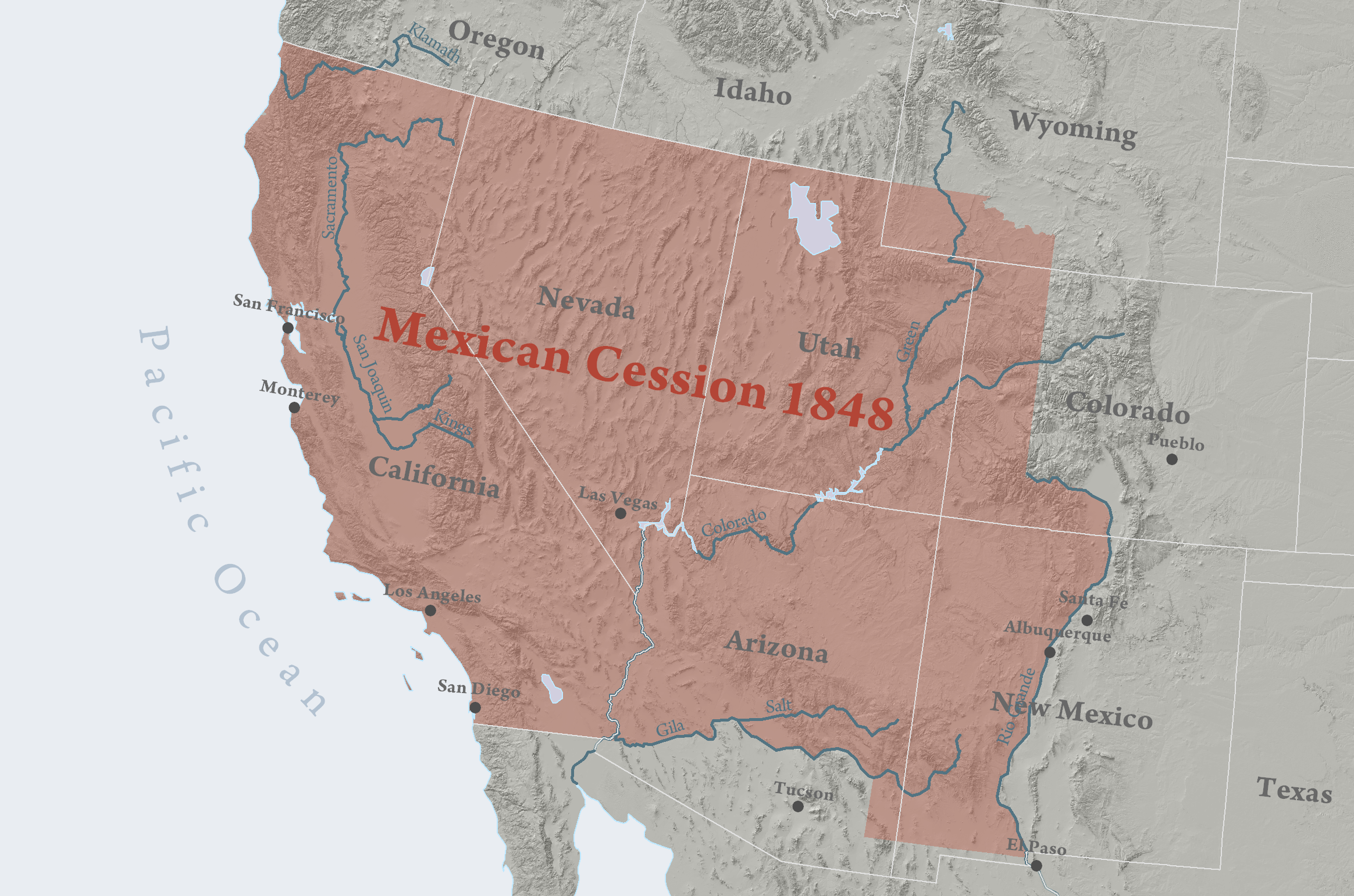
America **bought** half of Mexico for **$15 million** — and called it a **treaty**. But Mexico signed with a **gun to its head**.
Let’s read between the lines:
• **Gains**: 525,000 sq mi — bigger than France + Germany
• **Cost**: $15M + $100M war = **$115M total**
• **Promises**: Citizenship, land rights, religion — on paper
→ **Reality**: Many Californios lost land in U.S. courts. Citizenship? Second-class.
Why it matters: This wasn’t a fair deal. It was **conquest with a receipt**. The treaty tried to look noble — but it the law of conquest. And the **human cost**? Not in the fine print.
Historians Weigh In:
“The Treaty of Guadalupe Hidalgo was victor’s justice — a surrender disguised as diplomacy.”
— David J. Weber, The Mexican Frontier (1982)
So yeah — America got the West. But **Mexico got the bill**. Next: Who **really** paid?
Native American Land Acquisitions
Scale (1830–1850): Over 100 million acres ceded via treaties
Legal Framework
- Based on Doctrine of Discovery’s preemption right
- Treaty Record (1789–1871):Over 370 treaties signed
Why It Was Legal
-
Recognized tribal sovereignty
(treaties = agreements between sovereign entities) -
Provided compensation
annuities, reservations, relocation assistance -
Treaties enforceable as federal law
under Supremacy Clause
But Was it Theft?
📚 The Indian Treaty System
Between 1789-1871, the U.S. signed over 370 treaties with Native nations. This treaty system was the legal mechanism for transferring land from Native peoples to the United States.
🎯 How the Treaty System Worked
Legal foundation: Constitution (Article II, Section 2) gives President power to make treaties with Senate advice/consent (2/3 vote). Treaties with Indian nations treated as international agreements (tribe = sovereign nation). Once ratified, treaties become "supreme Law of the Land" (Article VI). This meant Indian treaties had same legal status as treaties with Britain or France.
What treaties typically included: Land cession (Tribe agreed to sell specific territory to U.S.), cash payment (One-time payment for land sold), annuities (Annual payments in cash or goods for period of years), reservation (Land set aside for tribe's exclusive use), services (Schools, agricultural instruction, medical care), protection (U.S. promised to protect tribe from other tribes/settlers).
💭 Example: Treaty of New Echota (1835)
Background: Cherokee Nation in Georgia/Tennessee/North Carolina. Controversy: Negotiated with minority faction; most Cherokee opposed it (Principal Chief John Ross rejected it).
Terms: Cherokee ceded all lands east of Mississippi (millions of acres). Received $5 million compensation. Granted 13 million acres in Indian Territory (Oklahoma). Promised assistance with relocation. Given 2 years to voluntarily move.
Outcome: Forced removal (1838-1839) became Trail of Tears—~4,000 Cherokee died during forced march. Despite treaty promises, relocation was brutal and poorly provisioned.
🎓 Scale of Land Transfers (1830-1850)
Over 100 million acres ceded via treaties in these two decades alone.
Major treaty periods: 1830s: Indian Removal Act (1830) led to treaties with Five Civilized Tribes (Cherokee, Choctaw, Chickasaw, Creek, Seminole). 1840s: Treaties with Plains tribes as westward migration increased. 1850s-1860s: Treaties with Pacific Northwest and California tribes.
⚠️ Johnson's Interpretation vs. Critical View
Johnson's framework: Treaties = state-to-state agreements between sovereign entities. Compensation provided (not just seizure). Legal framework governed by same principles as European diplomacy. Violations = breaches of contract, not inherent theft. U.S. recognized treaty violations were wrong (hence Indian Claims Commission 1946).
Critical perspective: Treaties signed under extreme duress—alternatives were starvation or military conquest. Many treaties negotiated with unrepresentative factions. U.S. repeatedly violated treaty terms (boundaries, annuities, protections). Tribes had no enforcement mechanism when U.S. broke treaties. Compensation was grossly inadequate (pennies per acre). U.S. stopped making treaties in 1871, shifting to executive orders—less protection.
🎯 The Key Question
Are these "legitimate transfers" or "coerced surrenders"?
Johnson's view: Legitimate because: Followed recognized legal process, provided compensation, recognized tribal sovereignty, later violations don't invalidate original agreements.
Critical view: Coerced because: Tribes faced military conquest if they refused, no alternative buyers (preemption meant only U.S. could purchase), power asymmetry made "negotiation" largely one-sided, persistent treaty violations showed bad faith.
Teaching point: Present both perspectives. Understanding the legal framework helps students see how Americans justified expansion. Analyzing power dynamics helps students think critically about whether legal forms guarantee justice.
Explicit Contemporary Statements
"Advised Congress that American expansion would cause the 'Savage as the Wolf to retire.'"
In his 1846 Senate speech on Oregon annexation, Thomas Hart Benton addressed the fate of tribes resisting expansion: "The Red race has disappeared from the Atlantic coast: the tribes that resisted civilization met extinction. This is a cause of lamentation with many. For my part, I cannot murmur at what seems to be the effect of divine law... Moral and intellectual superiority will do the rest: the White race will take the ascendant."
Critical Reality: The expansion was specifically anticipated and intended to be a disaster for the legal, cultural, economic, and political rights of Indian nations and native peoples.
📚 Why These Quotes Matter
These aren't isolated extremist views—they're statements from founding father (Washington) and leading senator (Benton) that reveal how mainstream American leaders understood expansion's human cost. They KNEW it would be catastrophic for Native peoples and proceeded anyway.
🎯 George Washington's 1783 Prediction
Context: Just after Revolutionary War, Washington was advising Congress on western policy.
The quote in context: Washington predicted that American settlement would inevitably push Native peoples westward and ultimately cause their disappearance ("retire" = euphemism for displacement/extinction).
Key point: This was 1783—62 years before "Manifest Destiny" was coined. The logic of displacement was built into American expansion from the beginning, not invented in the 1840s.
Washington's view: He saw this as inevitable (stadial logic—hunters must give way to farmers) rather than something to prevent. His policy recommendation: manage it through treaties rather than let it happen chaotically.
💭 Senator Benton's "Divine Law" Justification
Context: 1846 Senate debate over westward expansion and Mexican-American War.
Breaking down the quote: "resisted civilization" = Tribes that refused to adopt agriculture, Christianity, Euro-American property systems. "extinction" = Benton openly acknowledged expansion might lead to tribal disappearance. "I cannot murmur" = Can't complain/object—presents it as beyond human control. "divine law" = God's decree, not human choice—removes moral agency. "moral and intellectual superiority of the White race" = Explicit racial hierarchy. "will do the rest" = Inevitable process—resistance is futile.
The logic chain: (1) God ordained White/Anglo-Saxon superiority. (2) This superiority naturally leads to dominance. (3) Native peoples can either "civilize" (assimilate) or disappear. (4) If they disappear, it's divine will—not our fault. (5) Therefore, we bear no moral responsibility.
This reasoning absolves Americans of guilt by attributing outcomes to divine plan rather than human choices. It's theological determinism used to evade moral responsibility.
🎓 Racial Ideology Extended Beyond Native Peoples
The lecture outline notes: "It was claimed Mexicans must assimilate into the 'superior vigor of the Anglo-Saxon race, or they must utterly perish.'"
What this reveals: Same logic applied to Mexicans as Native peoples. Binary choice: assimilate or disappear. "Superior vigor" = racial/cultural dominance language. No option for Mexicans to maintain distinct identity. Framed as natural process rather than deliberate policy.
Historical outcome: Many Californios and Tejanos did lose land despite treaty protections, and were marginalized in societies they'd once dominated. The prediction was self-fulfilling because Americans designed systems to ensure it happened.
⚠️ Why We Study These Statements
The concluding statement is critical: "These statements reveal the racial ideology that undergirded legal frameworks. We study them not to excuse them but to understand how contemporaries reconciled republicanism with displacement."
Teaching purpose: NOT to make students feel guilty for being American. NOT to condemn individuals as uniquely evil. BUT to understand how intelligent, otherwise moral people convinced themselves that terrible actions were justified.
The critical question: How do people reconcile stated values (liberty, justice, equality) with actions that contradict those values (displacement, cultural destruction)?
The answer: Through intellectual frameworks (stadial theory, Doctrine of Discovery, racial hierarchies) that make contradictions seem coherent. Understanding these frameworks helps us identify similar rationalizations today.
💭 Discussion Prompts
- "If Benton truly believed this was 'divine law,' does that make him less morally culpable? Or does invoking divine will to justify harm make it worse?"
- "Washington and Benton were considered moral, intelligent leaders. What does it mean that good people can justify terrible things?"
- "What modern beliefs might future generations judge as harshly as we judge 19th-century racial theories?"
The Human Cost of Manifest Destiny
Americans
- ~13,000 U.S. troops dead (mostly disease)
- Financial cost: $100M+ war debt
- Political fracture → Civil War
- 620,000+ dead in 1861–65
Mexicans
- ~25,000 dead (military + civilians)
- Lost 55% of territory (2.1M km²)
- ~100,000 displaced in ceded lands
- Cultural & political erasure
Indigenous Nations
- 100M+ acres seized (1830–50)
- 60,000+ forcibly removed
- 15,000+ died in removals (e.g., Trail of Tears)
- Ethnic Cleansing, cultural annihilation
Ultimate Consequence: Civil War — the price of a continent built on displacement and division.
Americans: Paid in blood (Mexican War) and treasure — but the real cost was political: expansion shattered national unity.
Mexicans: Defeated militarily, dispossessed territorially, marginalized within the new U.S. Southwest.
Indigenous: Suffered the intended catastrophe — land, sovereignty, and survival systematically destroyed.
Final Irony: The “success” of Manifest Destiny created the conditions for its greatest failure — disunion and civil war.
Conclusion: Transformation Complete
1783
Atlantic republic
- Vulnerable
- Coastal
- 13 states
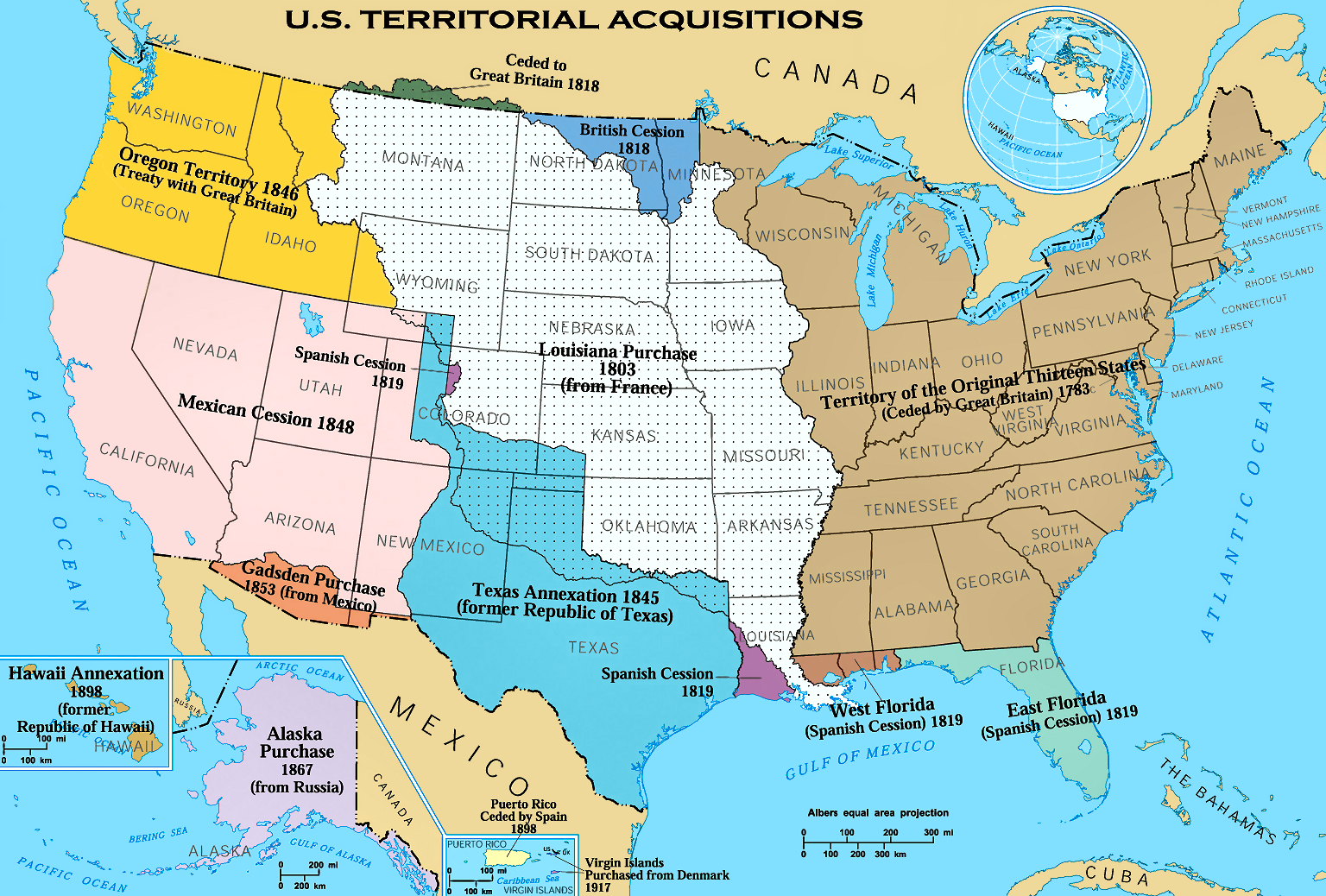
1853
Continental federation
- Secure
- Coast-to-coast
- 31 states
Tools of Transformation:
Treaties • Plows • Ballots • and Guns!
📚 The 70-Year Transformation
1783: The Starting Point - Treaty of Paris ended Revolutionary War. U.S. recognized as independent nation. Territory: Atlantic coast to Mississippi River. 13 original states. Population: ~3 million. Vulnerable to European powers (Britain, Spain, France). No certainty the republic would survive.
1853: The Culmination - Gadsden Purchase completed continental expansion. Territory: Atlantic to Pacific, Canada to Mexico. 31 states (California 1850 most recent). Population: ~25 million. Continental security—no immediate European threats. Economically thriving, technologically advanced. BUT sectionally divided and heading toward civil war.
🎯 The Three Tools
Treaties (Legal Framework): 370+ treaties with Native nations. International treaties (Louisiana, Oregon, Mexican Cession, Gadsden). Legal mechanisms provided appearance of legitimacy. Doctrine of Discovery provided intellectual foundation.
Plows (Economic/Technological): Agricultural settlement transformed Stage 1 lands to Stage 3. Railroads, telegraphs connected continent. Industrial tools enabled rapid development. Technology made expansion physically possible.
Ballots (Democratic Process): Voters supported expansionist candidates (Polk 1844). Congress approved territorial acquisitions. States voted to admit new territories. Democratic legitimacy distinguished U.S. from European empires.
💭 What Made It Possible
Demographic growth (population doubling every 25 years), technological advantage (industrial revolution), political stability (constitutional government), ideological confidence (Manifest Destiny, stadial theory), military capacity (professional army, militia system), weak neighbors (Mexico unstable, Native nations divided).